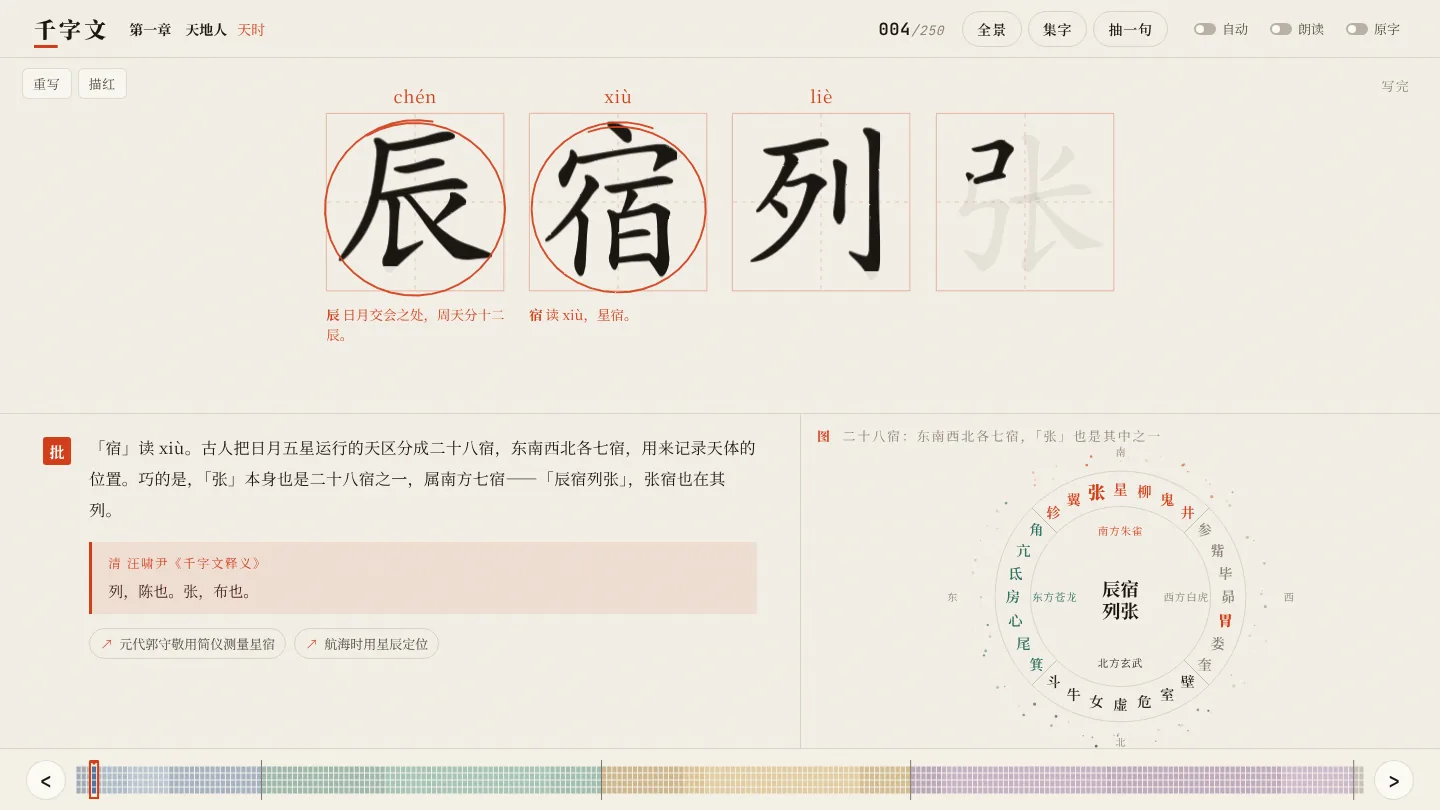
Shu·1The Study
The Thousand Character Classic: One Line, One Scene
All 250 lines written out and annotated, one by one; a panorama of the 1,000 characters, from which you can even assemble your name
- Accession no.
- Shu·1
- Location
- The Study
- Period
- Northern and Southern Dynasties to Qing
- Directed by
- Hu Yilin
- Made by
- Claude Opus 5.5
- Similar commission
- from S$18.75
About the exhibit
The Thousand Character Classic is a rhymed text in four-character lines, put together by Zhou Xingsi of the Liang dynasty in the Southern Dynasties: four characters to a line, 250 lines, and not one of its 1,000 characters repeated. His biography in the Book of Liang records that Emperor Wu of Liang ordered him to compose Rhymes on a Thousand Characters in Wang Xizhi’s Calligraphy, and that “whenever he presented his work, the emperor praised it”. Li Chuo of the Tang tells the story in more detail in his Shangshu Gushi (Old Stories from the Minister): to teach the princes calligraphy, Emperor Wu had Yin Tieshi take rubbings of 1,000 different characters from Wang Xizhi’s writing, each on its own sheet, all jumbled and in no order. He then summoned Zhou Xingsi and said, “You have literary talent: put these into rhyme for me.” Zhou Xingsi arranged them in a single night and presented the result, by which time his hair had turned completely white.
For the next 1,500 years it remained one of the most widely used primers for learning to read. According to the Record of the Orchid Pavilion by He Yanzhi of the Tang, Zhiyong, a seventh-generation descendant of Wang Xizhi, copied the Thousand Character Classic in regular and cursive script, picked out more than 800 good copies and gave one to each of the monasteries of eastern Zhejiang; Japan’s Kojiki records that Wani Kishi of Baekje presented the Analects in 10 scrolls and the Thousand Character Classic in one. Because none of its 1,000 characters is repeated, its order was also borrowed for numbering: the case numbers of the Chinese Buddhist canon, the rows of cells in the examination halls and the files of the Song-dynasty archives were all numbered in its sequence, 天, 地, 玄, 黄 (tian, di, xuan, huang) and onwards.
Following the chapter divisions of the Qianziwen Shiyi (Explanations of the Thousand Character Classic), the text falls into four chapters: the first moves from heaven and earth, the sun and moon and the four seasons to the rulers of high antiquity; the second deals with self-cultivation, the five constant virtues and human relationships; the third with capitals and palaces, books and men of talent, and the lands of the Nine Provinces; the fourth with farming, conduct in the world, retirement and daily life at home. The last two lines, “As for the words that help a sentence along: yan, zai, hu, ye”, bring it to a close. The whole text rhymes; when the rhymes are grouped by the rhyme categories of the Guangyun, the 250 lines change rhyme about eight times.
Base text and notes
The base text is the Qianziwen Shiyi, compiled by Wang Xiaoyin with notes by Sun Qianyi in the Qing dynasty (the edition collated and printed by Xu Shiye of Shexi, held by the National Library of China), checked against the standard version. To avoid writing the personal name of the Kangxi Emperor, Xuanye (玄烨), that edition writes 元 for 玄, and it writes 某 for 轲 in “Meng Ke” (Mencius); both are restored here. Character forms follow common usage, and lines with textual variants are noted in the commentary. The simplified text follows the current standard, under which six pairs of originally distinct characters merged into one (發 and 髮, for example, both became 发), so six characters appear twice in the simplified version; switch to “Original characters” to see the traditional forms.
The pronunciations and meanings of the characters, the sense of each line and the commentary were written for this work; allusions, people and dates were checked against the original classical texts, and where accounts differ, the alternatives are marked as such. The grey-shaded quotations below the commentary are the original notes of the Qianziwen Shiyi. Stroke-order data come from Make Me a Hanzi; seven characters missing from that data (凊, 磻, 俶, 輶, 煒, 寔, 翫) were pieced together from existing components, and their stroke order is only illustrative. The base map comes from Natural Earth; places are marked at their present-day locations and are only illustrative.
Sources and references
- Zhou Xingsi (Liang, Southern Dynasties), Thousand Character Classic
- Wang Xiaoyin, compiler, and Sun Qianyi, annotator (Qing), Qianziwen Shiyi; edition collated and printed by Xu Shiye of Shexi, held by the National Library of China; digitised copy https://archive.org/details/nlc-892-312002092940-327935
- Wikisource: Thousand Character Classic (the standard version, used for collation) https://zh.wikisource.org/wiki/千字文
- Yao Silian (Tang), Book of Liang, chapter 49, “Biographies of Men of Letters, part 1: Zhou Xingsi”
- Li Chuo (Tang), Shangshu Gushi
- He Yanzhi (Tang), Record of the Orchid Pavilion, in Zhang Yanyuan (Tang), Fashu Yaolu, chapter 3
- Ō no Yasumaro (Japan), Kojiki, middle volume (712)
- Wu Feng, “The Thousand Character Classic: An Ordering System of Ancient Times”, first published in Beijing Evening News; reprinted on chinawriter.com.cn, 20 October 2022, https://www.chinawriter.com.cn/n1/2022/1020/c442005-32548287.html
- Book of Changes, Book of Documents, Book of Songs (including the Preface to the Mao Odes), Rites of Zhou, Book of Rites, Zuo Commentary, Analects, Mencius, Classic of Filial Piety, Erya
- Laozi, Zhuangzi, Mozi, Xunzi, Han Feizi, Huainanzi
- Sima Qian (Western Han), Records of the Grand Historian (“Treatise on the Feng and Shan Sacrifices”, “Treatise on the Celestial Offices”, “Basic Annals of Emperor Gaozu”, “Hereditary House of the Marquis of Liu”, “Account of the Xiongnu”, etc.; the names of the seven stars of the Northern Dipper follow Sima Zhen (Tang), Shiji Suoyin, quoting the Chunqiu Yundoushu)
- Ban Gu (Eastern Han), Book of Han (“Treatise on Harmonics and the Calendar”, “Treatise on Arts and Letters”, “Biography of Shu Guang”, “Biography of Lu Jia”)
- Fan Ye (Liu Song, Southern Dynasties), Book of the Later Han (“Treatise on Harmonics and the Calendar”, “Biography of Song Hong”, “Biography of Wang Chong”); Chen Shou (Western Jin), Records of the Three Kingdoms, Book of Wei, “Biography of Lü Bu”
- Strategies of the Warring States, “Strategies of Qi 3”; Yuejue Shu, “Outer Tradition: Record of Precious Swords”
- Liu Yiqing (Liu Song, Southern Dynasties), A New Account of Tales of the World (“Cultivated Tolerance”, “Reclusion and Disengagement”)
- Xu Shen (Eastern Han), Shuowen Jiezi; Wang Chong (Eastern Han), Lunheng; Cai Yong (Eastern Han), Duduan; Zhang Hua (Western Jin), Bowu Zhi; Gan Bao (Eastern Jin), Soushen Ji; Sanfu Huangtu; Han Wu Gushi
- Song Yu, “Nine Changes”; Cui Yuan, “Motto on the Right of My Seat”; Ban Gu, “Inscription for the Feng Sacrifice at Mount Yanran”; Cao Cao, “Walking out of the Xia Gate: Viewing the Sea” and “Short Song”; Du Fu, “Gazing at Mount Tai”; Han Yu, “On Teachers”; Su Shi, “Inscription for the Hall of the Three Pagoda Trees”
- Stroke-order data: Make Me a Hanzi, Shaunak Kishore, 2016, with glyphs derived from Arphic’s AR PL KaitiM GB and AR PL UKai, Arphic Public License, https://github.com/skishore/makemeahanzi; packaged via hanzi-writer-data 2.0.1
- Tracing: Hanzi Writer 3.7.3, David Chanin, MIT License, https://github.com/chanind/hanzi-writer
- Radicals and Cantonese readings: the Unicode Han Database, Unihan (kRSUnicode, kCantonese), https://www.unicode.org/charts/unihan.html
- First draft of the pinyin: pypinyin (MIT License), with every character that has more than one reading checked one by one
- Base map: Natural Earth, 1:50m land, 1:10m rivers and lakes, public domain, https://www.naturalearthdata.com/
- Font: Source Han Serif (Noto Serif SC), SIL Open Font License 1.1
Want something like this? See how to commission a talk website or a literature review →
Spotted an error in the history, data or sources? Please write to [email protected].
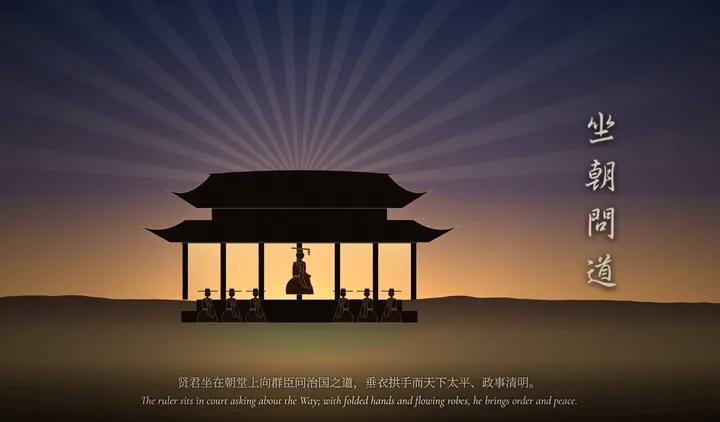 Jiang·3The Thousand Character Classic: A Picture for Every CoupletNineteen minutes, 125 couplets: a silhouette picture for each, with Chinese and English subtitles
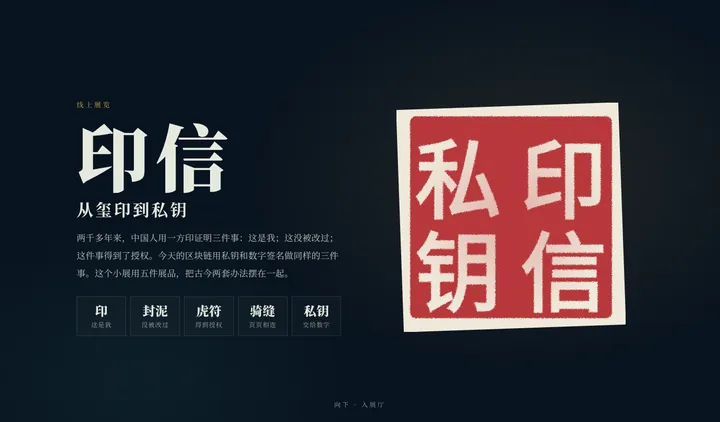 Zi·1Seals: From Imperial Seals to Private KeysFive exhibits that set two systems of “proof”, ancient and modern, side by side
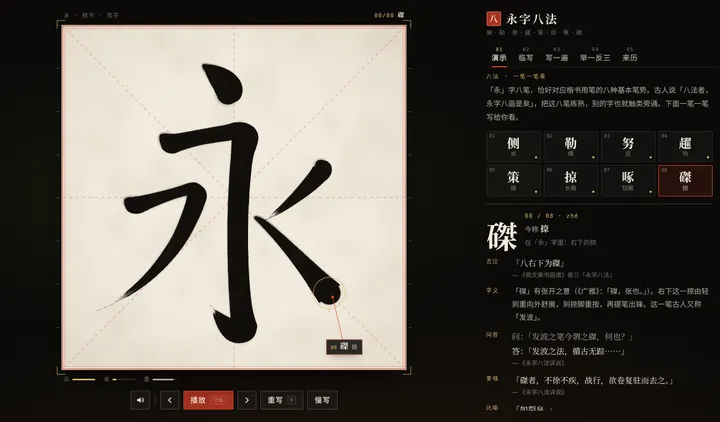 Zi·2The Eight Strokes of YongA simulated brush writes the character 永 for you stroke by stroke, then invites you to copy it yourself
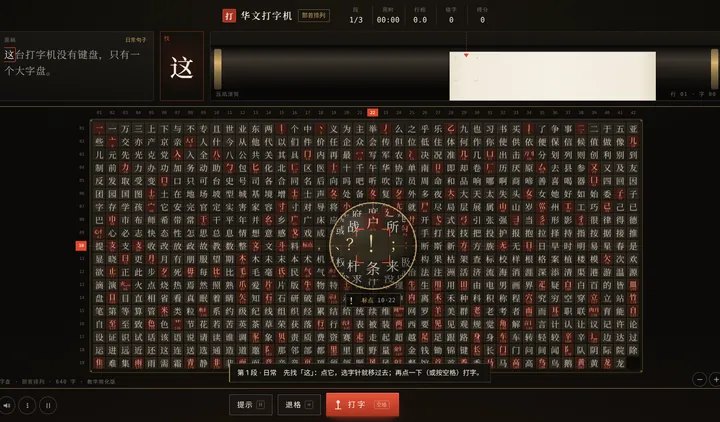 Ji·1The Chinese TypewriterFind and type characters on the tray, and compare two arrangements
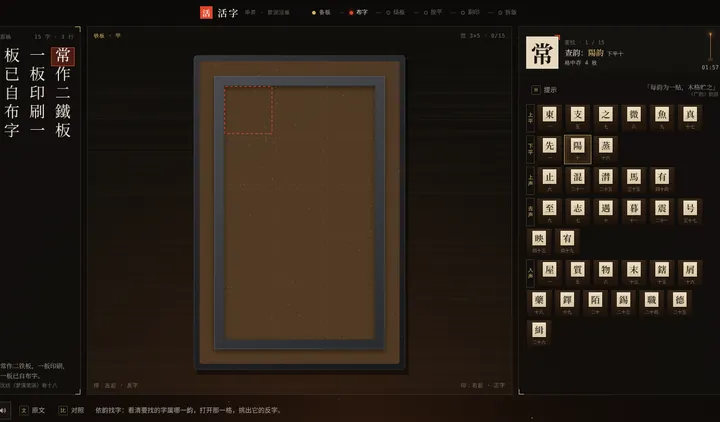 Ya·5Movable Type: Bi Sheng’s Clay TypeSet a plate of clay movable type by hand, as recorded in the Dream Pool Essays
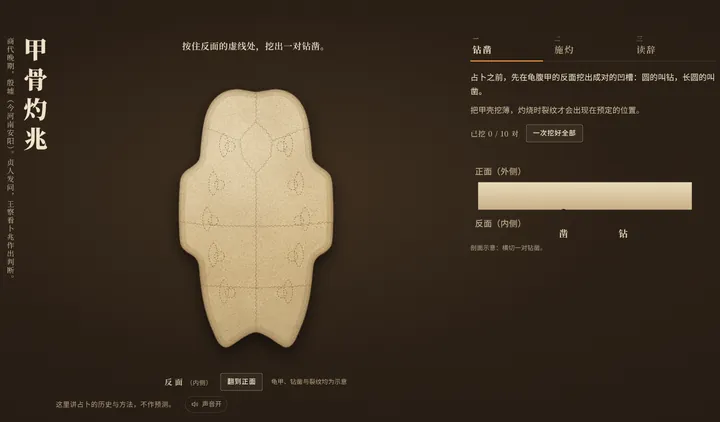 Xuan·2Cracking Oracle BonesDrilling, burning, reading: the three steps of Shang turtle-shell divination
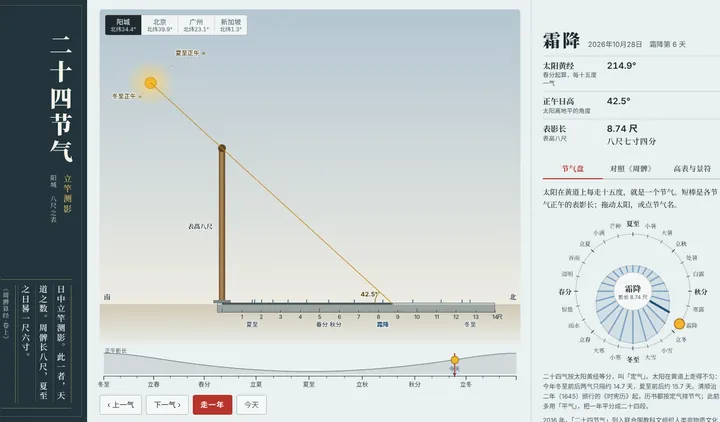 Tian·2The 24 Solar Terms: Measuring the Gnomon’s ShadowAn 8-chi gnomon and a year of shadows
 Tian·4The 72 PentadsFive days to a pentad: 72 generated vignettes cycling through a whole year