Ya·5Song: Heavenly Craft and Refinement
Movable Type: Bi Sheng’s Clay Type
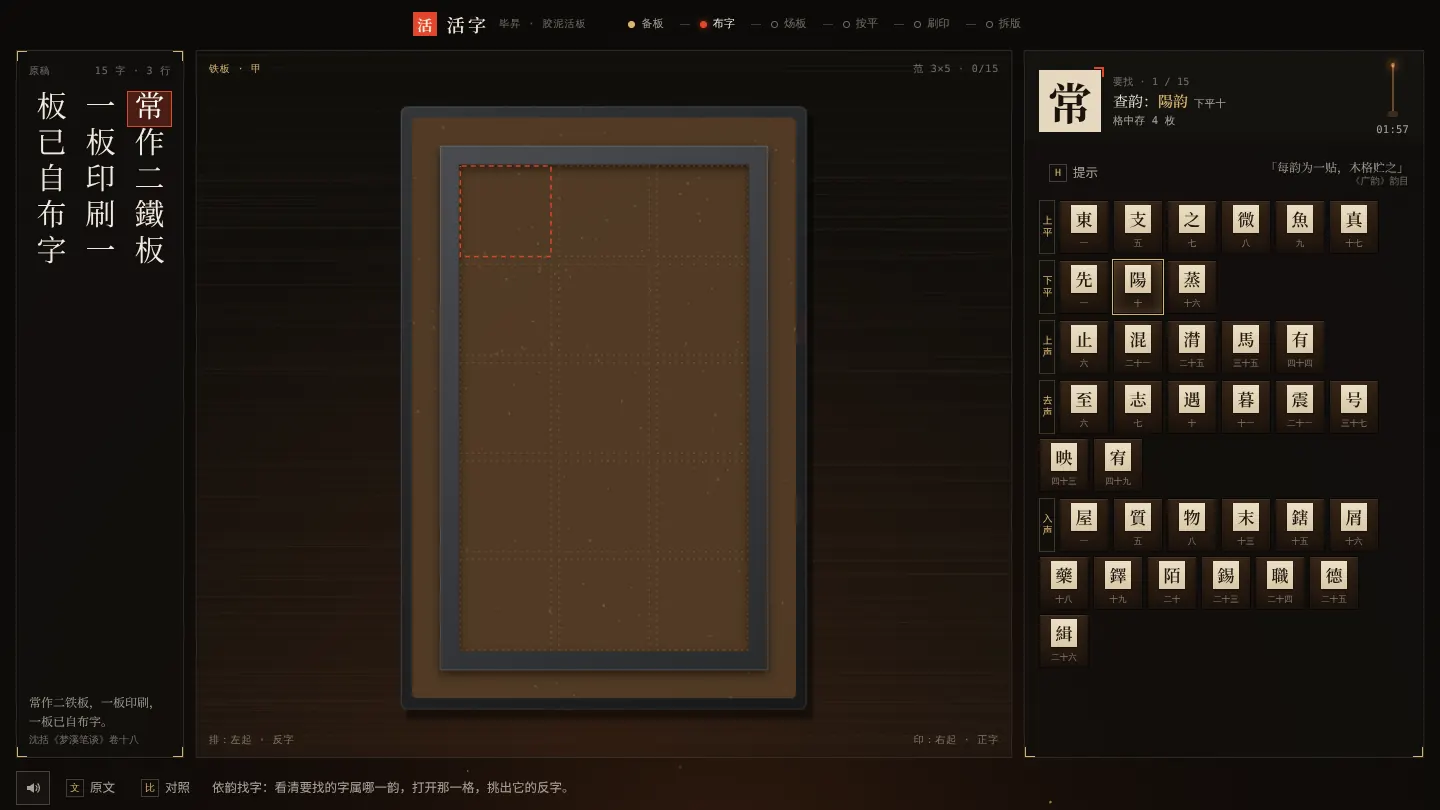
Set a plate of clay movable type by hand, as recorded in the Dream Pool Essays
- Accession no.
- Ya·5
- Category
- Interactive works
- Period
- Song
- Directed by
- Hu Yilin
- Made by
- Claude Opus 5.5
- Similar commission
- from S$18.75
About the exhibit
In the Northern Song, Shen Kuo (1031–1095) wrote in chapter 18 of the Dream Pool Essays, “Technical Skills”: “During the Qingli reign there was a commoner, Bi Sheng, who also made movable type. His method was to carve characters in sticky clay, as thin as the rim of a coin, one character to each piece, and to fire them hard.” He goes on to describe the whole process. An iron plate is first coated with yao, a paste of pine resin, wax, paper ash and the like; an iron frame is set on it and packed tight with type; then “hold it to the fire to warm it, and when the paste has softened a little, press a flat board on its face, and the type will be as level as a whetstone”. After printing, “heat it again to melt the paste and brush it with the hand: the type drops off by itself, without the least soiling”. Common characters were kept in several copies: “characters such as 之 and 也 have more than 20 pieces each”; when not in use, the type was “labelled with paper, one label for each rhyme, and stored in wooden cases”; and for a rare character not in stock, “carve it on the spot and bake it over a straw fire; it is ready in an instant”. He also says that two iron plates were kept at hand, “one plate printing while the type is already being set on the other”, and used in turn. Printing only two or three copies saves no effort; only for dozens, hundreds or thousands of copies is the method “wonderfully fast”. As for why wood was not used: “its grain is dense in places and loose in others, it becomes uneven when wet, and it also sticks to the paste, so it will not do”. Bi Sheng’s method is known today only from this passage.
In the Yuan dynasty, while serving as magistrate of Jingde county, Wang Zhen had craftsmen carve more than 30,000 pieces of wooden type, stored by rhyme on two revolving tables “about 7 chi across”: “for a person to go looking for the characters is hard; for the characters to come to the person is easy”. As a trial he printed the county gazetteer: “some 60,000 characters in all, and in less than a month 100 copies were complete”. His method is appended to his Treatise on Agriculture (Nong Shu). In the mid-15th century, Gutenberg in Mainz printed books with cast metal type, oil-based ink and a press; the 42-line Bible was completed in about 1454 or 1455.
How this work was made
Every step follows Shen Kuo’s text: mixing the paste and coating the plate, setting the iron frame; picking type from the compartments and setting it; holding the plate over the fire until “the paste has softened a little”, then pressing it with a flat board until the top of every piece of type is at the same height; inking, laying on the paper, brushing the back of the paper and peeling it off; reheating, brushing off the type and returning it to its compartments. The characters on the type are mirror images, so the columns are laid out on the plate from left to right; only when the peeled-off paper is turned over do the characters read the right way round, from right to left. The printed sheet is produced by flipping the face of the plate from left to right, not by setting the text a second time.
Shen Kuo says only “one label for each rhyme”, without naming a rhyme dictionary; here, as an illustration, the compartments follow the rhyme headings of the Expanded Rhymes (Guangyun, 1008), the rhyme dictionary in general use in the Northern Song. Every character in the 35 compartments has been checked against the rhyme it belongs to in the Guangyun, and a character with more than one reading is filed only under the rhyme of the reading it has in the passage. The number of pieces kept for each character is assumed; only 之 and 也 are given more than 20 pieces, following the original. The character 昇 in the first passage is not in stock, so one has to be carved on the spot. Shen Kuo does not say how the ink was applied, so the printing step follows Wang Zhen’s Method of Making Movable Type and Printing Books from the Yuan dynasty: “Brush straight up and down along the column rules with a palm-fibre brush; never brush across. The printing paper, too, is brushed along the column rules with a palm-fibre brush.” The differences in height between pieces of type, the softening of the paste and the depth of the ink are all exaggerated illustrations; temperatures and times are not measured, and the “stick of incense” is only the game’s timer. The ink marks and paper texture are generated in real time, and the printed sheet can be downloaded as a PNG; the sound is synthesised in real time too.
Sources and references
- Shen Kuo, Dream Pool Essays, chapter 18, “Technical Skills”, facsimile of a Ming edition in the Sibu Congkan, Second Series (Wikisource transcription)
- Wang Zhen, Treatise on Agriculture (Nong Shu), chapter 22, “Method of Making Movable Type and Printing Books” and postscript; the original preface to the Treatise on Agriculture is dated “Huangqing, guichou year” (Wikisource transcription)
- Analects, “Yong Ye”
- Chen Pengnian et al., Expanded Rhymes (Guangyun, 1008); rhyme headings and character assignments follow the collated Guangyun data in nk2028/tshet-uinh-data
- Encyclopaedia Britannica, “Johannes Gutenberg”
- Wikipedia, “Gutenberg Bible”
- Wikipedia, “Bi Sheng”
- Wikipedia, “Guangyun”
Want something like this? See how to commission an interactive teaching page →
Spotted an error in the history, data or sources? Please write to [email protected].
 Ya·3Shen Kuo’s Scholar CardAlways Slightly East: turn a compass laid out from the Dream Pool Essays
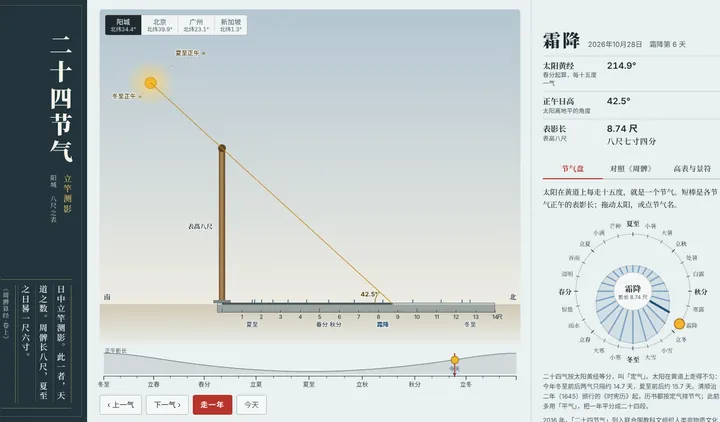 Tian·2The 24 Solar Terms: Measuring the Gnomon’s ShadowAn 8-chi gnomon and a year of shadows
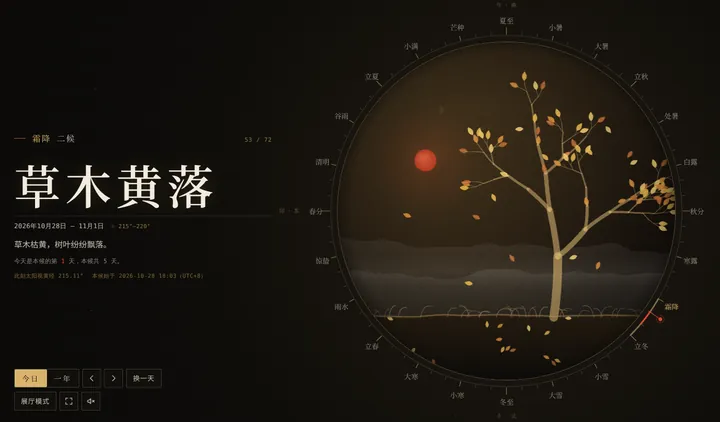 Tian·4The 72 PentadsFive days to a pentad: 72 generated vignettes cycling through a whole year
 Tian·5Guo Shoujing and the Simplified ArmillaAn armillary sphere split into two instruments that do not block each other; turn the double declination ring to sight a star
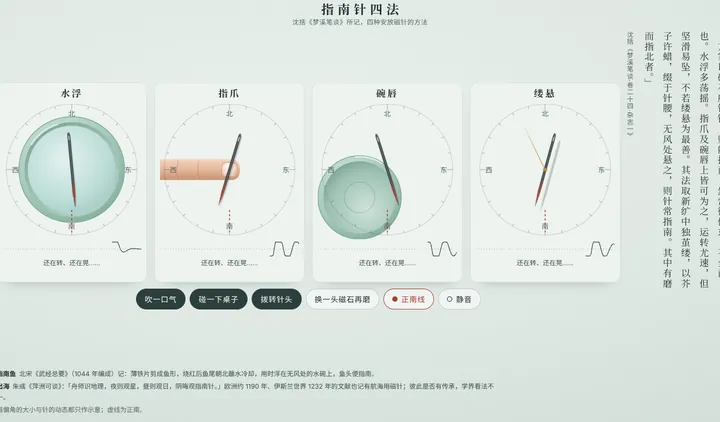 Hai·2Four Ways to Hang a Compass NeedleFour ways to mount a needle, recorded by Shen Kuo
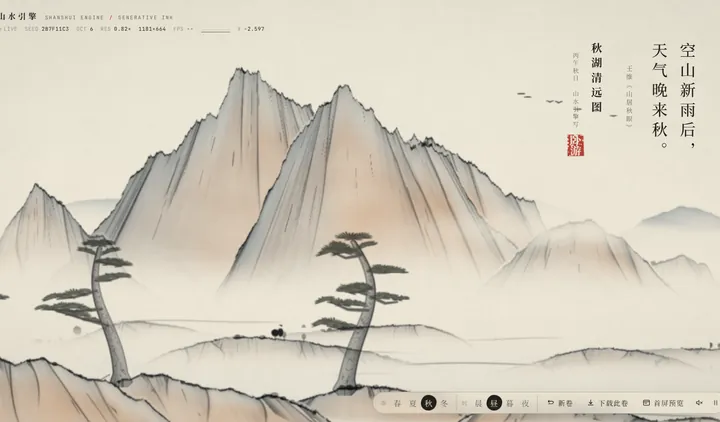 Ya·2The Three Distances of LandscapeAn ink landscape scroll generated in real time
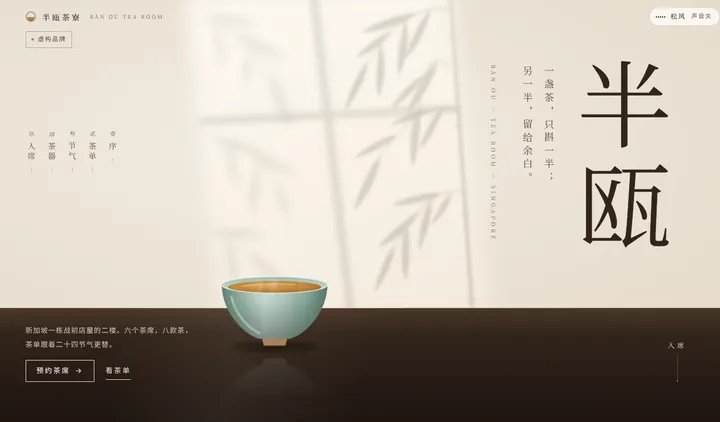 Ya·4Tea RoomThe official website of a fictional tea room
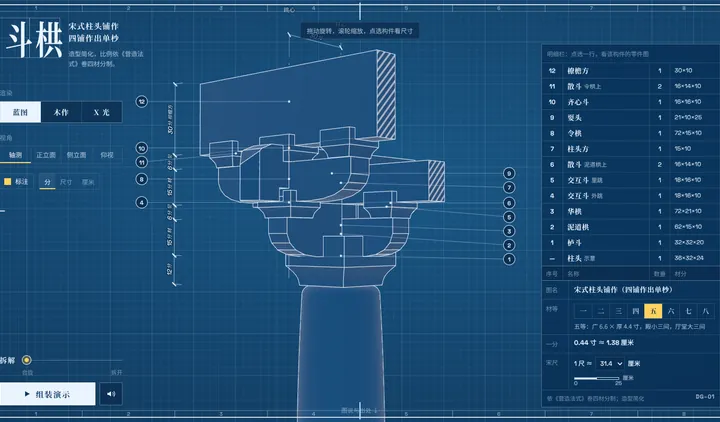 Ya·1The Dougong BracketA Song-style bracket set, built according to the Treatise on Architectural Methods
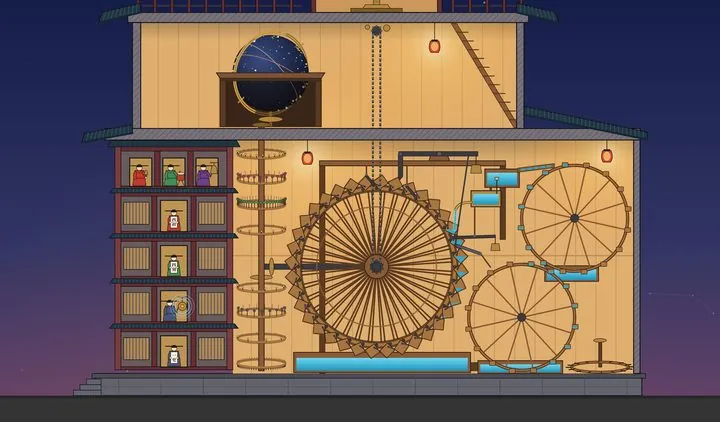 Ya·6The Water-Powered Astronomical Clock TowerA cutaway look at an astronomical clock tower driven by water