Tian·5Questions to Heaven: Astronomy and CalendarsFeatured
Guo Shoujing and the Simplified Armilla
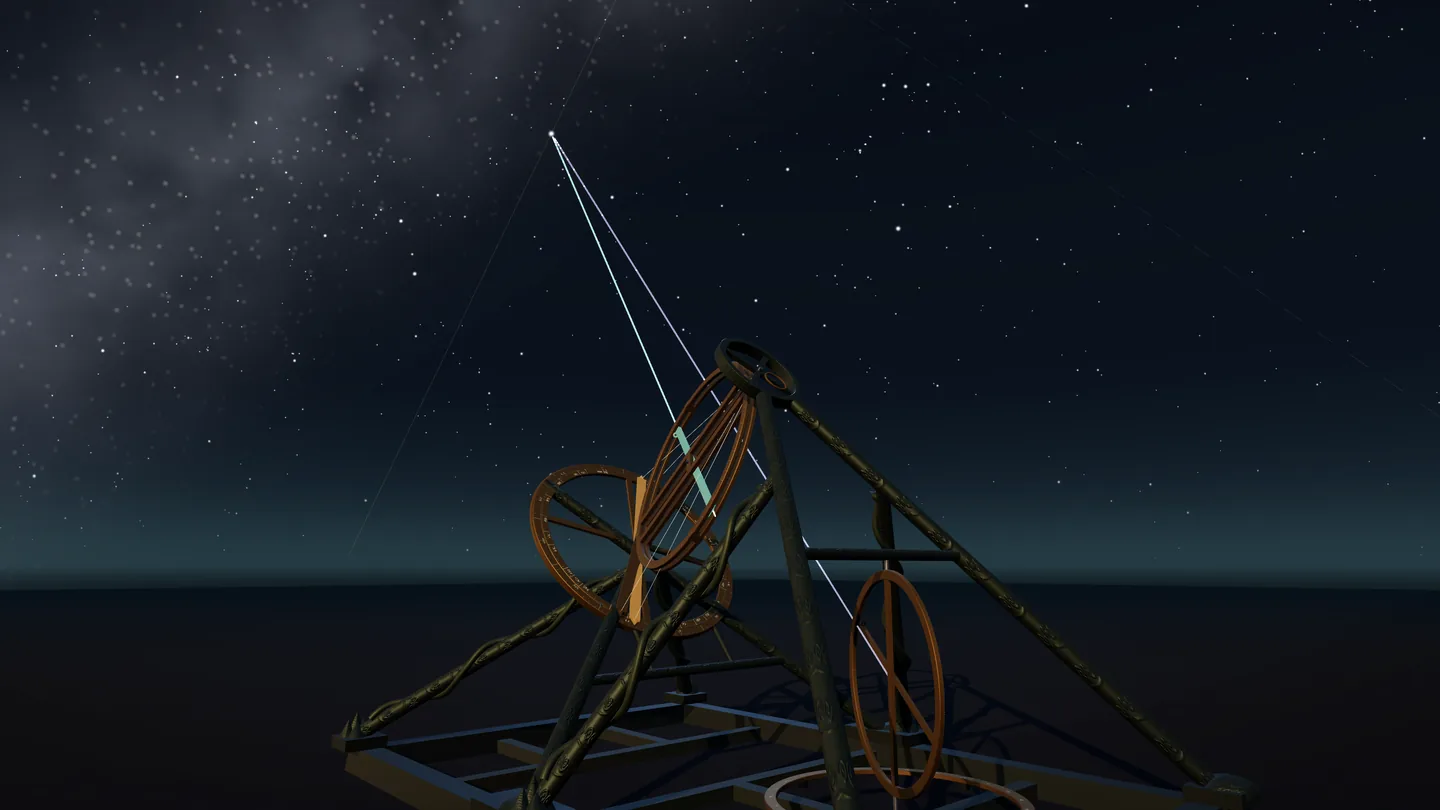
The armillary sphere split into two instruments that no longer block each other; turn the double declination ring to sight a star
- Accession no.
- Tian·5
- Category
- Interactive works
- Period
- Yuan
- Directed by
- Hu Yilin
- Made by
- Claude Opus 5.5
- Similar commission
- from S$18.75
About the exhibit
In the 13th year of Zhiyuan (1276), Emperor Shizu of Yuan (Kublai Khan) ordered Guo Shoujing, Wang Xun and others to draw up a new calendar. Guo Shoujing said: “The root of the calendar lies in observation, and of the instruments of observation none comes before the armilla and the gnomon.” He began by building the simplified armilla and the tall gnomon. The entry on the simplified armilla in the Treatise on Astronomy of the History of Yuan records its form: “The base is a rectangle, 1 zhang 8 chi long; take away a third for its width”; to the north, two north cloud-frame pillars hold up the upper circle, which carries the north polar pivot; to the south, the south cloud-frame pillars cross each other, holding up the hundred-ke ring and the equatorial ring, which carry the south polar pivot; between the two pivots is the double declination ring, 6 chi in diameter, with a sighting bar 5 chi 9 cun 4 fen long mounted within it. Beneath the northern frame there is also an altazimuth: its upright ring can turn, and its horizontal horizon ring is marked with the directions.
The original text explains how it was used: “The declination ring described above turns east and west and tilts north and south; with it are measured the polar distances of the Seven Luminaries, the mansions and the central and outer constellations. The equatorial ring is turned to match the determinative star of a mansion; then the boundary bar is turned so that its two threads line up, and with it are measured the positions within the mansions of the sun, moon and five planets and of the central and outer constellations.” The altazimuth is “for sighting the altitudes of the sun, moon and stars above the horizon”. In the old armillary spheres the rings were nested layer within layer; the Treatise on Astronomy of the History of Song records that one cast in the Southern Song had “three layers in all, inside and out”. The simplified armilla dropped the ecliptic ring, moved the equatorial ring to the south end of the polar axis, and turned the horizon and meridian rings into the altazimuth, which can rotate (Biography of Guo Shoujing, History of Yuan: “Of old there were the meridian and horizon rings, fixed and immovable; Shoujing changed them and made the altazimuth”), so that “compared with the old instruments, in observing the rising and setting of the sun, moon and five planets there is no obstruction from the meridian and horizon rings or the cloud pillars”. Sighting, too, changed to fine threads: “People of old looked at the sky through a tube, and the fractional parts of the mansion widths were only approximated as three-quarters, a half or a quarter, never exactly. Now two threads are used for sighting, and even the finest fractions can be determined.” The Biography of Guo Shoujing says the new instruments were “all finely graduated in du and fen around the circle of heaven, each du (Chinese degree) divided into 36 fen, with threads in place of sighting tubes”.
At the winter solstice in the 17th year of Zhiyuan (1280) the new calendar was completed and named the Shoushi (Season-Granting) Calendar; in the 18th year (1281) it was promulgated throughout the realm (Treatise on Calendars, History of Yuan). Its year length was “3,652,425 fen”, with the day as 10,000 fen: that is, 365.2425 days. When Guo Shoujing and his colleagues presented the new calendar, they said that they had measured actual values with the newly built simplified armilla and tall gnomon, and that “seven matters in all were examined and corrected”, among them the widths of the 28 lunar mansions: “the fractional parts of the mansion widths all follow actual measurement and are not bent to suit private opinion”. Computed back to the 17th year of Zhiyuan from a modern star catalogue, the equatorial mansion widths listed in the Canon of the Shoushi Calendar are off by only about 0.07 degrees on average. In the 16th year of Zhiyuan (1279), Guo Shoujing asked to send observers out along separate routes, “east as far as Goryeo, west to Dianchi, south beyond Zhuya, north to the land of the Tiele: a survey of the four seas, at 27 places in all”. The “height of the pole above the ground” at each place is recorded in the Treatise on Astronomy; for Dadu it was “a little over 40¾ du”.
The Yuan originals no longer survive. In the second year of Zhengtong in the Ming (1437), the Directorate of Astronomy asked to make wooden models in Nanjing to the dimensions of Guo Shoujing’s armillary sphere and simplified armilla, take them to Beijing to be checked and then recast them in bronze; the casting was finished in the seventh year of Zhengtong (1442). In the 54th year of Kangxi in the Qing (1715), the missionary Kilian Stumpf melted down the armillary sphere and simplified armilla stored below the observatory platform as scrap bronze, leaving only the Ming-made armillary sphere, simplified armilla and a few others. The Ming simplified armilla was moved to Nanjing in the 1930s and is now on display at the Purple Mountain Observatory.
What is illustrative
The main dimensions follow the Treatise on Astronomy of the History of Yuan: base 1 zhang 8 chi long and 1 zhang 2 chi wide; double declination ring and equatorial ring 6 chi in diameter; hundred-ke ring 6 chi 4 cun in diameter; sighting bar and boundary bar 5 chi 9 cun 4 fen long; upper circle 2 chi 4 cun in diameter; north cloud-frame pillars 1 zhang 2 chi 8 cun long, south cloud-frame pillars 1 zhang 1 chi 5 cun long. The original text does not give the sizes of the altazimuth’s upright ring and horizon ring; the dragon and cloud patterns, the shape of the lugs at either end of the sighting bar and the direction of the thread across each lug are all illustrative. The slope of the north and south frames is illustrative; the polar axis is set for the latitude of Dadu (present-day Beijing), about 39.9°, while the original text records for Dadu that “the pole is a little over 40¾ du above the ground”. Readings are given in du of 36 fen each. Star positions are taken from the stars brighter than magnitude 6 in the Yale Bright Star Catalogue, 5th edition (Hoffleit and Warren, 1991; published by NASA HEASARC, public domain), and carried back to the 17th year of Zhiyuan for proper motion and precession; the time of night and the appearance of the Milky Way are illustrative. The armillary sphere put together in “Compare with the armillary sphere” simply gathers the rings of the simplified armilla into three layers and adds an ecliptic ring; it is not a reconstruction of any particular armillary sphere.
Sources and references
- History of Yuan, chapter 48, “Treatise on Astronomy 1” (the simplified armilla; the Survey of the Four Seas)
- History of Yuan, chapter 52, “Treatise on Calendars 1” (promulgation of the Shoushi Calendar; mansion widths around the circle of heaven)
- History of Yuan, chapter 54, “Treatise on Calendars 3: Canon of the Shoushi Calendar” (year length, circle of heaven, equatorial mansion widths)
- History of Yuan, chapter 164, “Biography of Guo Shoujing” and “Biography of Wang Xun”
- History of Song, chapter 48, “Treatise on Astronomy 1” (Southern Song armillary sphere: “three layers in all, inside and out”)
- Ning Xiaoyu, “700 Years of Travels between South and North”, Guangming Online, 2020
- Virtual Science Museum of China, “Simplified Armilla”
- Yale Bright Star Catalogue, 5th edition (Hoffleit and Warren, 1991; published by NASA HEASARC, public domain)
Want something like this? See how to commission an interactive teaching page →
Spotted an error in the history, data or sources? Please write to [email protected].
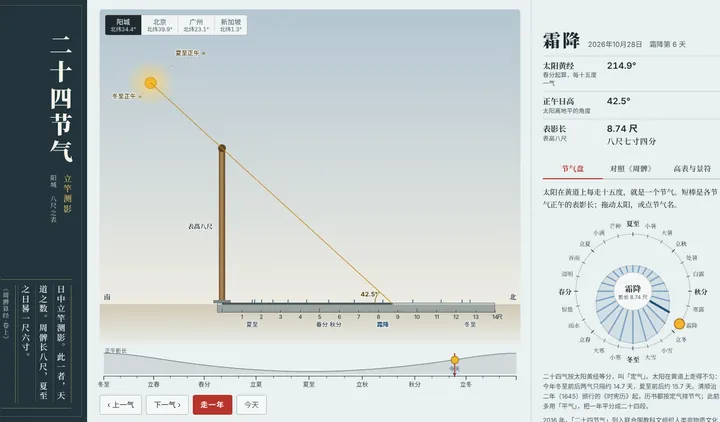 Tian·2The 24 Solar Terms: Measuring the Gnomon’s ShadowAn 8-chi gnomon and a year of shadows
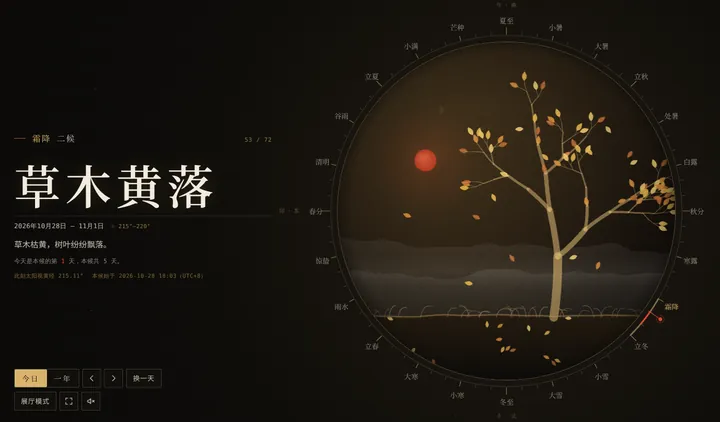 Tian·4The 72 PentadsFive days to a pentad: 72 generated vignettes cycling through a whole year
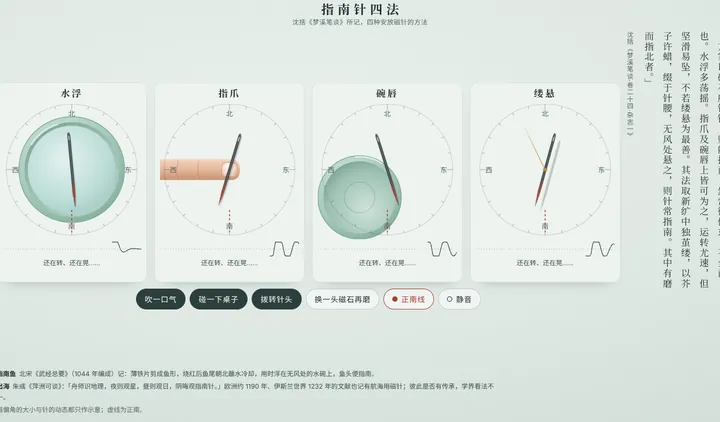 Hai·2Four Ways to Hang a Compass NeedleFour ways to mount a needle, recorded by Shen Kuo
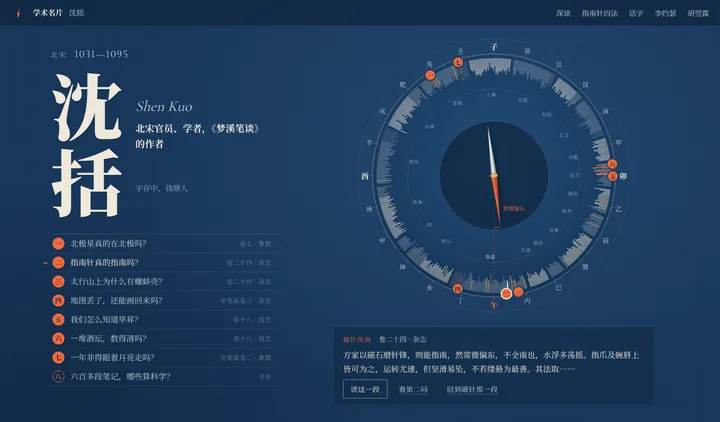 Ya·3Shen Kuo’s Scholar CardAlways Slightly East: turn a compass laid out from the Dream Pool Essays
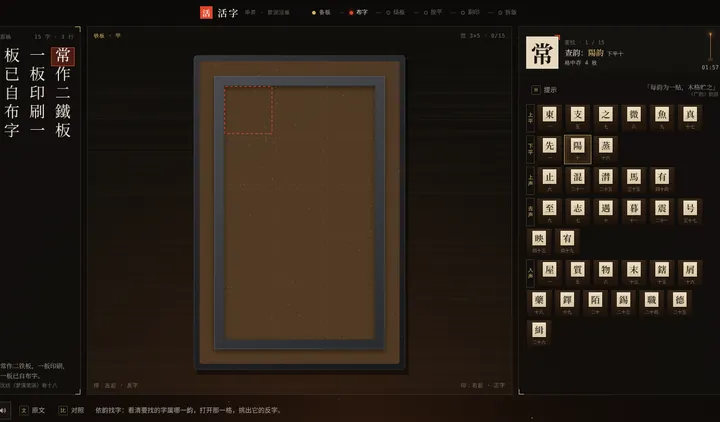 Ya·5Movable Type: Bi Sheng’s Clay TypeSet a plate of clay movable type by hand, as recorded in the Dream Pool Essays
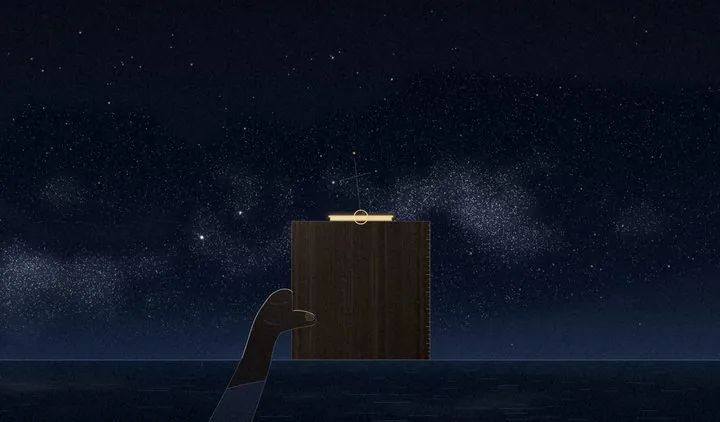 Hai·4Crossing the Ocean by the StarsMeasuring star heights with a star board to tell how far north or south the ship is
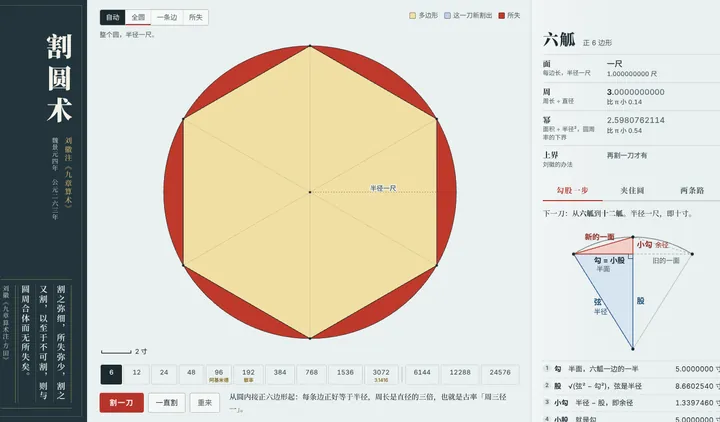 Tian·1Cutting the CircleHow Liu Hui closed in on π, one cut at a time