Hai·2Ten Thousand Li by Sea: Compasses and Voyages
Four Ways to Hang a Compass Needle
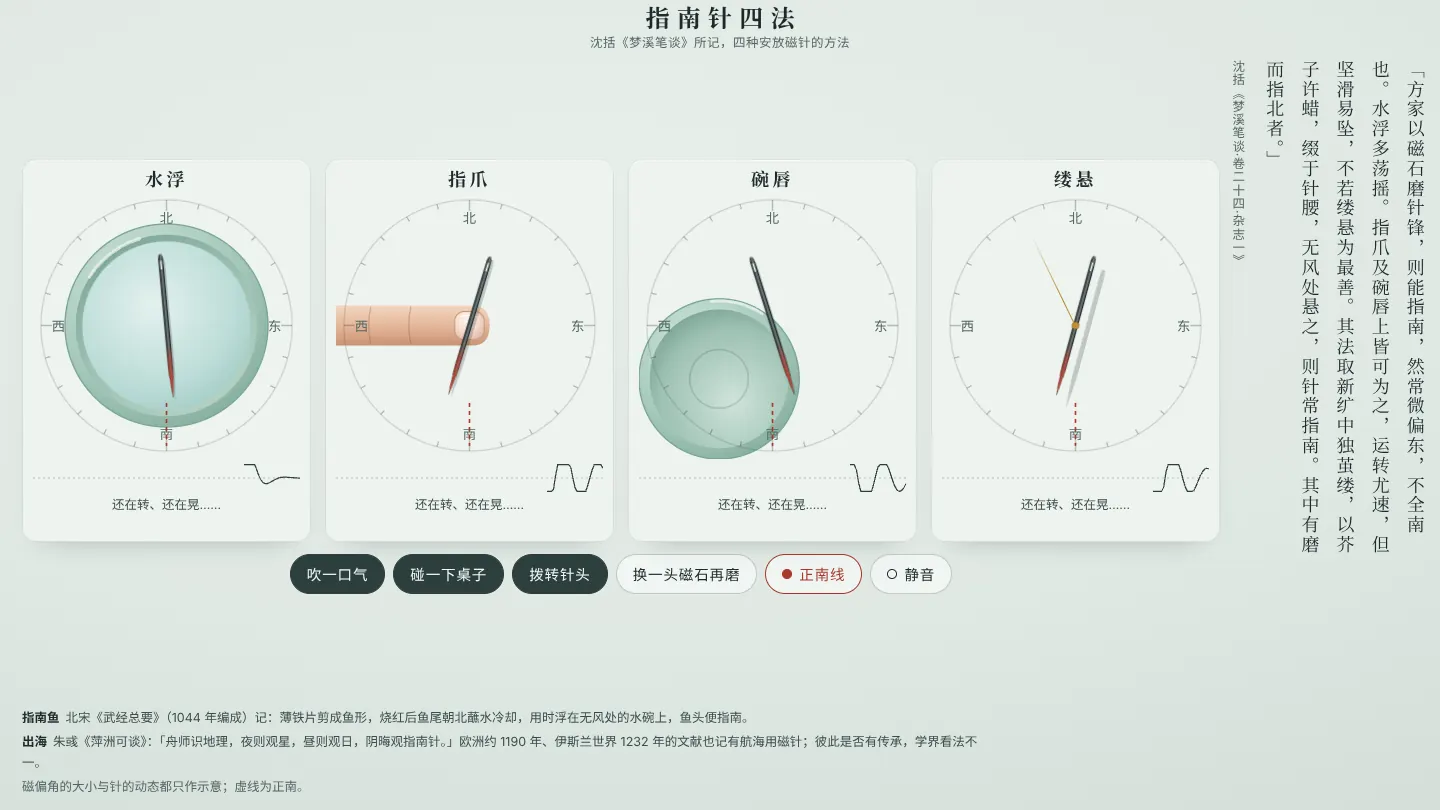
Four ways to mount a needle, recorded by Shen Kuo
- Accession no.
- Hai·2
- Category
- Interactive works
- Period
- Song
- Directed by
- Hu Yilin
- Made by
- Claude Opus 5.5
- Similar commission
- from S$18.75
About the exhibit
In chapter 24 of the Dream Pool Essays (Miscellaneous Notes 1), Shen Kuo (1031–1095) of the Northern Song wrote: “Geomancers rub the point of a needle with a lodestone, and it will then point south; yet it always inclines slightly to the east and does not point due south. Floated on water, it tends to waver. It can also be balanced on a fingernail or on the rim of a bowl, where it turns most freely, but these are hard and slippery and it easily falls off. Best of all is to hang it by a thread. The method is to take a single silk filament from new floss and fix it to the middle of the needle with a dab of wax the size of a mustard seed; hung in a windless place, the needle will always point south. Among such needles there are some that point north after rubbing.” In this one short passage he recorded that rubbing a needle with a lodestone lets it show direction, that the needle deviates from due south, and four ways of mounting the needle, with the strengths and weaknesses of each.
“It always inclines slightly to the east and does not point due south” describes a small angle between the needle’s direction and true north–south, now called magnetic declination; it varies from place to place and changes slowly over the years. “Among such needles there are some that point north after rubbing” records that some needles, though rubbed in the same way, ended up with their points facing north: we now know this depends on which pole of the lodestone is used and how the needle is rubbed.
A little before Shen Kuo, the Northern Song Collection of the Most Important Military Techniques (Wujing Zongyao, compiled in 1044) describes a “south-pointing fish”: a thin sheet of iron cut into the shape of a fish, heated red-hot and quenched in water with its tail pointing north; in use it is floated on a bowl of water out of the wind, and its head points south. A little later, Zhu Yu’s Pingzhou Table Talk records that the pilots of seagoing ships “watch the south-pointing needle in dark and overcast weather”. Magnetic needles for navigation also appear in European texts of about 1190 and Islamic texts of 1232; whether there is a line of descent between these and the Chinese needle is still debated among scholars.
How this work was made
All four test benches use the same needle and the same simplified mechanics: the magnetic force pulls the needle’s point towards magnetic south, with a restoring torque proportional to the sine of the angle of deflection. Only the damping, the friction and the stability differ. The floating needle is heavily damped, and after a disturbance it is also jostled by ripples, so it drifts and knocks against the side of the bowl. On the fingernail and the bowl rim the pivot has almost no drag, so the needle swings back quickly, but static friction often leaves it resting slightly off, and a puff or a knock easily makes it slip off. The single silk filament of the hanging needle barely twists, so the needle can come to rest on magnetic south; its one weakness is wind. All the parameters, the size of the declination (set at 5°) and the chance of a needle slipping off are illustrative, not measured. The button sounds are synthesised live.
Sources and references
- Shen Kuo, Dream Pool Essays, chapter 24, Miscellaneous Notes 1
- Zeng Gongliang et al., Collection of the Most Important Military Techniques (Wujing Zongyao), first part, chapter 15
- Zhu Yu, Pingzhou Table Talk
- Alexander Neckam, De naturis rerum (c. 1190)
- Joseph Needham, Science and Civilisation in China, Vol. 4, Part 1: Physics, 1962
- “History of the compass”, Wikipedia
Want something like this? See how to commission an interactive teaching page →
Spotted an error in the history, data or sources? Please write to [email protected].
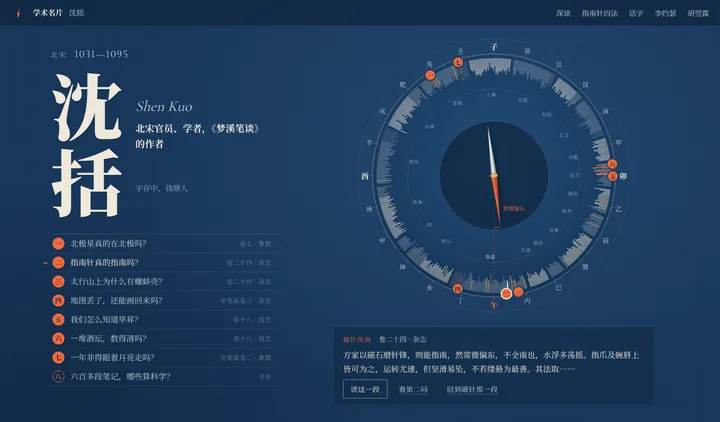 Ya·3Shen Kuo’s Scholar CardAlways Slightly East: turn a compass laid out from the Dream Pool Essays
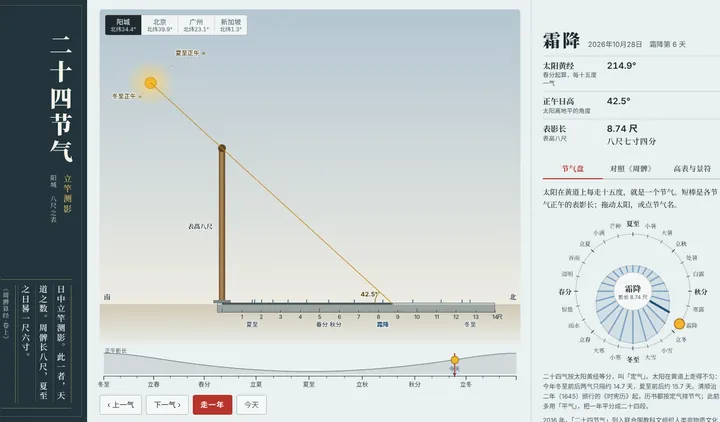 Tian·2The 24 Solar Terms: Measuring the Gnomon’s ShadowAn 8-chi gnomon and a year of shadows
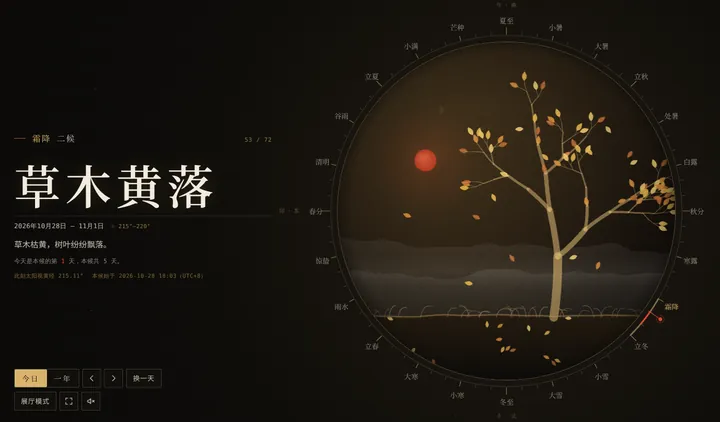 Tian·4The 72 PentadsFive days to a pentad: 72 generated vignettes cycling through a whole year
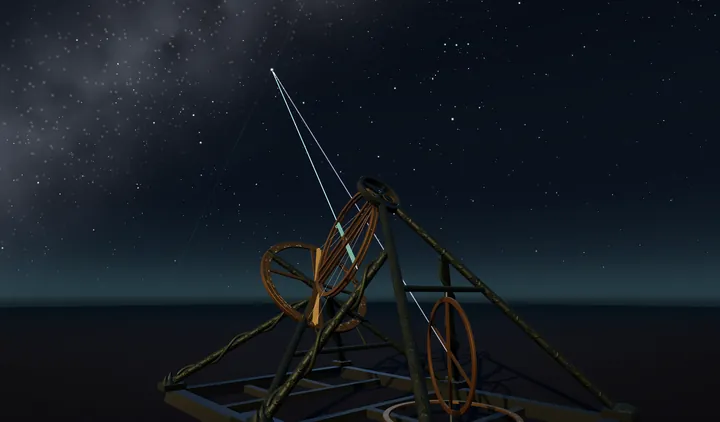 Tian·5Guo Shoujing and the Simplified ArmillaAn armillary sphere split into two instruments that do not block each other; turn the double declination ring to sight a star
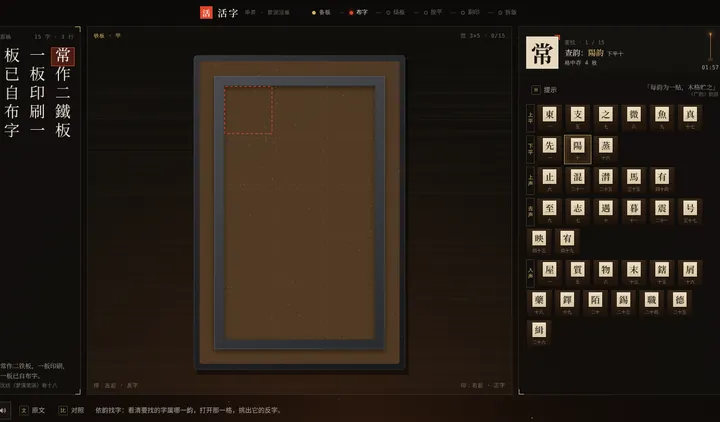 Ya·5Movable Type: Bi Sheng’s Clay TypeSet a plate of clay movable type by hand, as recorded in the Dream Pool Essays
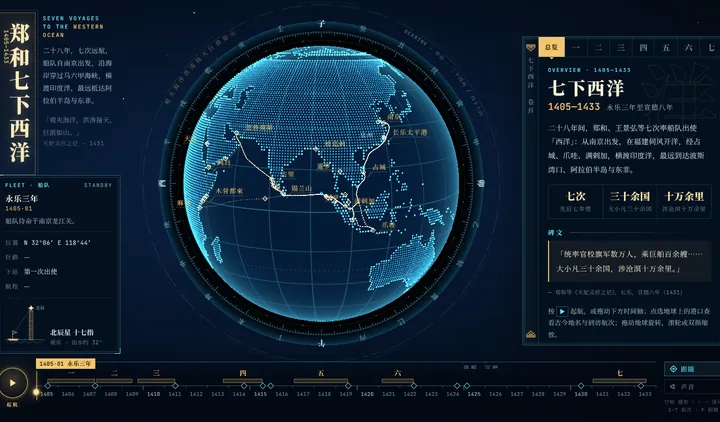 Hai·1Zheng He’s Seven VoyagesSeven voyages, drawn on a globe you can turn
 Xu·1Heavenly CraftSix hands-on exhibits of ancient science and technology
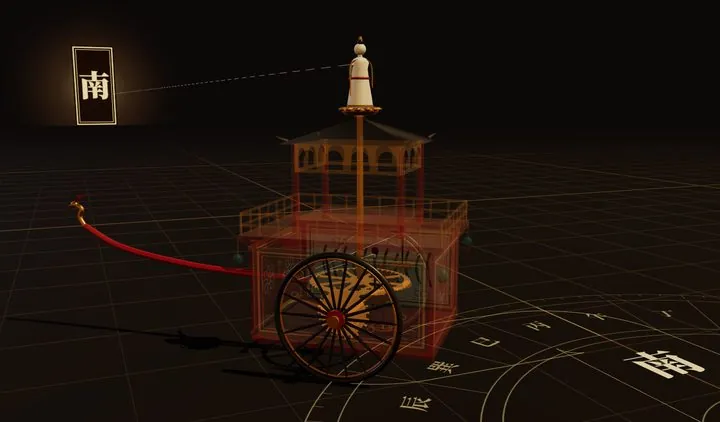 Hai·3The South-Pointing ChariotYan Su’s design: nine wheels, 120 teeth
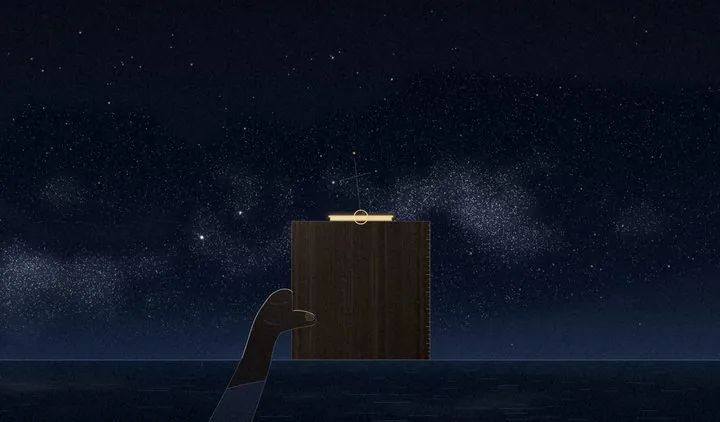 Hai·4Crossing the Ocean by the StarsMeasuring star heights with a star board to tell how far north or south the ship is