Hai·3Ten Thousand Li by Sea: Compasses and VoyagesFeatured
The South-Pointing Chariot
Yan Su’s design: nine wheels, 120 teeth
- Accession no.
- Hai·3
- Category
- Interactive works
- Period
- Song
- Directed by
- Hu Yilin
- Made by
- Claude Opus 5.5
- Similar commission
- from S$18.75
About the exhibit
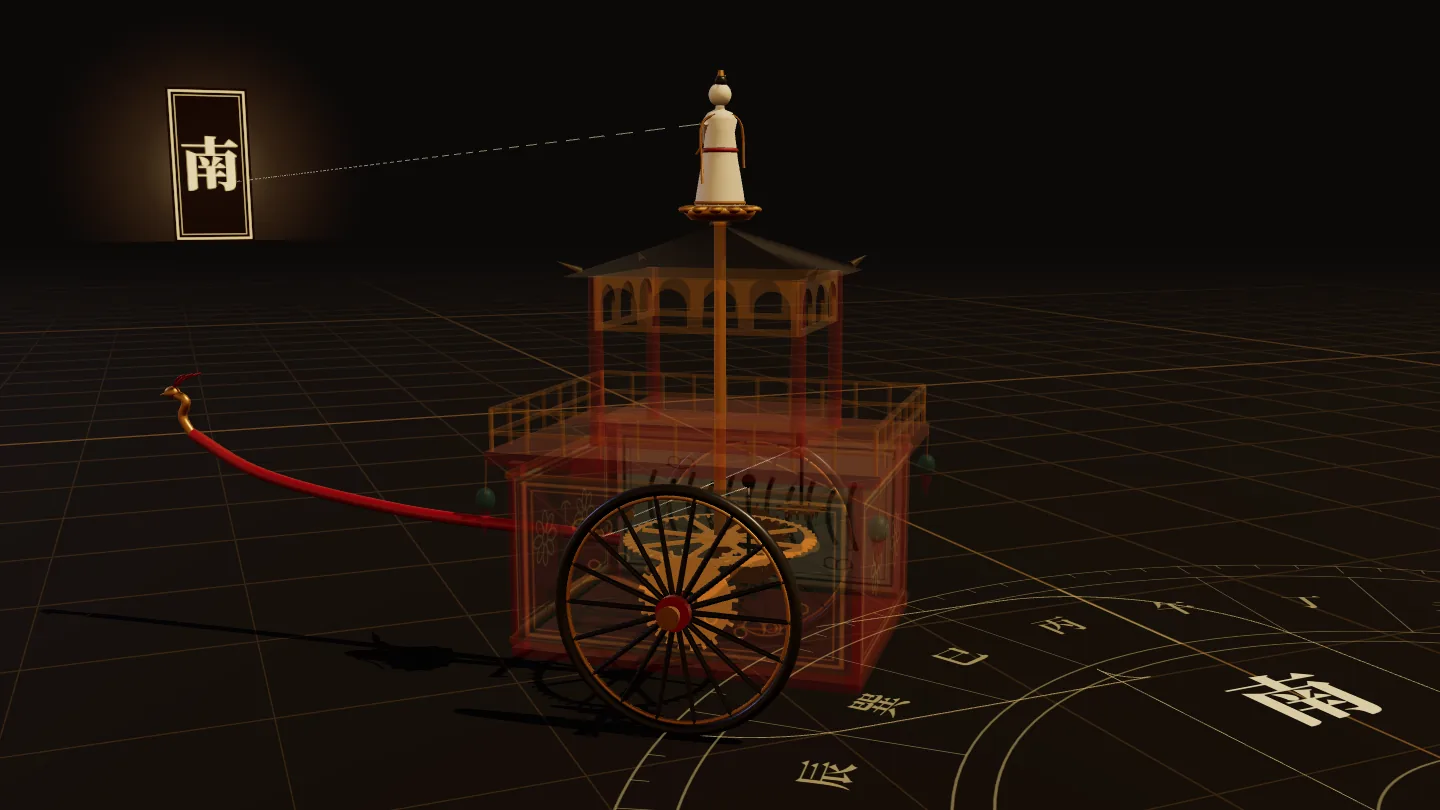
The south-pointing chariot was one of the carriages in a Song emperor’s ceremonial procession. The Treatise on Carriages and Dress in the History of Song describes it: “Its body is red; the two side panels are painted with the Azure Dragon and the White Tiger, and all four faces with flowers and birds. It has a two-tiered platform, balustrades and openwork brackets, with scent pouches hanging at the four corners. On top stands an immortal; however the chariot turns, his hand always points south.” There is no magnetic needle inside: it works by gears.
In the fifth year of the Tiansheng reign of the Northern Song (1027), Yan Su, a director in the Ministry of Works, built one and described how it was made in a memorial to the throne: “Nine wheels, large and small, with 120 teeth in all.” There are two road wheels, 6 chi high; attached to them, two upright gear wheels, 2 chi 4 cun across, with 24 teeth each; a small horizontal wheel on each side, 1 chi 2 cun across, with 12 teeth each; one large horizontal wheel in the centre, 4 chi 8 cun across, with 48 teeth; and under the crossbar at the end of the pole, two more small wheels 3 cun across. Through the middle runs a central axle 8 chi tall: “on top a wooden immortal is carved; as the chariot moves, the wooden figure points south.”
The original is very specific about what happens in a turn: “If it turns east, the pole is pushed round to the right; the gear wheel attached to the right road wheel turns forward 12 teeth, driving the small right horizontal wheel one full turn and engaging the large central horizontal wheel, which turns a quarter turn to the left, 12 teeth. The chariot travels east, and the wooden figure, now crosswise, points south.” Reckoning from this passage, the chariot starts out facing south. When it turns east, the right road wheel is on the outside of the turn and carries the right gear wheel round 12 teeth; the small right horizontal wheel is driven one full turn, and the large central wheel turns a quarter turn the opposite way, exactly cancelling the 90 degrees through which the body has turned. Turning west, the left-hand set does the same. When the chariot goes straight, both small horizontal wheels are lifted clear and the large wheel stays still.
In the first year of the Daguan reign (1107), Wu Deren of the Palace Domestic Service presented another design: road wheels 5 chi 7 cun in diameter, a large central horizontal wheel 3 chi 8 cun across with 100 teeth, and several sets of horizontal, attached, stacked and upright wheels. He also set out how the gears were engaged and disengaged: at the rear of each shaft was a small toothless wheel, attached to the left and right axles by bamboo strips and cords; “when turning right, the small wheel of the right shaft strikes the right wheel and drops it into place; when turning left, the small wheel of the left shaft strikes the left wheel and drops it into place.”
In his memorial Yan Su recounted the legends that the Yellow Emperor and the Duke of Zhou built south-pointing chariots; the earliest maker on reliable record is Ma Jun of Wei in the Three Kingdoms period. Later reconstructions differ: Wang Zhenduo worked from the History of Song and built a model in 1937; by the early 1980s nearly 20 possible drive mechanisms had been proposed; and the British engineer George Lanchester, among others, put forward designs using differential gearing.
What in the model is illustrative
The wheel diameters and numbers of teeth follow Yan Su’s text. The size and decoration of the carriage body (how the Azure Dragon, the White Tiger and the flowers and birds are painted), the shape of the teeth, and how the small horizontal wheels are raised and lowered on cords are all illustrative: Yan Su’s passage mentions only two small wheels under the crossbar at the end of the pole and does not make the engaging mechanism clear. In a turn the chariot pivots about a point 6 chi from the outer wheel. This is worked out by calculation: for half a turn of the outer wheel to correspond exactly to a 90-degree turn of the body, the outer wheel must be 6 chi from the centre of the turn, equal to the wheel’s diameter. The track width of 7 chi is also illustrative.
Sources and references
- History of Song, chapter 149: Treatise on Carriages and Dress, part 1
- Wan Baiwu, On the South-Pointing Chariot and the Invariance Principle It Applies, Systems and Control Panorama, 2015, no. 1
- China Mechanical Engineering Digital Museum, “South-pointing chariot”
- “South-pointing chariot”, Wikipedia
Want something like this? See how to commission an interactive teaching page →
Spotted an error in the history, data or sources? Please write to [email protected].
 Xu·1Heavenly CraftSix hands-on exhibits of ancient science and technology
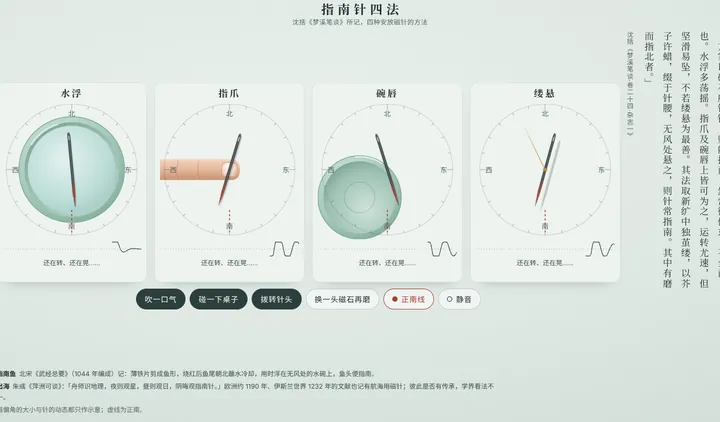 Hai·2Four Ways to Hang a Compass NeedleFour ways to mount a needle, recorded by Shen Kuo
 Hai·1Zheng He’s Seven VoyagesSeven voyages, drawn on a globe you can turn
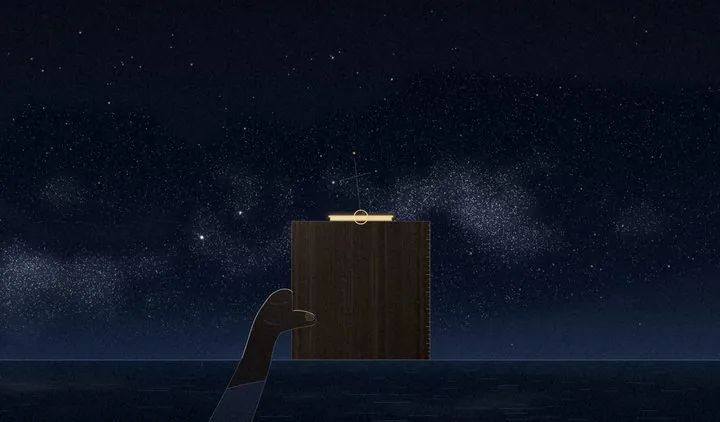 Hai·4Crossing the Ocean by the StarsMeasuring star heights with a star board to tell how far north or south the ship is