CNDAOCommissions · Teaching
Interactive teaching websitesMake the principle move
How Liu Hui closed in on π, why the south-pointing chariot always points south, how one bronze bell rings two notes — ideas that take half a lesson on the blackboard become web pages to drag, click and step through, so students see it for themselves.
Our current director is Hu Yilin, historian of science and philosopher of technology, and the founder of CNDAO.
By what you want to make:TeachingExhibitionsResearchAll commissions
AYou want to…
- give a lesson an interactive demo: project it in class, and let students explore it afterwards
- turn a diagram from the textbook into a model with parts to drag and settings to change
- make an online exhibit for a museum or science centre’s education programme
- add hands-on digital resources to a book or an online course
- turn a piece of history or a set of data into a chart students can explore
- turn a topic into a short quiz or game
BWhat you get
- A web page that just worksOpens on computers, phones, tablets and projectors — nothing to install, no sign-up.
- Step by step, start to finishA guided tour to follow with “Next”, plus a list of everything there is to see.
- Sources on the pageWhere the history, data and formulas come from, so they can be cited and checked.
- The source codePut it on your own site or course platform; commercial use is fine.
CPrices
The base price is the starting price on the commission order; larger pieces are quoted in proportion. We only take on work that can be finished within 7 days; within 14 days of delivery you can ask for one round of light revisions free.
- Interactive worksfrom S$18.753D models you can take apart, installations that make sound, hands-on popular-science exhibits and small games.See all works of this kind →
- Data visualisationfrom S$18.75Turn a stretch of history or a set of data into a picture you can explore: maps, timelines, networks and globes.See all works of this kind →
- Gamesfrom S$18.75Turn a piece of history, a body of knowledge or an event into a small game people can play: fun quizzes, cards and puzzles.See all works of this kind →
DSimilar works in the museum
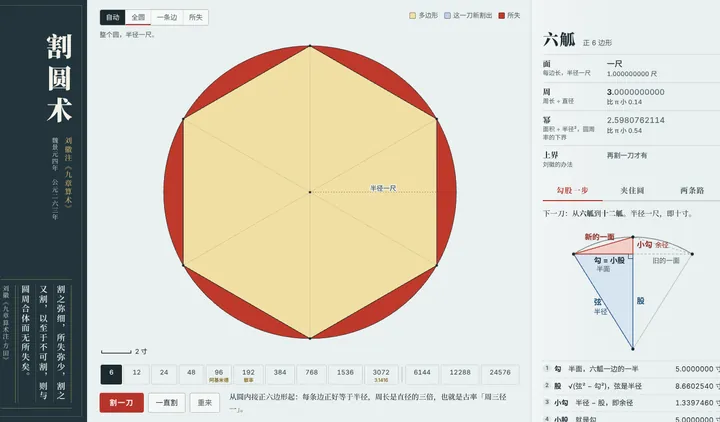 Tian·1Cutting the CircleStart from a regular hexagon inscribed in a circle and double the number of sides again and again: follow Liu Hui as he uses the gougu (Pythagorean) rule to work out the new side at each cut, watch the circle’s area being squeezed between an upper and a lower bound, then see Archimedes’ other road, which sets out from the perimeter and arrives at the same place.
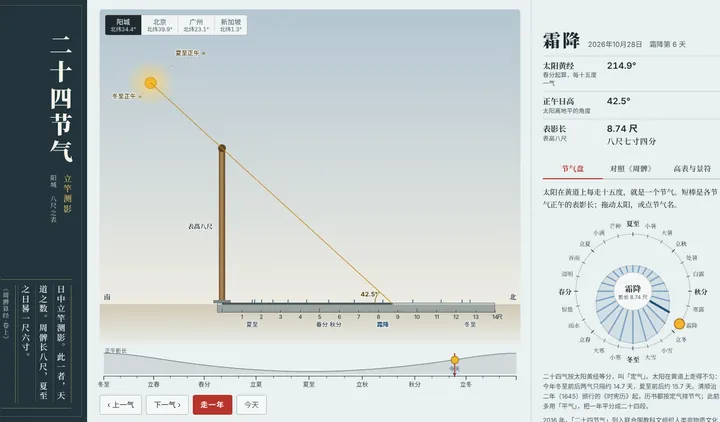 Tian·2The 24 Solar Terms: Measuring the Gnomon’s ShadowSet up a gnomon 8 chi tall at Yangcheng and drag through the days to watch the noon shadow stretch and shrink along the gui scale: the 24 solar terms come one for every 15 degrees the Sun travels along the ecliptic.
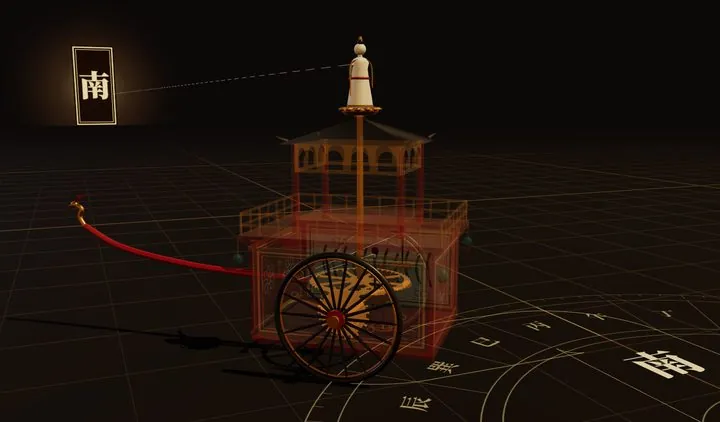 Hai·3The South-Pointing ChariotIn the fifth year of the Tiansheng era of the Northern Song (1027), Yan Su completed a south-pointing chariot: nine wheels, large and small, with 120 teeth.
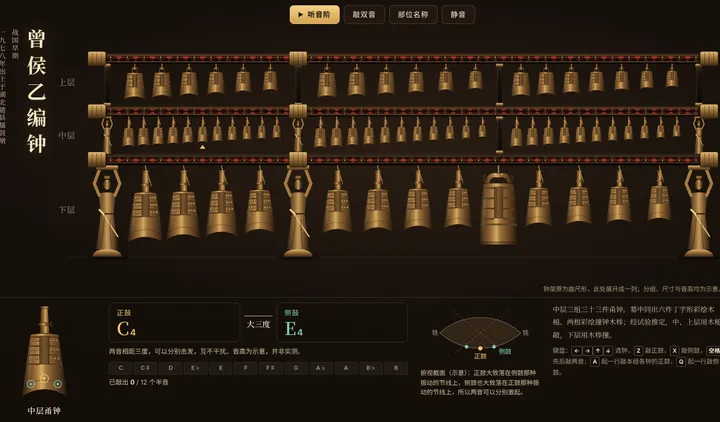 Lü·2The Bells of Marquis Yi of ZengThe 65 bells of Marquis Yi of Zeng: each bell sounds one note when struck at the centre and another when struck at the side, the two notes a third apart.
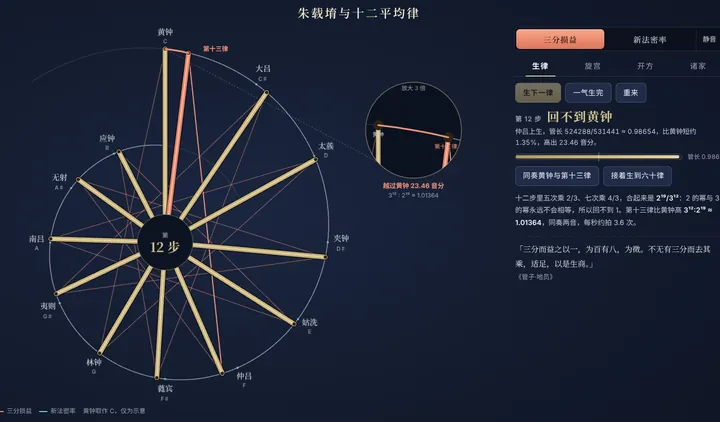 Lü·3Zhu Zaiyu and Equal TemperamentWhen the 12 pitches are generated by alternately cutting and adding a third of the length, the 12th step overshoots huangzhong by 23.46 cents and never comes back to the start; in the Ming dynasty, Zhu Zaiyu made the ratio of every semitone equal to the 12th root of 2, and the 12 pitches at last joined up end to end.
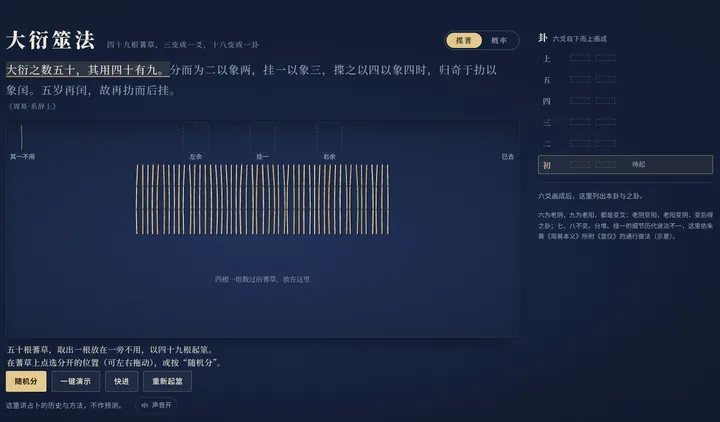 Xuan·3Yarrow-Stalk DivinationFollowing the Great Expansion number of the Book of Changes (Great Commentary, Part One), go through the yarrow-stalk count by hand with 49 stalks: three changes make a line and six lines a hexagram, giving the primary hexagram and the one it changes into; then compare the probabilities of the two ways of casting, with yarrow stalks and with three coins.
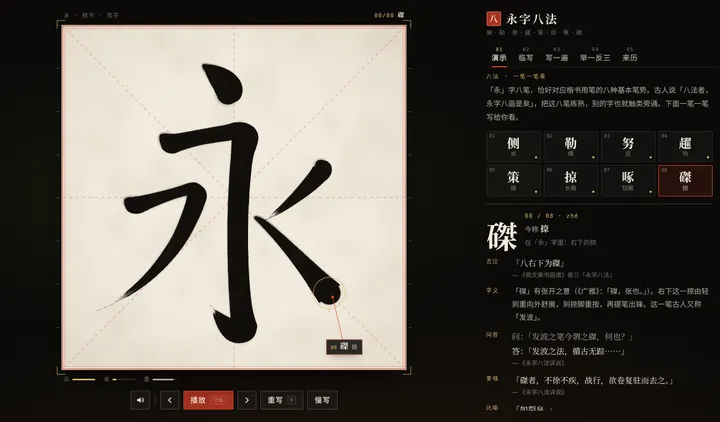 Zi·2The Eight Strokes of YongSide, rein, bow, leap, whip, sweep, peck, slash: the eight strokes of 永 (yong), matching the eight basic brush movements of regular script.
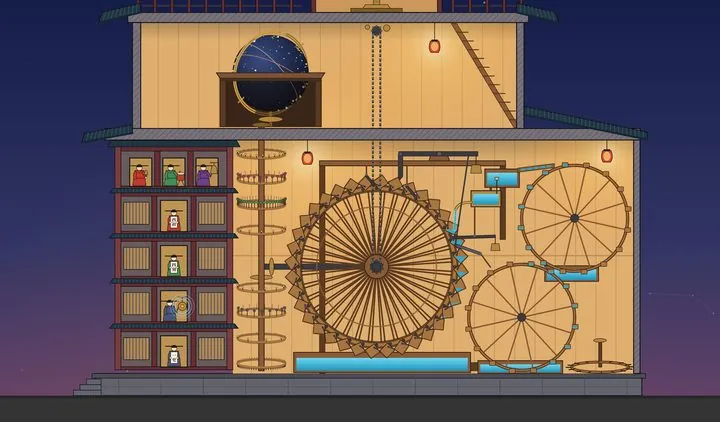 Ya·6The Water-Powered Astronomical Clock TowerIn the Yuanyou era of the Northern Song, Su Song, Han Gonglian and others completed the water-powered astronomical clock tower in Bianjing: an armillary sphere on top to observe the heavens, a celestial globe in the middle to show them turning, and below, wooden figures in a wooden pavilion announcing the hours, all driven by a single stream of water.
EQuestions
Q01Which subjects can you do?
Not only Chinese culture: maths, physics, astronomy, chemistry, biology, geography, history and languages all work, as long as the idea can be explained and drawn.
Q02Do students need an account or software?
No. You get an ordinary web page that opens in any browser; you can also host it on your own site.
Q03Is the content accurate?
The director checks the history, data and sources, and the sources are written into the work. If something is clearly wrong after delivery, we fix it free.
A lesson that is hard to teach?
Tell us the idea you want students to grasp. Consultation starts free; place an order whenever you are ready.