Lü·2Bronze Sounds, Jade Echoes: Music and TemperamentFeatured
The Bells of Marquis Yi of Zeng
One bell, two notes
- Accession no.
- Lü·2
- Category
- Interactive works
- Period
- Warring States
- Directed by
- Hu Yilin
- Made by
- Claude Opus 5.5
- Similar commission
- from S$18.75
About the exhibit
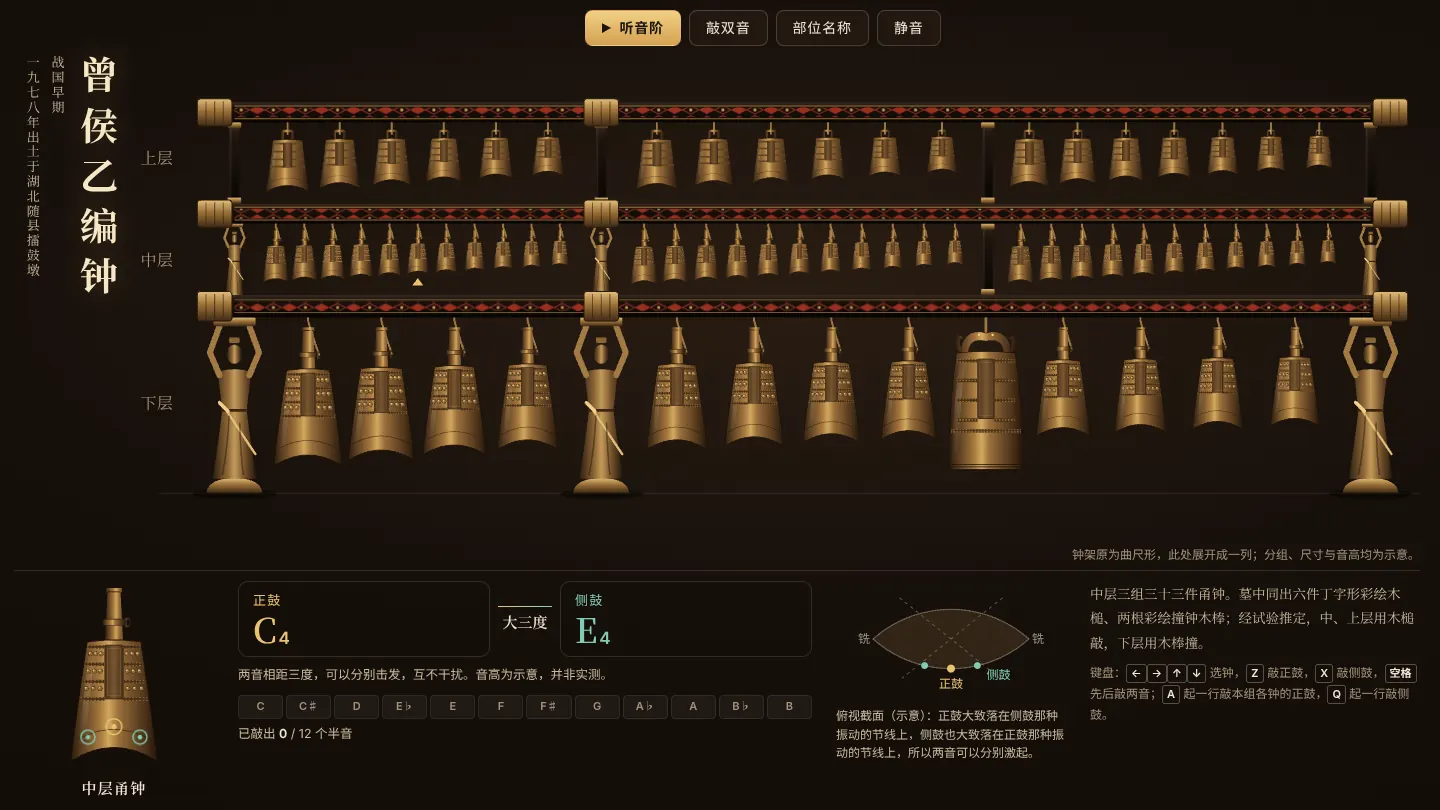
In 1978 a set of bells was excavated from the tomb of Marquis Yi of Zeng at Leigudun in Sui County (now Suizhou), Hubei. It dates from the early Warring States period. The set has 65 pieces, hung in eight groups on three tiers of an L-shaped bronze and wooden rack: three groups of 19 niuzhong (bells with loop handles) on the top tier, three groups of 33 yongzhong (bells with shanks) on the middle tier, and two groups of 12 large yongzhong with long bosses on the bottom tier, plus a bozhong presented by King Hui of Chu. The rack is held up by six bronze pillars in the form of sword-bearing warriors and several round columns.
The most remarkable feature of the set is “one bell, two notes”: striking the centre of the lower body (the zhenggu) and striking towards either side (the cegu) give two different notes, usually a major or minor third apart, which can be sounded separately without interfering with each other. The body is made like two roof tiles joined together, a form called hewa (‘joined tiles’), with a flattened oval cross-section, so the two strike points set off two different modes of vibration; the shape also makes the sound die away fairly quickly, so that notes do not blur into one another in quick passages. Inscriptions on the bells name the scale degree sounded at each strike point and set out how these names correspond to the pitch systems of Chu, Zhou, Qi, Shen and other states. The whole set spans five and a half octaves, with all 12 semitones present in the central register.
Before the excavation, the musicologist Huang Xiangpeng and others studying pre-Qin bells had already proposed that one bell could give two notes; the pitch inscriptions at each strike point of the Marquis Yi bells, which match the notes actually sounded, confirmed the idea. The inscription on the bozhong is dated to the 56th year of King Hui of Chu (433 BCE) and records that Xiong Zhang, King of Chu, made it as an ancestral ritual vessel for Marquis Yi of Zeng. The tomb also held six painted T-shaped wooden mallets and two painted wooden poles for striking the bells.
Different civilisations found different paths for the bell. The round bells of European churches have complex overtones, and each is suited to only one note; it was not until 1644 that the Hemony brothers cast the first tuned carillon at Zutphen in the Netherlands, with the musician Jacob van Eyck helping them identify the overtones of each bell. The bells of Marquis Yi took another road: their flattened bodies let one bell yield two usable notes.
How this work was made
The rack and bells are drawn after the forms of the excavated originals, with the L-shaped rack unfolded into a single row. The number of bells in each group, their sizes and their pitches are illustrative, not measured data: each group takes the five notes of the pentatonic scale as its centre notes, with each side note a major or minor third above, and together the groups cover all 12 semitones. The sound is synthesised live in the browser: each strike is built from several groups of partials that are not whole-number multiples of one another, with the higher partials dying away faster and slow beating between neighbouring pairs, plus the transient of the mallet’s blow and the reverberation of a hall; striking the centre also faintly sounds the side note, and vice versa. The cross-section seen from above illustrates the difference between centre and side strikes with two modes of vibration, with the movement exaggerated. The bozhong is given only one note.
Sources and references
- The bells of Marquis Yi of Zeng in the Hubei Provincial Museum
- Hubei Provincial Museum (ed.), The Tomb of Marquis Yi of Zeng, Cultural Relics Publishing House, 1989
- Rites of Zhou, “Record of Crafts” (Kaogongji), section “Bell-Founders” (Fu shi)
- Xinhua, “A Wonder of Human Musical History: Suizhou’s Bells of Marquis Yi of Zeng Enter the Memory of the World Register”, 2025-04-18
- Thomas D. Rossing, “Acoustics of Historical Chinese Bells”, Proceedings of the Institute of Acoustics
- “Pieter and François Hemony”, Wikipedia (the Hemony brothers and the 1644 Zutphen carillon)
Want something like this? See how to commission an interactive teaching page →
Spotted an error in the history, data or sources? Please write to [email protected].
 Xu·1Heavenly CraftSix hands-on exhibits of ancient science and technology
 Lü·1Qin · MachineA playable guqin with electronic beats
 Lü·3Zhu Zaiyu and Equal TemperamentHow the 12 pitches come full circle
 Hai·2Four Ways to Hang a Compass NeedleFour ways to mount a needle, recorded by Shen Kuo