Lü·3Bronze Sounds, Jade Echoes: Music and Temperament
Zhu Zaiyu and Equal Temperament
How the 12 pitches come full circle
- Accession no.
- Lü·3
- Category
- Interactive works
- Period
- Pre-Qin to Ming
- Directed by
- Hu Yilin
- Made by
- Claude Opus 5.5
- Similar commission
- from S$18.75
About the exhibit
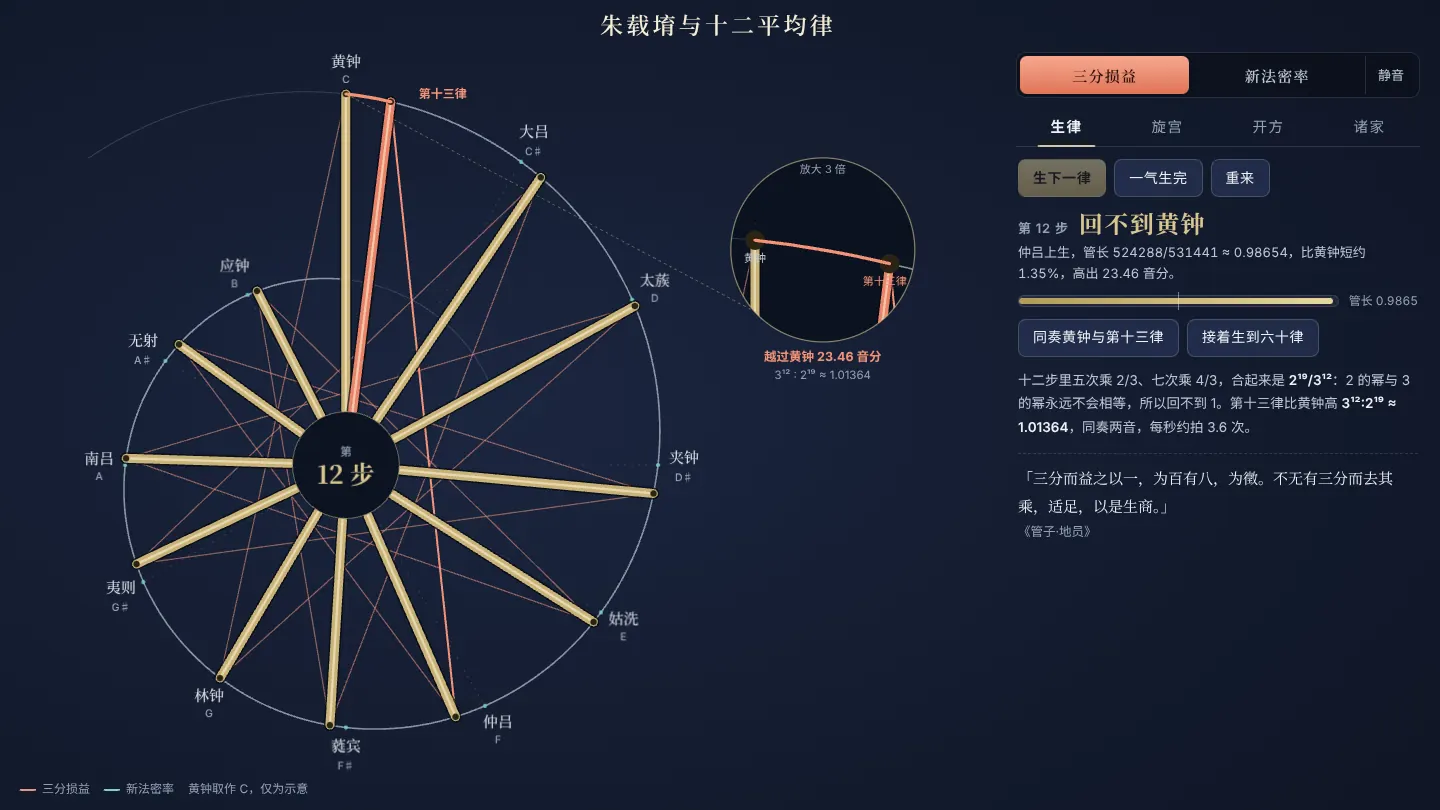
In ancient China, pitches were derived by “subtracting and adding a third” (sanfen sunyi): a pipe or string was shortened by a third (multiplied by 2/3, called “downward generation”) or lengthened by a third (multiplied by 4/3, called “upward generation”). The Diyuan chapter of the Guanzi takes a length of 81, nine times nine, as the gong note and, adding first and then subtracting, obtains zhi, shang, yu and jue in turn: the earliest record of the method. The Yinlü chapter of the Annals of Lü Buwei (Lüshi Chunqiu) extends it to all 12 pitches. But generating once more from zhonglü, the last of the 12 to be generated, does not lead back to the original Yellow Bell (huangzhong): the 13th pitch is about 23.46 cents higher than the Yellow Bell, a ratio of 3¹²∶2¹⁹ ≈ 1.01364. So the steps between the 12 pitches are not all equal either, and “each in turn serving as gong”, as the Liyun chapter of the Book of Rites puts it, runs into a narrowed fifth in some keys.
Pitch theorists in later dynasties tried many remedies. Jing Fang of the Western Han kept on generating and reached 60 pitches; Qian Lezhi of the Liu Song, in the Southern Dynasties, went on to 360; his contemporary He Chengtian spread the shortfall that kept the cycle from returning to the Yellow Bell across all the pitches; Cai Yuanding of the Southern Song generated six “variant pitches” in addition to the 12, making 18. Zhu Zaiyu (1536–1611), a member of the Ming imperial clan, took another path. In his New Account of the Science of Pitch-Pipes (Lüxue Xinshuo) of 1584 he proposed a “new precise ratio” (xinfa milü), later set out in detail in his Essential Meaning of the Pitch-Pipes (Lülü Jingyi). It abandoned subtracting and adding a third and made the ratio between any two adjacent pitches equal to the twelfth root of 2. By taking a square root, then another square root, then a cube root, he calculated this number to 25 significant figures: 1.059463094359295264561825.
Generating pitches by the ratio 3∶2 was not unique to China. Ancient Greek tuning by fifths leaves the same surplus, known today as the Pythagorean comma. At almost the same time as Zhu Zaiyu, the Dutch mathematician Simon Stevin also used the twelfth root of 2 to calculate equal temperament, in a manuscript of about 1605 that was not printed until 1884. The new precise ratio was never adopted for official court music under either the Ming or the Qing.
How this work was made
On the pitch circle, each pitch is drawn as a pipe pointing outwards from the centre. The pipe’s length is the string length (the Yellow Bell is 1) and its angle shows where its pitch falls within the octave, so all the notes lie on a single logarithmic spiral: one full turn halves the length. Subtracting and adding a third overshoots the Yellow Bell at the 12th step, while the new precise ratio lands exactly back on it; the magnifier shows those 23.46 cents clearly. The sound is a steady tone synthesised on the spot, with regular overtones, so that the beats between two notes sounding together can be heard clearly. The Yellow Bell is set to C only for listening and does not stand for a historical absolute pitch. The 25-digit number on the “Roots” page is computed live by the browser with big integers, using Newton’s method rather than Zhu Zaiyu’s own procedure; the result matches his figure digit for digit.
Sources and references
- Guanzi, Diyuan chapter
- Annals of Lü Buwei (Lüshi Chunqiu), Yinlü chapter
- Book of Rites, Liyun chapter
- Zhu Zaiyu, New Account of the Science of Pitch-Pipes (Lüxue Xinshuo), 1584
- Zhu Zaiyu, Essential Meaning of the Pitch-Pipes (Lülü Jingyi)
- Simon Stevin, Vande Spiegheling der Singconst (manuscript, c. 1605; printed 1884)
- “Zhu Zaiyu”, “12 equal temperament”, Wikipedia
Want something like this? See how to commission an interactive teaching page →
Spotted an error in the history, data or sources? Please write to [email protected].
 Lü·1Qin · MachineA playable guqin with electronic beats
 Lü·2The Bells of Marquis Yi of ZengOne bell, two notes
 Ya·3Shen Kuo’s Scholar CardAlways Slightly East: turn a compass laid out from the Dream Pool Essays