Ya·3Song: Heavenly Craft and RefinementFeatured
Shen Kuo’s Scholar Card
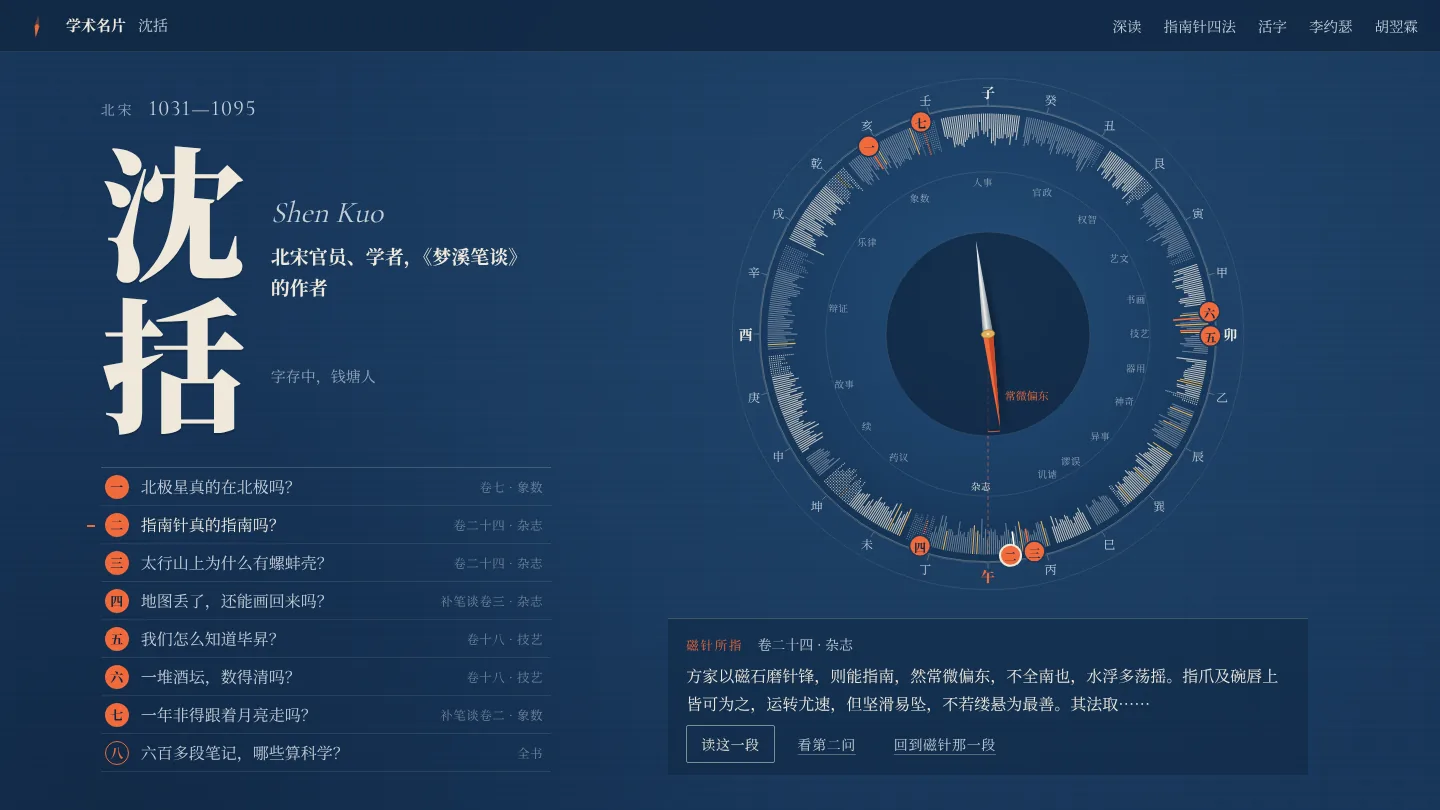
Always Slightly East: turn a compass laid out from the Dream Pool Essays
- Accession no.
- Ya·3
- Period
- Song
- Directed by
- Hu Yilin
- Made by
- Claude Opus 5.5
- Similar commission
- from S$18.75
About the exhibit
Shen Kuo (1031–1095), courtesy name Cunzhong, a native of Qiantang, was an official and scholar of the Northern Song. He worked on water control, headed the Bureau of Astronomy and in 1075 went as envoy to the Liao; on his return to court he became a Hanlin Academician and acting Finance Commissioner. In 1082 he was demoted after the defeat at Yongle, and in his last years he lived at Mengxi Garden in Runzhou, where he wrote the Dream Pool Essays. His biography in the History of Song says that “in astronomy, regional geography, harmonics and calendrics, music, medicine and divination there was nothing he did not master, and on all of them he wrote”.
The star of the card is the Dream Pool Essays itself. Following the Wikisource transcription, the book is divided into 604 passages, set in a ring according to the 17 categories of the original, one tick mark to a passage: the longer the mark, the longer the passage. In the centre hangs a magnetic needle that always points a little east of due south: this is what he wrote down as “it always inclines slightly to the east and does not point due south”. Eight questions are drawn from the book: Is the Pole Star really at the pole? Does the compass really point south? Why are there whelk and clam shells in the Taihang Mountains? If a map is lost, can it be drawn again? How do we know about Bi Sheng? Can a stack of wine jars be counted? Must the year follow the moon? Of more than 600 notes, which count as science? Each question comes with the original text, a modern translation and the source, and at the end are listed those who promoted him, those who impeached him, and those who carried his work on.
The figures for each question are illustrative, drawn from what the original text records: in the sighting tube the pole star circles the celestial pole at a radius of “a little over three degrees”; the needle’s declination is set at 7 degrees, within the range of 5 to 10 degrees estimated by Needham and Smith; places on the map are at their present-day latitudes and longitudes; and the date of Lichun is reckoned by mean new moons and mean solar terms. The in-depth page, Always Slightly East, is a short academic biography of him in ten sections, with notes giving the source of each point.
Sources and references
- History of Song, chapter 331, “Biography of Shen Kuo” (compiled by Toqto’a et al., Yuan; appended to the biography of his elder cousin Shen Gou), Wikisource transcription. https://zh.wikisource.org/wiki/宋史/卷331
- Nathan Sivin, “Shen Kua”, Dictionary of Scientific Biography, vol. 12, New York: Charles Scribner's Sons, 1975; full text of the Complete Dictionary of Scientific Biography version on Encyclopedia.com, accessed October 2026. A revised version is included in Sivin’s collected papers, Science in Ancient China: Researches and Reflections (Aldershot: Variorum, 1995). The article cites entries of the Dream Pool Essays by their numbers in Hu Daojing’s critical edition, and this page does the same. https://www.encyclopedia.com/science/dictionaries-thesauruses-pictures-and-press-releases/shen-kua
- Shen Kuo, Dream Pool Essays, author’s preface. Wikisource transcription. https://zh.wikisource.org/wiki/夢溪筆談/序
- Dream Pool Essays, chapter 7, Astronomy and Calendar 1, the entries beginning “The sun and moon are shaped like balls” and “The sun and moon on their courses sometimes eclipse and sometimes do not” (nos. 130 and 131 in Hu Daojing’s critical edition). https://zh.wikisource.org/wiki/夢溪筆談/卷07
- Dream Pool Essays, chapter 8, Astronomy and Calendar 2, the entry beginning “The bronze armillary sphere of the Bureau of Astronomy” (no. 150). https://zh.wikisource.org/wiki/夢溪筆談/卷08
- Dream Pool Essays, chapter 7, Astronomy and Calendar 1, the entry beginning “Before the Han, all held that the Pole Star stood at the centre of the heavens” (no. 127). https://zh.wikisource.org/wiki/夢溪筆談/卷07
- Dream Pool Essays, chapter 8, Astronomy and Calendar 2, the entry beginning “I once examined the motions of the five planets in calendars ancient and modern” (no. 148); the willow-leaf simile and the story of the observation logs are both in this entry. https://zh.wikisource.org/wiki/夢溪筆談/卷08
- Dream Pool Essays, chapter 7, Astronomy and Calendar 1, the entry beginning “In the Qingli reign there was a diviner surnamed Li” (no. 139); the account of Wei Pu correcting the method of calculating solar eclipses is appended at the end of the entry. https://zh.wikisource.org/wiki/夢溪筆談/卷07
- Dream Pool Essays, chapter 18, Technical Skills, the entry beginning “Wei Pu, a man of Huainan, was expert in calendrical calculation”. https://zh.wikisource.org/wiki/夢溪筆談/卷18
- Dream Pool Essays, chapter 7, Astronomy and Calendar 1, the entry beginning “Writers on water clocks, ancient and modern, number several dozen” (no. 128). https://zh.wikisource.org/wiki/夢溪筆談/卷07
- Dream Pool Essays, chapter 24, Miscellaneous Notes 1, the entry beginning “Geomancers rub the point of a needle with a lodestone” (no. 437). https://zh.wikisource.org/wiki/夢溪筆談/卷24
- Supplement to the Dream Pool Essays, chapter 3, Discussions of Medicines, the entry beginning “When the point of a needle is rubbed with a lodestone, the sharp end always points south” (no. 588). https://zh.wikisource.org/wiki/夢溪筆談/補筆談
- Joseph Needham and Peter J. Smith, “Magnetic Declination in Mediaeval China”, Nature, vol. 214 (17 June 1967), pp. 1213–1214; as cited by Sivin.
- Dream Pool Essays, chapter 24, Miscellaneous Notes 1, the entry beginning “When I was sent on a mission to Hebei, I travelled north along the Taihang Mountains” (no. 430). https://zh.wikisource.org/wiki/夢溪筆談/卷24
- Dream Pool Essays, chapter 24, Miscellaneous Notes 1, the entry beginning “The Yandang Mountains of Wenzhou are the most wondrously beautiful under heaven” (no. 433). https://zh.wikisource.org/wiki/夢溪筆談/卷24
- Dream Pool Essays, chapter 21, Strange Happenings, the entry beginning “Recently, at Yongning Pass in Yanzhou, the bank of the Yellow River collapsed” (no. 373). https://zh.wikisource.org/wiki/夢溪筆談/卷21
- Dream Pool Essays, chapter 21, Strange Happenings, the entry beginning “It is commonly said that a rainbow can come down into a stream to drink” (no. 357). https://zh.wikisource.org/wiki/夢溪筆談/卷21
- Supplement to the Dream Pool Essays, chapter 3, Miscellaneous Notes, the entry beginning “Of books on geography, the ancients had the Flying Bird Map” (no. 575). https://zh.wikisource.org/wiki/夢溪筆談/補筆談
- Dream Pool Essays, chapter 25, Miscellaneous Notes 2, the entry beginning “Under the present dynasty, the Bian Canal” (no. 457). https://zh.wikisource.org/wiki/夢溪筆談/卷25
- Dream Pool Essays, chapter 25, Miscellaneous Notes 2, the entry beginning “When I was sent to inspect the frontier, I first made a wooden map” (no. 472). https://zh.wikisource.org/wiki/夢溪筆談/卷25
- Dream Pool Essays, chapter 18, Technical Skills, the entry beginning “The printing of books from blocks” (no. 307). https://zh.wikisource.org/wiki/夢溪筆談/卷18
- English Wikipedia, “Bi Sheng”: “Bi Sheng's invention was only recorded in the Dream Pool Essays.” Accessed October 2026. https://en.wikipedia.org/wiki/Bi_Sheng
- Dream Pool Essays, chapter 18, Technical Skills, the entry beginning “The methods in arithmetic for finding volumes” (no. 301); the xiji method for volumes with interstices and the huiyuan method for arcs of a circle are both in this entry. https://zh.wikisource.org/wiki/夢溪筆談/卷18
- Dream Pool Essays, chapter 18, Technical Skills, the entry beginning “The Tang monk Yixing once calculated the total number of positions on a go board” (no. 304). https://zh.wikisource.org/wiki/夢溪筆談/卷18
- Supplement to the Dream Pool Essays, chapter 2, Astronomy and Calendar, the entry beginning “Of the calendrical methods found in the classics” (no. 545). https://zh.wikisource.org/wiki/夢溪筆談/補筆談
- Shen Kuo, A Complete Translation of the Dream Pool Essays, translated and annotated by Hu Daojing et al., Guiyang: Guizhou People’s Publishing House, 1998; according to the book description on Douban Books, “609 entries are listed in all”. https://book.douban.com/subject/1033960/
- Needham’s passage-by-passage classification as listed in the English Wikipedia article “Dream Pool Essays” (584 passages in all, cited to Science and Civilisation in China, vol. 1, p. 136), accessed October 2026. https://en.wikipedia.org/wiki/Dream_Pool_Essays
- Dream Pool Essays, chapter 26, Discussions of Medicines, the entry beginning “Ancient prescriptions say that mica taken unrefined” (no. 480). https://zh.wikisource.org/wiki/夢溪筆談/卷26
- Hu Daojing, The Dream Pool Essays: Collated and Annotated, first published in Shanghai; revised edition in two volumes, Beijing, 1960 (as described by Sivin).
- Zhang Jiaju, Shen Kuo, Shanghai People’s Publishing House, 1962. Sivin called it the most complete and accurate account of his life available at the time.
- Donald Holzman, “Shen Kua and his Meng-ch'i pi-t'an”, T'oung Pao, vol. 46 (1958), pp. 260–292. Sivin called it the first account of Shen Kuo’s life written in a European language.
- Dream Pool Essays, facsimile of a Ming edition in the Sibu Congkan, Second Series (with Zhang Yuanji’s collation notes), Wikisource transcription: https://zh.wikisource.org/wiki/夢溪筆談_(四部叢刊本); Wenyuange Siku Quanshu edition: https://zh.wikisource.org/wiki/夢溪筆談_(四庫全書本). A few characters in the quotations on this page have been checked against these two editions.
- Full text of the Dream Pool Essays (the 604 passages used for the card’s compass and for “Read this passage”), Wikisource transcription, public domain: https://zh.wikisource.org/wiki/夢溪筆談
- Coastline: Natural Earth 1:50m Land (public domain), https://www.naturalearthdata.com/
- Latin typeface: Cormorant Garamond (SIL OFL 1.1)
Want something like this? See how to commission a talk website or a literature review →
Spotted an error in the history, data or sources? Please write to [email protected].
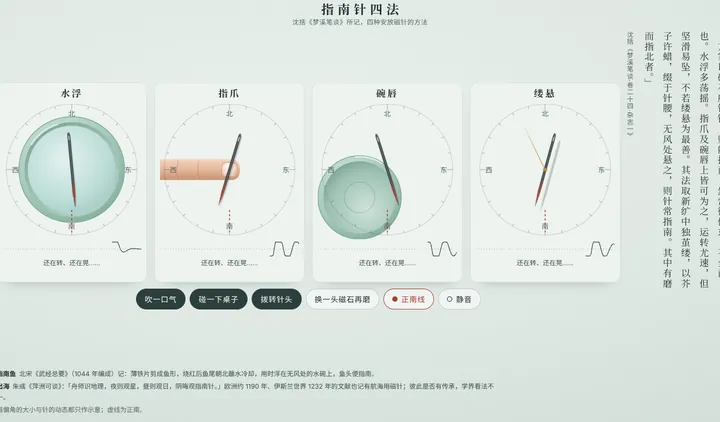 Hai·2Four Ways to Hang a Compass NeedleFour ways to mount a needle, recorded by Shen Kuo
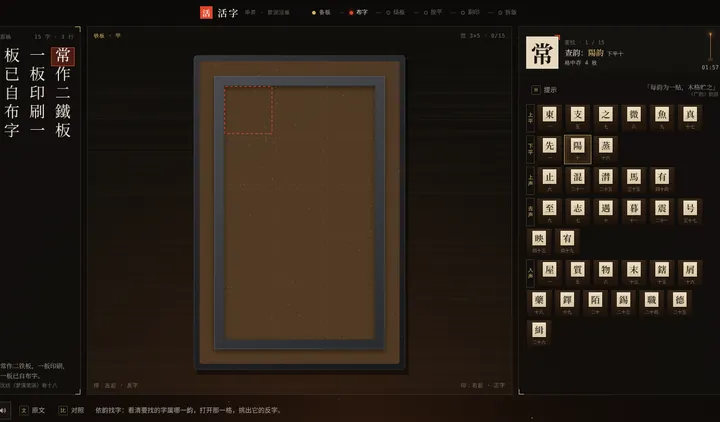 Ya·5Movable Type: Bi Sheng’s Clay TypeSet a plate of clay movable type by hand, as recorded in the Dream Pool Essays
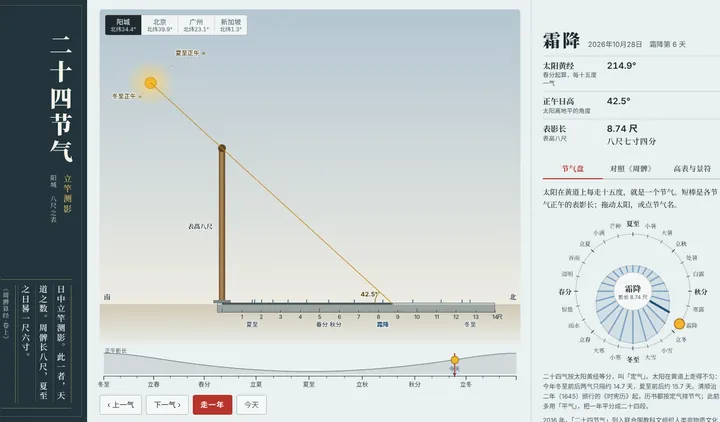 Tian·2The 24 Solar Terms: Measuring the Gnomon’s ShadowAn 8-chi gnomon and a year of shadows
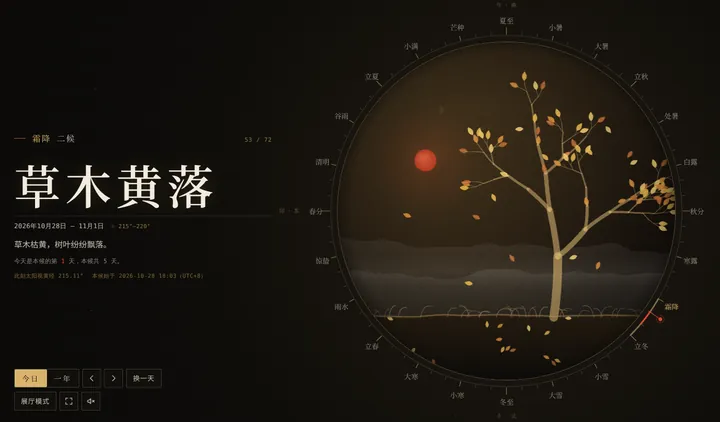 Tian·4The 72 PentadsFive days to a pentad: 72 generated vignettes cycling through a whole year
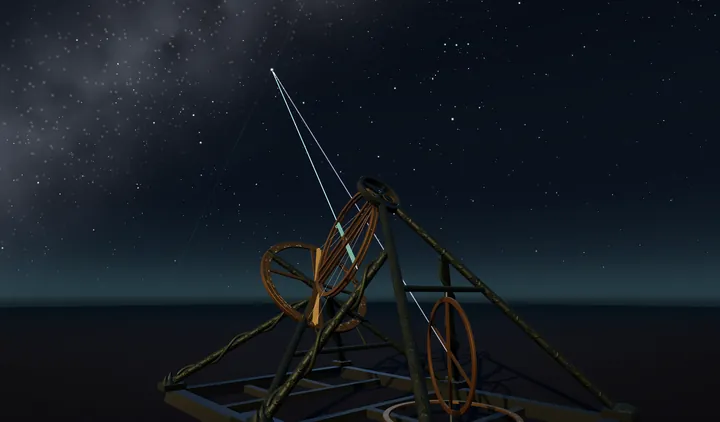 Tian·5Guo Shoujing and the Simplified ArmillaAn armillary sphere split into two instruments that do not block each other; turn the double declination ring to sight a star
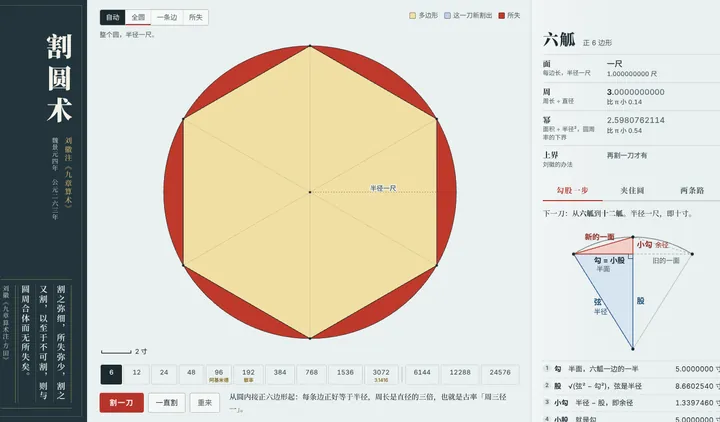 Tian·1Cutting the CircleHow Liu Hui closed in on π, one cut at a time
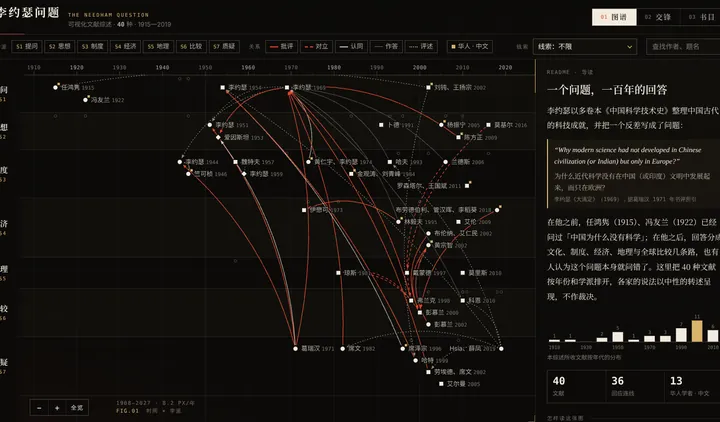 Shu·2The Needham QuestionA visual literature review: why modern science did not arise in China, and whether the question should be asked this way
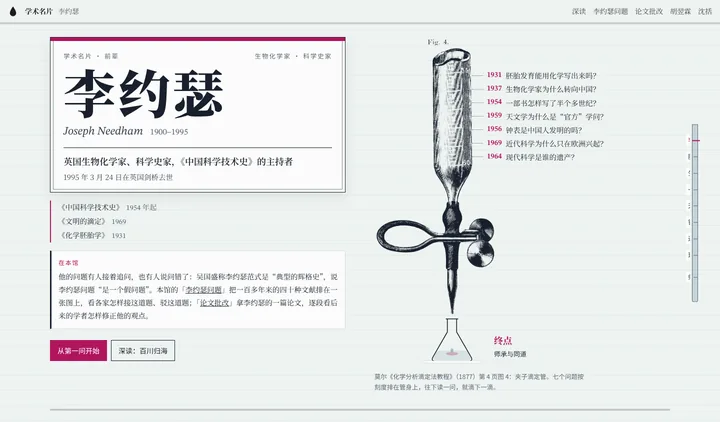 Shu·5Joseph Needham’s Scholar CardA burette, with seven questions dripping down its scale
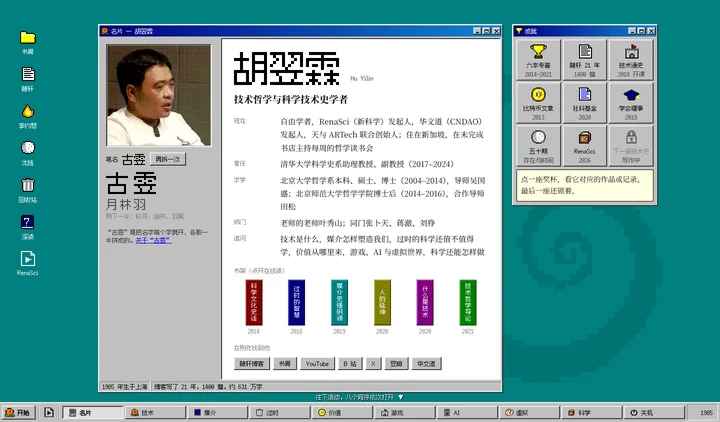 Shu·4Hu Yilin’s Scholar CardAn old Windows-style desktop where eight programs open one by one