Ya·1
The Dougong Bracket
A Song-style bracket set built according to the Treatise on Architectural Methods
This is a handscroll that unrolls from right to left. Use the “Next section” and “Previous section” buttons or the position slider below the scroll to move through it.
Scroll the wheel, or press and drag
The scroll unrolls from right to left
Bianjing, capital of the Northern Song, was one of the most prosperous cities in the world at the time. Carpenters assembled dougong brackets to the cai-fen modules of the Treatise on Architectural Methods (Yingzao Fashi); Su Song and Han Gonglian built a water-driven astronomical clock tower; Bi Sheng carved characters in clay and set them as type; painters used the “three distances” to gather whole landscapes into long scrolls; and in the streets people whisked tea and held tea contests. The city was open to the world: merchants from afar came and went, and the Jewish community of Kaifeng is recorded as having settled there in the Song.
This exhibition starts from one city, to see how technology grows into everyday life and taste.
Ya·1
A Song-style bracket set built according to the Treatise on Architectural Methods
{{ syDef }}
Ya·3
Always Slightly East: turn a compass laid out from the Dream Pool Essays
{{ pgQ }}
{{ pgT }}
{{ pgSrc }}
Ya·5
In the Qingli era of the Northern Song, Bi Sheng, a commoner, carved characters in clay and fired them hard to make movable type. Following Shen Kuo’s account in the Dream Pool Essays, pick the mirror-image clay characters from a case arranged by rhyme, coat the iron plate with its resin mixture, warm it soft and press the type flat, ink it and print a sheet, then brush the type off and put it back in its compartments.
Type case (arranged by rhyme, illustrative)
Ya·6
A cutaway look at an astronomical clock tower driven by water

Ya·7
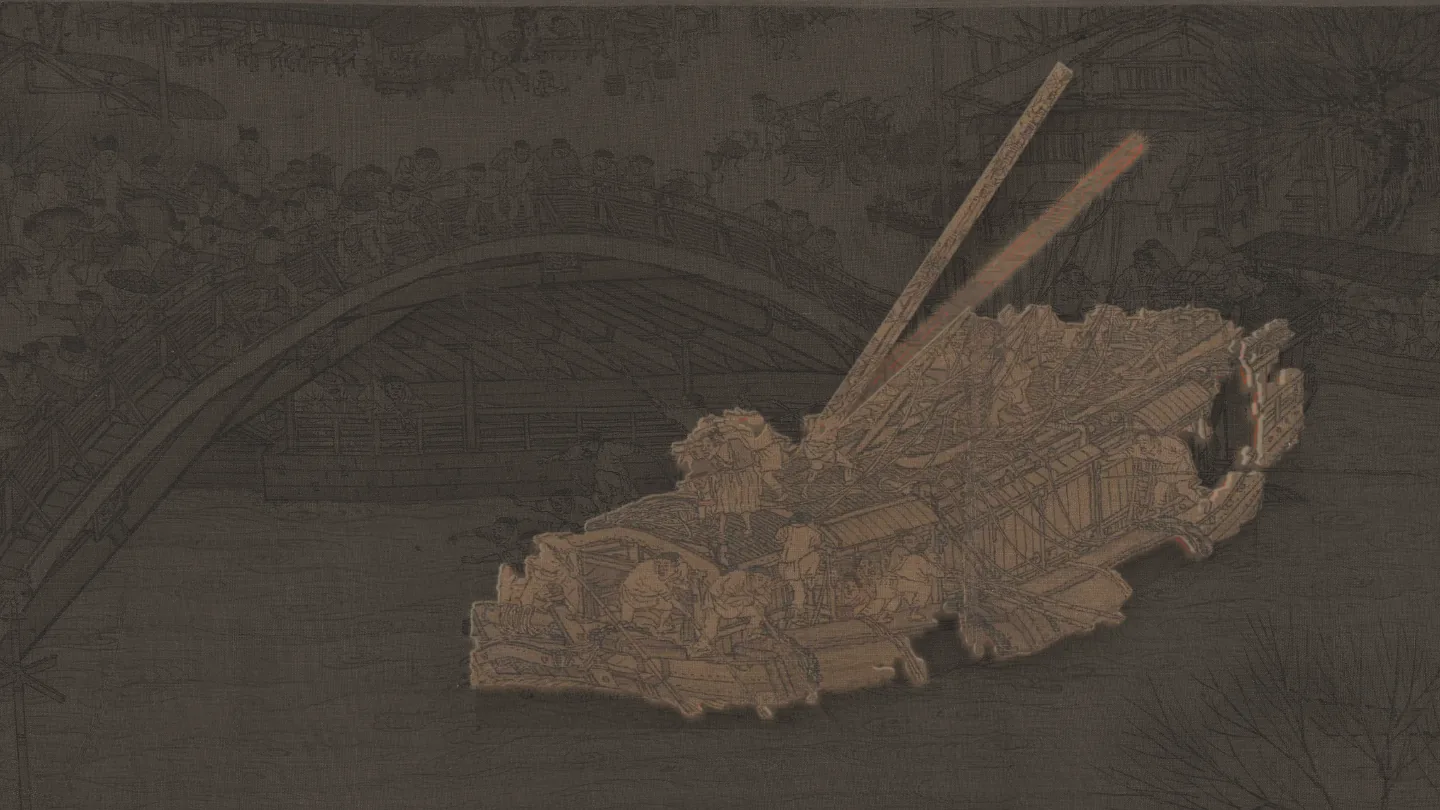
From the countryside, along the Bian River and past the Rainbow Bridge into the city of Bianjing

Curated by Hu Yilin
Made by AI, directed by people