Shu·2The StudyFeatured
The Needham Question
A visual literature review: why modern science did not arise in China, and whether the question should be asked this way
- Accession no.
- Shu·2
- Location
- The Study
- Period
- Modern to contemporary
- Directed by
- Hu Yilin
- Made by
- Claude Opus 5.5
- Similar commission
- from S$18.75
About the exhibit
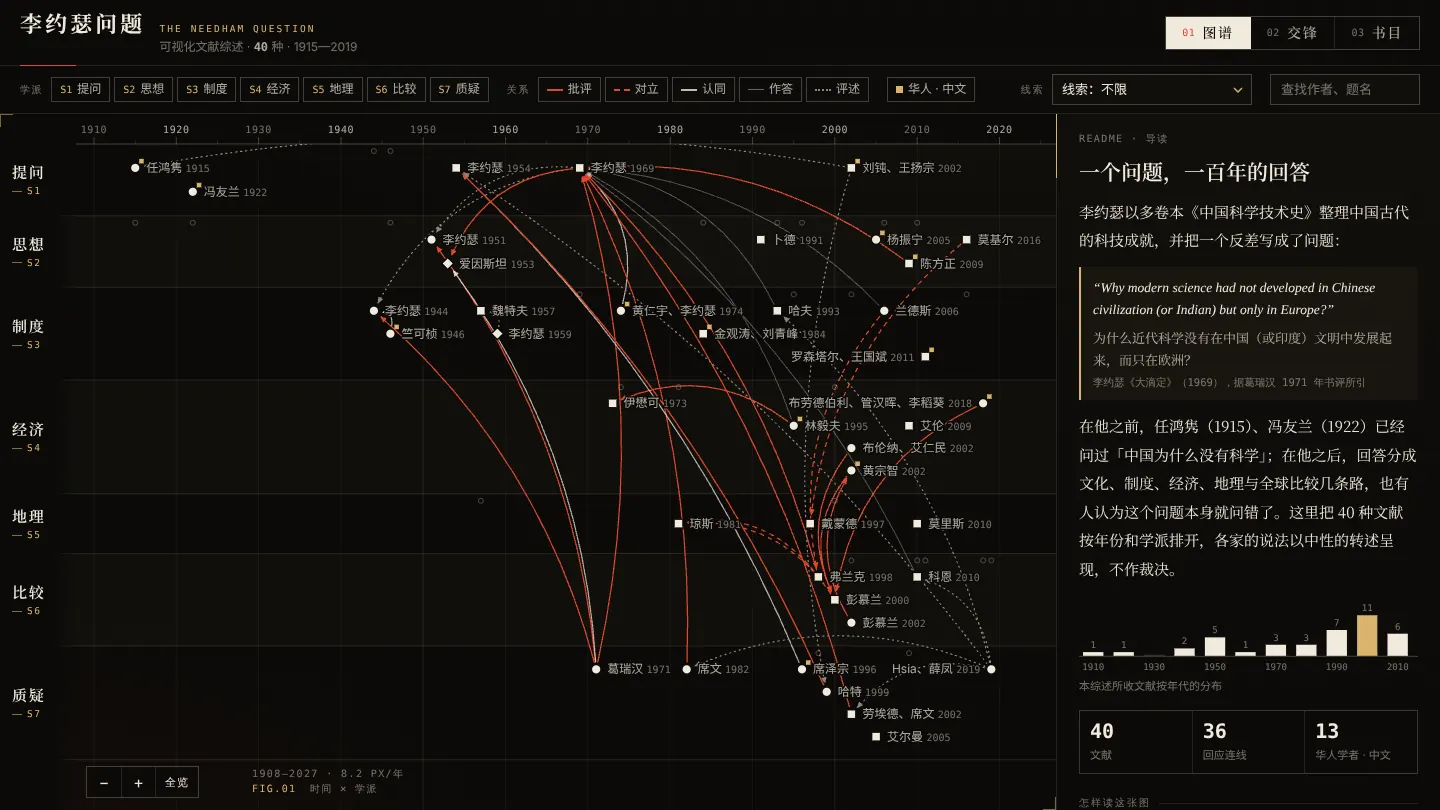
The question “Why did modern science not arise in China?” is often named after Joseph Needham, but as early as 1915 Ren Hongjun wrote “On the Reasons Why China Has No Science” in the first issue of Science (Kexue), and in 1922 Feng Youlan published “Why China Has No Science” in the International Journal of Ethics. Needham documented the scientific and technological achievements of ancient China in his multi-volume Science and Civilisation in China, and in The Grand Titration (1969) he framed the problem as two questions: why modern science arose only in Europe, and why, for more than a thousand years before that, China had been more effective than Europe at putting knowledge of nature to use.
Later answers fall roughly along several lines: looking for causes in philosophy, language and ways of thinking; in bureaucracy, the civil service examinations, law and property rights; in population, factor prices and output data; in geography and resources; or placing China and Europe in a single framework of global comparison and asking when and why the “Great Divergence” happened. Some scholars think the “why not” question is itself flawed: A. C. Graham, Nathan Sivin and others have pointed out that something that never happened is hardly a question historical research can answer.
The review gathers 40 publications from 1915 to 2019, more than 10 of them by Chinese scholars, set out on a single map by year and across seven schools, with lines marking who responded to whom and whether in agreement or criticism. Nine “Debate” cards set opposing sides next to each other, each with its strongest arguments, and citations in the bibliography can be copied in GB/T 7714 or Chicago style. Each position is given in neutral paraphrase, without a verdict.
How this work was made
Every bibliographic entry (author, year, title, source) and every summary of an argument has been checked against publisher and journal pages, the authors’ own websites, scholarly encyclopaedias and scholars’ reviews; details for which no reliable source could be found are left out. Quotations use only verified wording, with the source given: Sivin’s “page 3 of the newspaper” comparison, for example, is quoted from his 2005 revised version, and Graham’s words from the original 1971 issue of Asia Major. Lines are drawn only for documented responses: book reviews, replies, dedicated rebuttals or explicit groupings in a review; where two sides never engaged directly and simply hold opposite positions, the Debate card is marked “Contrasting positions”. Translated titles marked “Chinese edition” are those of a published Chinese edition or the author’s own Chinese version; the rest are free translations.
The map is drawn live in SVG. The horizontal axis is the year of publication and can be dragged and zoomed; publications in the same school are sorted into tracks automatically according to label width, and where labels overlap, the more important ones are kept. Selecting a publication highlights all its lines and lists the earlier and later publications they connect it to; you can also read along six preset threads, one publication at a time. All the code and data are contained in the page, and no external resources are loaded.
Sources and references
- Joseph Needham, Science and Civilisation in China, Vol. 1: Introductory Orientations (Cambridge University Press, 1954)
- Joseph Needham, The Grand Titration: Science and Society in East and West (George Allen & Unwin, 1969)
- Ren Hongjun, “On the Reasons Why China Has No Science”, Science (Kexue), vol. 1, no. 1, 1915
- Feng Youlan (Fung Yu-lan), “Why China Has No Science”, International Journal of Ethics 32 (3), 1922
- Zhu Kezhen, “Why Did Ancient China Not Produce Natural Science?”, Science (Kexue), vol. 28, no. 3, 1946
- A. C. Graham, “China, Europe, and the Origins of Modern Science”, Asia Major, n.s. 16, 1971
- Nathan Sivin, “Why the Scientific Revolution Did Not Take Place in China—or Didn’t It?”, Chinese Science 5, 1982 (author’s 2005 revised version)
- Liu Dun and Wang Yangzong (eds), Chinese Science and the Scientific Revolution (Liaoning Education Press, 2002)
- Kenneth Pomeranz, The Great Divergence (Princeton University Press, 2000)
- The Journal of Asian Studies 61 (2), 2002: the debate among Philip Huang, Kenneth Pomeranz, Robert Brenner and Christopher Isett
- Stephen Broadberry, Hanhui Guan & David Daokui Li, The Journal of Economic History 78 (4), 2018
- Florence Hsia & Dagmar Schäfer, “A Second Look at Joseph Needham”, Isis 110 (1), 2019
- Meng Jianwei, “The Debate over Whether Ancient China Had Science, and Going Beyond It”, Journal of Dialectics of Nature, no. 9, 2024
- Nathan Sivin’s introductory bibliography on the history of Chinese science (author’s website)
Want something like this? See how to commission a talk website or a literature review →
Spotted an error in the history, data or sources? Please write to [email protected].
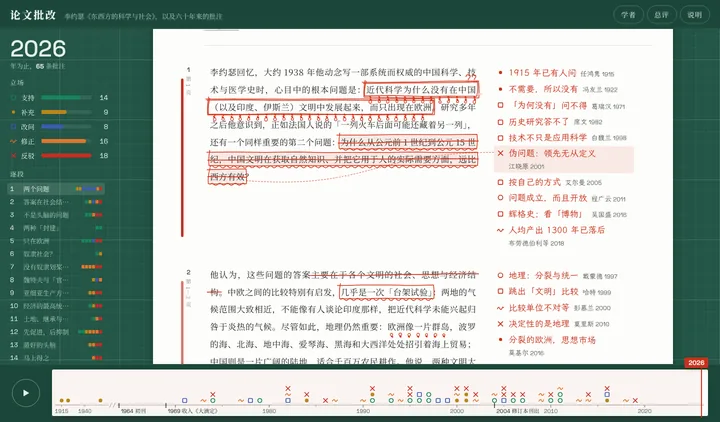 Shu·3Paper Review: Joseph Needham’s “Science and Society in East and West”The red-ink notes that 60 years of scholars have left on Needham’s most-cited paper
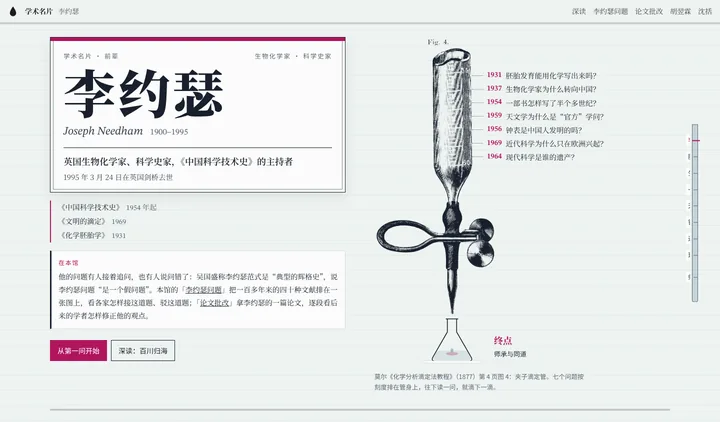 Shu·5Joseph Needham’s Scholar CardA burette, with seven questions dripping down its scale
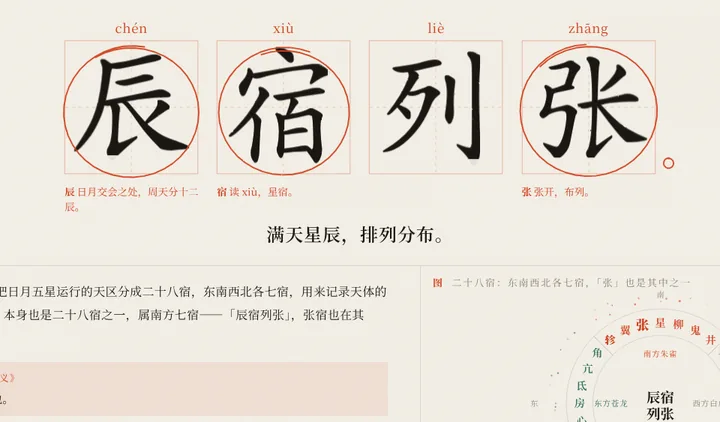 Shu·1The Thousand Character Classic: One Line, One SceneAll 250 lines written out and annotated, one by one; a panorama of the 1,000 characters, from which you can even assemble your name
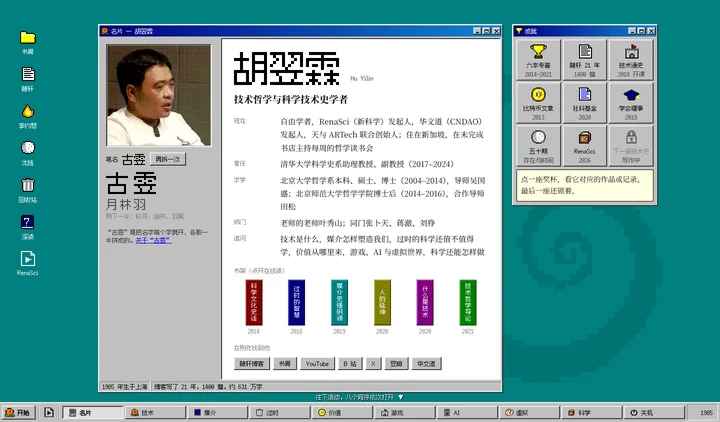 Shu·4Hu Yilin’s Scholar CardAn old Windows-style desktop where eight programs open one by one
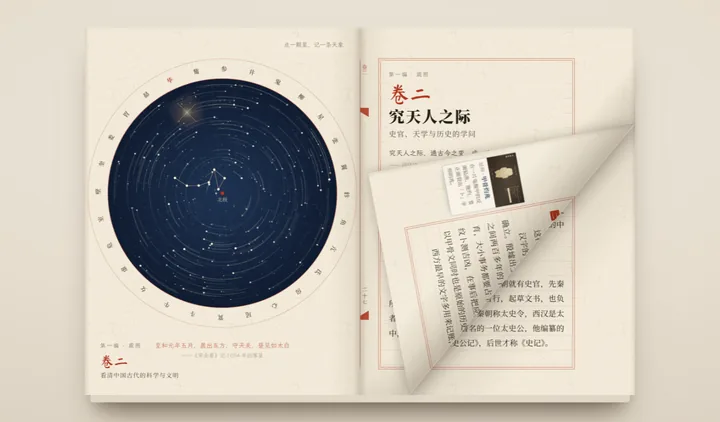 Shu·6Reviving Chinese Civilisation in the Age of TechnologySelected essays from Suixuan: a thread-bound book you can page through and annotate