Shu·3The Study
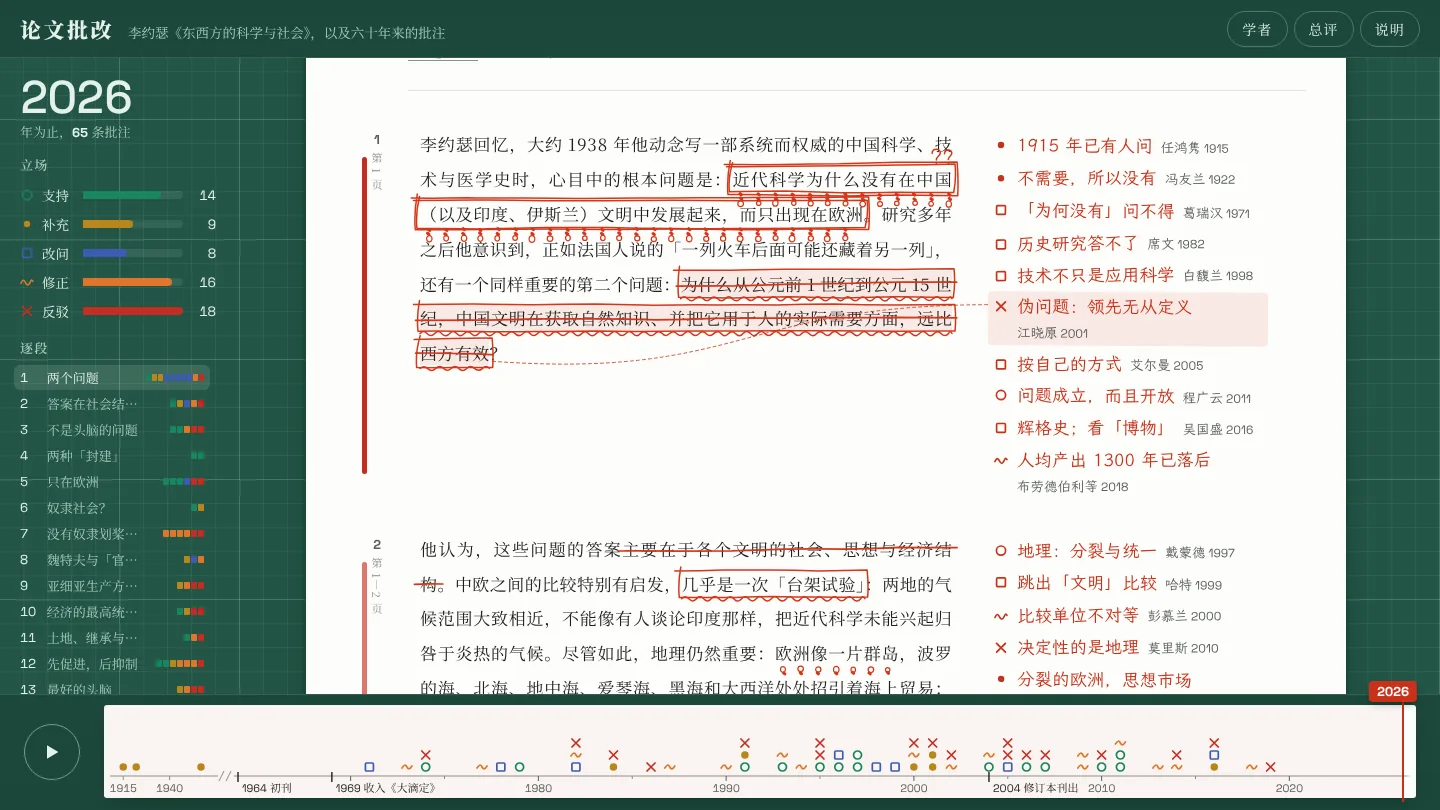
Paper Review: Joseph Needham’s “Science and Society in East and West”
The red-ink notes scholars have left over 60 years on Joseph Needham’s most-cited paper
- Accession no.
- Shu·3
- Location
- The Study
- Category
- Paper review
- Period
- Contemporary
- Directed by
- Hu Yilin
- Made by
- Claude Opus 5.5
- Similar commission
- from S$18.75
About the exhibit
The question “Why did modern science not arise in China?” was given its most-cited formulation in Joseph Needham’s 1964 paper “Science and Society in East and West”. He put it as two questions: why modern science arose only in Europe, and why, for more than a thousand years before that, China had been far more effective than the West at acquiring knowledge of nature and putting it to use. His answer was mainly social and economic: China’s “bureaucratic feudalism” at first favoured the growth and application of natural knowledge, but later held back capitalism and modern science. In 1964 the paper appeared in turn in The Science of Science, a volume in honour of J. D. Bernal, in the American journal Science & Society and in the history-of-science journal Centaurus, and in 1969 it was collected in The Grand Titration. The version the author revised in his lifetime was published in 2004 in Science and Civilisation in China, Volume 7, Part II.
Here the publicly available excerpt of the revised version from Cambridge University Press (pages 1–10, 15 paragraphs in all) is paraphrased paragraph by paragraph, with later scholars’ responses written in the margins. The notes come in five kinds: support, addition, correction, rebuttal, and “reframing”, for notes holding that a sentence asks the wrong question and should be put another way. The notes are densest around how the question is posed in paragraph 1: A. C. Graham and Nathan Sivin hold that “why not” is not a question historical research can answer, Jiang Xiaoyuan calls it a pseudo-question, and some scholars defend it. The speculation in paragraph 7 about slavery and labour-saving machinery, and the central explanation in paragraph 12, that bureaucratic feudalism first fostered and then held back science, have also drawn many corrections and rebuttals; on the role of the state, research on the Great Divergence even points the opposite way. The author revised himself too: in a footnote to the revised version, he concedes that “bureaucratic feudalism” would be better called “feudal bureaucratism”.
The summaries are paraphrases, not translations of the original; for the original, see the excerpt the publisher has made available. Every note gives the scholar, the year and the work, and both the bibliographic details and the arguments have been checked against descriptions by publishers, journals or reviews. Publications also included in the map of “The Needham Question” can be reached directly from the notes.
Sources and references
- Paper: Joseph Needham, “Science and Society in East and West”, 1964
- First published in a volume in honour of J. D. Bernal: Maurice Goldsmith & Alan Mackay (eds.), The Science of Science (London: Souvenir Press, 1964)
- Science & Society 28 (4) (1964): 385–408 (DOI 10.1177/003682376402800401)
- Centaurus 10 (3) (1964): 174–197 (DOI 10.1111/j.1600-0498.1965.tb00399.x)
- Collected in The Grand Titration: Science and Society in East and West (London: George Allen & Unwin, 1969): 190–217
- Revised version: Science and Civilisation in China, Vol. 7, Part II: General Conclusions and Reflections, ed. Kenneth Girdwood Robinson (Cambridge: Cambridge University Press, 2004), chapter 50, section (a)
- The publicly available excerpt (Cambridge University Press) that this work paraphrases: https://assets.cambridge.org/052108/7325/excerpt/0521087325_excerpt.pdf
- Ren Hongjun, “On the Reasons Why China Has No Science”, Science (Kexue), vol. 1, no. 1, 1915
- Fung Yu-lan (Feng Youlan), “Why China Has No Science—An Interpretation of the History and Consequences of Chinese Philosophy”, International Journal of Ethics 32 (3) (1922): 237–263 (DOI 10.1086/intejethi.32.3.2377487)
- Karl A. Wittfogel, Oriental Despotism: A Comparative Study of Total Power (New Haven: Yale University Press, 1957); for Needham’s review, see Science and Society 23 (1) (1959): 58–65
- A. C. Graham, “China, Europe, and the Origins of Modern Science: Needham’s The Grand Titration”, Asia Major, new series 16 (1971): 178–196
- Mark Elvin, The Pattern of the Chinese Past: A Social and Economic Interpretation (Stanford: Stanford University Press, 1973)
- Perry Anderson, Lineages of the Absolutist State (London: New Left Books, 1974), appended note “The ‘Asiatic Mode of Production’”
- Ray Huang & Joseph Needham, “The Nature of Chinese Society: A Technical Interpretation”, East and West, new series 24 (1974): 381–401
- G. William Skinner (ed.), The City in Late Imperial China (Stanford: Stanford University Press, 1977)
- Edward W. Said, Orientalism (New York: Pantheon Books, 1978)
- Huang Xianfan, “An Inquiry into the Absence of a Slave Society in Our Nation’s History” (1979), published in Journal of Guangxi Normal University, no. 2, 1979, according to Jiao Peimin, New Views on the Periodisation of Chinese History; Zhang Guangzhi, “A Brief Discussion of the Historical Position of Slavery”, Journal of Qinghai Normal College, no. 1, 1980
- Nathan Sivin, “Why the Scientific Revolution Did Not Take Place in China—or Didn’t It?”, Chinese Science 5 (1982): 45–66 (DOI 10.1163/26669323-00501006)
- Peter C. Perdue, “Water Control in the Dongting Lake Region during the Ming and Qing Periods”, The Journal of Asian Studies 41 (4) (1982): 747–765; see also his Exhausting the Earth: State and Peasant in Hunan, 1500–1850 (Cambridge, MA: Council on East Asian Studies, Harvard University, 1987) (DOI 10.2307/2055448)
- William T. Rowe, Hankow: Commerce and Society in a Chinese City, 1796–1889 (Stanford: Stanford University Press, 1984)
- Jin Guantao and Liu Qingfeng, Prosperity and Crisis (Changsha: Hunan People’s Publishing House, 1984)
- Robert P. Hymes, Statesmen and Gentlemen: The Elite of Fu-chou, Chiang-hsi, in Northern and Southern Sung (Cambridge: Cambridge University Press, 1986)
- Yu Ying-shih, Religious Ethics and the Merchant Spirit in Early Modern China (Taipei: Linking Publishing, 1987)
- Mark Edward Lewis, Sanctioned Violence in Early China (Albany: State University of New York Press, 1990) (https://www.sunypress.edu/p-752-sanctioned-violence-in-early-ch.aspx)
- Derk Bodde, Chinese Thought, Society, and Science: The Intellectual and Social Background of Science and Technology in Pre-modern China (Honolulu: University of Hawaii Press, 1991)
- Randall A. Dodgen, “Hydraulic Evolution and Dynastic Decline: The Yellow River Conservancy, 1796–1855”, Late Imperial China 12 (2) (1991): 36–63 (DOI 10.1353/late.1991.0009)
- Pierre-Étienne Will & R. Bin Wong, Nourish the People: The State Civilian Granary System in China, 1650–1850 (Ann Arbor: University of Michigan Center for Chinese Studies, 1991) (DOI 10.3998/mpub.19044)
- Toby E. Huff, The Rise of Early Modern Science: Islam, China, and the West (Cambridge: Cambridge University Press, 1993)
- M. J. T. Lewis, “The Origins of the Wheelbarrow”, Technology and Culture 35 (3) (1994): 453–475 (DOI 10.1353/tech.1994.0036)
- Justin Yifu Lin, “The Needham Puzzle: Why the Industrial Revolution Did Not Originate in China”, Economic Development and Cultural Change 43 (2) (1995): 269–292 (DOI 10.1086/452150)
- Alastair Iain Johnston, Cultural Realism: Strategic Culture and Grand Strategy in Chinese History (Princeton: Princeton University Press, 1995) (DOI 10.1515/9780691213149)
- Xi Zezong, “A Dialogue on the ‘Needham Puzzle’ and the Greek Origins of Modern Science”, Science (Kexue), vol. 48, no. 4 (1996): 32–34
- Steven Shapin, The Scientific Revolution (Chicago: University of Chicago Press, 1996)
- Jared Diamond, Guns, Germs, and Steel: The Fates of Human Societies (New York: W. W. Norton, 1997)
- R. Bin Wong, China Transformed: Historical Change and the Limits of European Experience (Ithaca: Cornell University Press, 1997) (DOI 10.7591/9781501736049)
- Francesca Bray, “Technics and Civilization in Late Imperial China: An Essay in the Cultural History of Technology”, Osiris 13 (1998): 11–33; reprinted in 2019 in the open-access volume The History of Science in a World of Readers (Berlin: Edition Open Access) (DOI 10.1086/649278)
- Roger Hart, “Beyond Science and Civilization: A Post-Needham Critique”, East Asian Science, Technology, and Medicine 16 (1999): 88–114 (DOI 10.1163/26669323-01601006)
- Kenneth Pomeranz, The Great Divergence: China, Europe, and the Making of the Modern World Economy (Princeton: Princeton University Press, 2000)
- Kevin Greene, “Technological Innovation and Economic Progress in the Ancient World: M. I. Finley Re-Considered”, The Economic History Review 53 (1) (2000): 29–59 (DOI 10.1111/1468-0289.00151)
- Benjamin A. Elman, A Cultural History of Civil Examinations in Late Imperial China (Berkeley: University of California Press, 2000) (DOI 10.1525/9780520921474)
- Jiang Xiaoyuan, “Joseph Needham, Misread by the Chinese: For the Centenary of His Birth”, Journal of Dialectics of Nature, vol. 23, no. 1 (2001) (https://www.aisixiang.com/data/104650.html)
- Robin D. S. Yates, “Slavery in Early China: A Socio-Cultural Approach”, Journal of East Asian Archaeology 3 (1) (2001): 283–331 (DOI 10.1163/156852301100402723)
- Donald B. Wagner, The State and the Iron Industry in Han China (Copenhagen: Nordic Institute of Asian Studies, 2001) (https://donwagner.dk/)
- Andrew Wilson, “Machines, Power and the Ancient Economy”, The Journal of Roman Studies 92 (2002): 1–32 (DOI 10.2307/3184857)
- Philip C. C. Huang, “Development or Involution in Eighteenth-Century Britain and China? A Review of Kenneth Pomeranz’s The Great Divergence”, The Journal of Asian Studies 61 (2) (2002): 501–538 (DOI 10.2307/2700299)
- Pamela H. Smith, The Body of the Artisan: Art and Experience in the Scientific Revolution (Chicago: University of Chicago Press, 2004)
- Joseph Needham, Science and Civilisation in China, Vol. 7, Part II: General Conclusions and Reflections, ed. Kenneth Girdwood Robinson (Cambridge: Cambridge University Press, 2004), p. 5, note 15 (https://assets.cambridge.org/052108/7325/excerpt/0521087325_excerpt.pdf)
- Benjamin A. Elman, On Their Own Terms: Science in China, 1550–1900 (Cambridge, MA: Harvard University Press, 2005)
- C. N. Yang, “The Influence of the Book of Changes on Chinese Culture”, Chinese Journal of Nature, vol. 27, no. 1 (2005): 1–3
- Madeleine Zelin, The Merchants of Zigong: Industrial Entrepreneurship in Early Modern China (New York: Columbia University Press, 2005)
- David S. Landes, “Why Europe and the West? Why Not China?”, Journal of Economic Perspectives 20 (2) (2006): 3–22 (DOI 10.1257/jep.20.2.3)
- Joanna Waley-Cohen, The Culture of War in China: Empire and the Military under the Qing Dynasty (London: I. B. Tauris, 2006)
- Feng Tianyu, An Inquiry into “Feudalism” (Wuhan: Wuhan University Press, 2007)
- Kapil Raj, Relocating Modern Science: Circulation and the Construction of Knowledge in South Asia and Europe, 1650–1900 (Basingstoke: Palgrave Macmillan, 2007)
- Robert C. Allen, The British Industrial Revolution in Global Perspective (Cambridge: Cambridge University Press, 2009)
- Nicola Di Cosmo (ed.), Military Culture in Imperial China (Cambridge, MA: Harvard University Press, 2009)
- Ian Morris, Why the West Rules—For Now (New York: Farrar, Straus and Giroux, 2010)
- H. Floris Cohen, How Modern Science Came into the World: Four Civilizations, One 17th-Century Breakthrough (Amsterdam: Amsterdam University Press, 2010)
- Cheng Guangyun, “The Generalised Needham Question: An Endless Enumeration—A Rebuttal of the Claim That the Needham Question Is Finished”, Social Science Journal, no. 1, 2011 (https://www.aisixiang.com/data/51545.html)
- Toby E. Huff, Intellectual Curiosity and the Scientific Revolution: A Global Perspective (Cambridge: Cambridge University Press, 2011)
- Jean-Laurent Rosenthal & R. Bin Wong, Before and Beyond Divergence: The Politics of Economic Change in China and Europe (Cambridge, MA: Harvard University Press, 2011) (DOI 10.4159/harvard.9780674061293)
- Benjamin A. Elman, Civil Examinations and Meritocracy in Late Imperial China (Cambridge, MA: Harvard University Press, 2013) (DOI 10.4159/harvard.9780674726048)
- Tuan-Hwee Sng, “Size and Dynastic Decline: The Principal-Agent Problem in Late Imperial China, 1700–1850”, Explorations in Economic History 54 (2014): 107–127 (DOI 10.1016/j.eeh.2014.05.002)
- Loren Brandt, Debin Ma & Thomas G. Rawski, “From Divergence to Convergence: Reevaluating the History Behind China’s Economic Boom”, Journal of Economic Literature 52 (1) (2014): 45–123 (DOI 10.1257/jel.52.1.45)
- Wu Guosheng, What Is Science? (Guangzhou: Guangdong People’s Publishing House, 2016); Zang Jixian and Zhu Fan, “Interview with Peking University Professor Wu Guosheng: Ancient China Had No Mathematical Science, and That Was Its Fate”, The Paper, 3 September 2016; Wen Xinhong, “Ancient China Had ‘Science’”, China Science Daily, 23 December 2016 (https://m.thepaper.cn/newsDetail_forward_1523638)
- Joel Mokyr, A Culture of Growth: The Origins of the Modern Economy (Princeton: Princeton University Press, 2016)
- Ling Zhang, The River, the Plain, and the State: An Environmental Drama in Northern Song China, 1048–1128 (Cambridge: Cambridge University Press, 2016)
- Stephen Broadberry, Hanhui Guan & David Daokui Li, “China, Europe, and the Great Divergence: A Study in Historical National Accounting, 980–1850”, The Journal of Economic History 78 (4) (2018): 955–1000 (DOI 10.1017/S0022050718000529)
- Debin Ma & Jared Rubin, “The Paradox of Power: Principal-Agent Problems and Administrative Capacity in Imperial China (and Other Absolutist Regimes)”, Journal of Comparative Economics 47 (2) (2019): 277–294 (DOI 10.1016/j.jce.2019.03.002)
- Florence Hsia & Dagmar Schäfer, “History of Science, Technology, and Medicine: A Second Look at Joseph Needham”, Isis 110 (1) (2019): 94–99 (DOI 10.1086/702895)
- Records of the Grand Historian: “Biographies of Li Sheng and Lu Jia” (Lu Jia: “You won the empire on horseback, but can you govern it on horseback?”)
Want something like this? See how to commission a talk website or a literature review →
Spotted an error in the history, data or sources? Please write to [email protected].
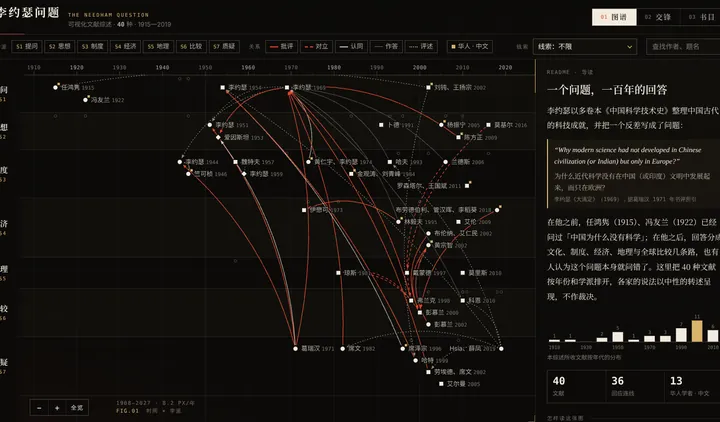 Shu·2The Needham QuestionA visual literature review: why modern science did not arise in China, and whether the question should be asked this way
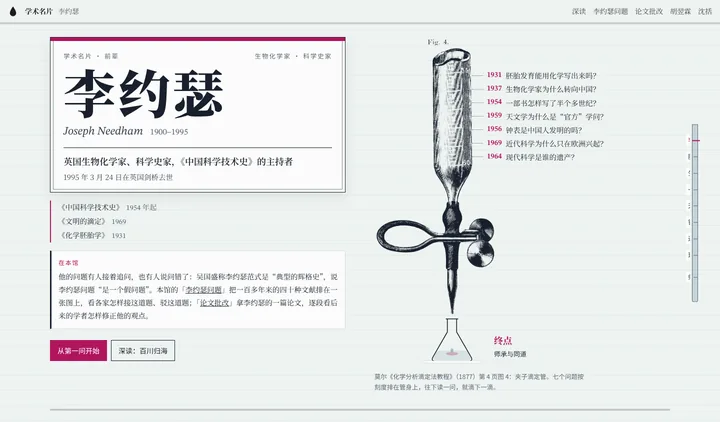 Shu·5Joseph Needham’s Scholar CardA burette, with seven questions dripping down its scale
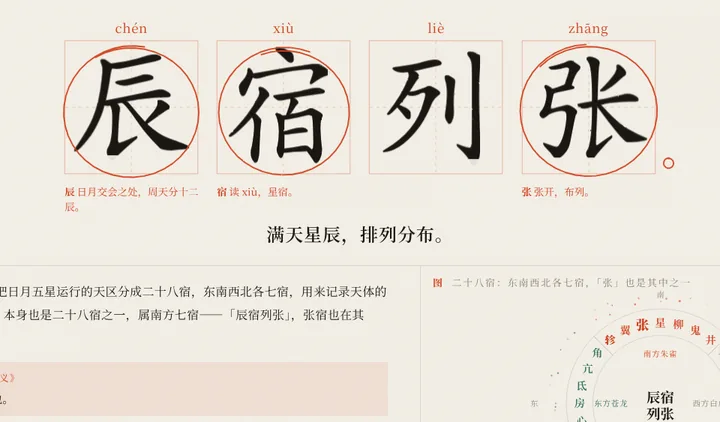 Shu·1The Thousand Character Classic: One Line, One SceneAll 250 lines written out and annotated, one by one; a panorama of the 1,000 characters, from which you can even assemble your name
 Shu·4Hu Yilin’s Scholar CardAn old Windows-style desktop where eight programs open one by one
 Shu·6Reviving Chinese Civilisation in the Age of TechnologySelected essays from Suixuan: a thread-bound book you can page through and annotate