Shu·5The Study
Joseph Needham’s Scholar Card
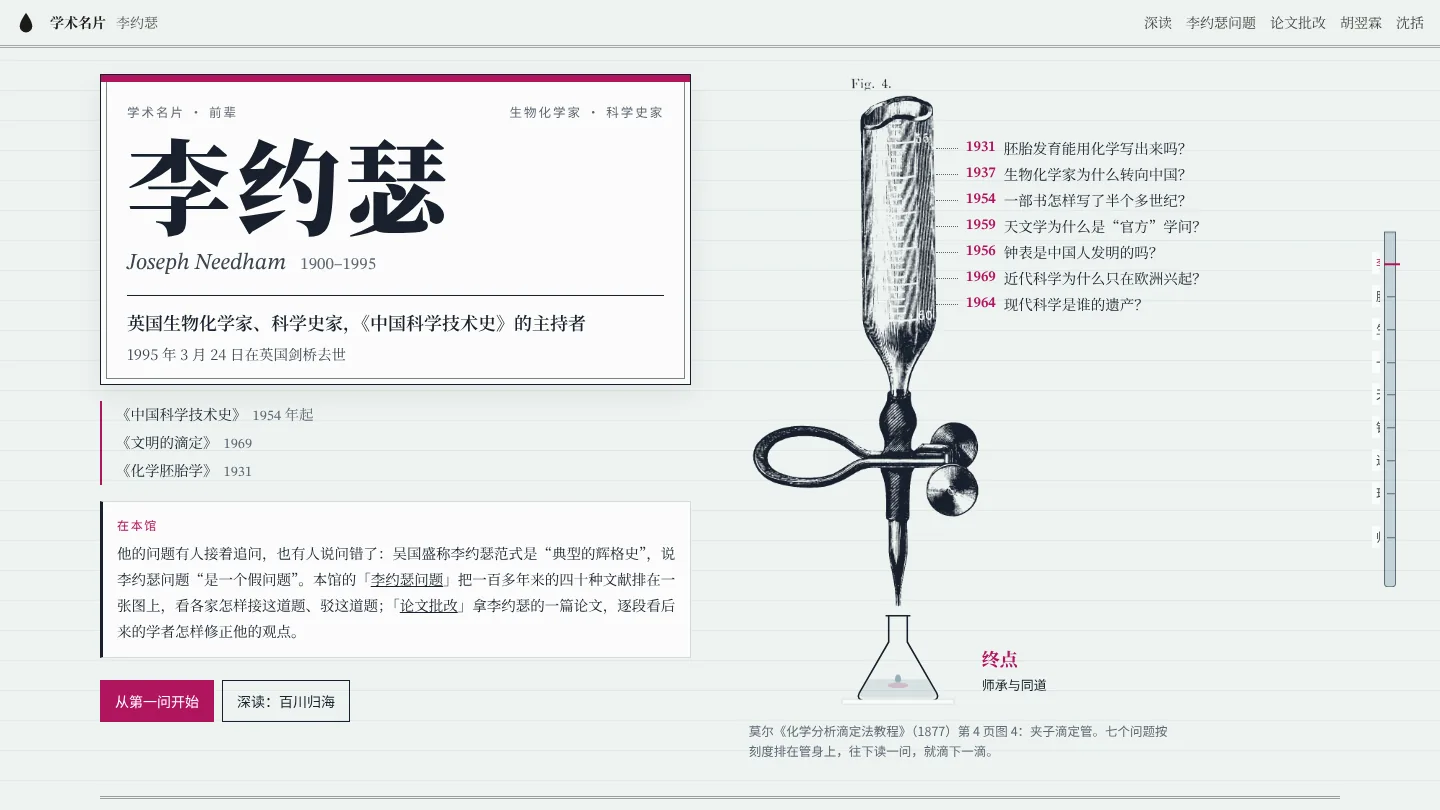
A burette, with seven questions dripping down its scale
- Accession no.
- Shu·5
- Location
- The Study
- Period
- Modern to contemporary
- Directed by
- Hu Yilin
- Made by
- Claude Opus 5.5
- Similar commission
- from S$18.75
About the exhibit
Joseph Needham (1900–1995) was a British biochemist and historian of science. In the first half of his life he worked on the chemistry of embryonic development, and in 1931 he published Chemical Embryology in three volumes. In his thirties he met several young Chinese scientists who had come to Cambridge to do research, and from then on he turned to China; from 1943 to 1946 he ran the Sino-British Science Co-operation Office in Chongqing. From 1954 Science and Civilisation in China, the series he led, came out book by book; by 2015 there were 25. The question he pursued — why modern science arose only in Europe — came to be called “the Needham Question”.
The card curates his ideas and achievements through seven questions: Can embryonic development be written in chemical terms? Why did a biochemist turn to China? How did one book come to be written over more than half a century? Why was astronomy an “official” science? Did the Chinese invent the clock? Why did modern science arise only in Europe? Whose legacy is modern science? Each question comes with plates from the time, a line in his own words and his key works. Some have taken his question further; others say it was the wrong question: Wu Guosheng calls the Needham paradigm “typical Whig history” and says that the Needham Question “is a pseudo-question”.
Elsewhere in the museum, “The Needham Question” sets out on a single map 40 publications that have answered the question over more than a century, and “Paper Review” takes his most-cited paper and shows, paragraph by paragraph, how later scholars have corrected his views. The in-depth page, A Hundred Rivers to the Sea, is his academic biography in nine sections, with notes giving the source of every point.
Sources and references
- Needham Research Institute, “Publications: Science and Civilisation in China Series” (list of published volumes and parts), institute website, accessed October 2026. https://www.nri.cam.ac.uk/publications/
- Needham Research Institute, “Joseph Needham CH FRS FBA (1900–1995)”, institute website, accessed October 2026. https://www.nri.org.uk/joseph-needham/
- Encyclopaedia Britannica, “Joseph Needham”, accessed October 2026. https://www.britannica.com/biography/Joseph-Needham
- Joseph Needham, Chemical Embryology, vol. 1, Cambridge University Press, 1931 (dedication, epigraph, introduction p. 1, preliminary note to Part II pp. 41–43, plate I; from the copy on archive.org). https://archive.org/details/chemicalembryolo01need
- Joseph Needham, Time: The Refreshing River (Essays and Addresses, 1932–1942), London: George Allen & Unwin, 1943 (contents and dedication). https://archive.org/details/timerefreshingri00need
- Wu Guosheng, “Towards Research on the History of Early Modern Western Science” (written for the 50th anniversary of the Institute for the History of Natural Sciences, Chinese Academy of Sciences, c. 2007), reposted on Aisixiang. https://www.aisixiang.com/data/17398.html
- Henry Holorenshaw (a pen name of Joseph Needham), “The Making of an Honorary Taoist”, in Mikuláš Teich and Robert Young (eds), Changing Perspectives in the History of Science: Essays in Honour of Joseph Needham, London: Heinemann, 1973 (pieced together sentence by sentence through full-text search on archive.org). https://archive.org/details/changingperspect0000miku
- Needham Research Institute, “Joseph Needham in China and Korea, 1952”, institute website, accessed October 2026. https://www.nri.cam.ac.uk/joseph-needham/joseph-needham-in-china-and-korea/
- History of Science Society, “The Sarton Medal” (list of past recipients), accessed October 2026. https://hssonline.org/page/sartonmedal
- Wikipedia, “Joseph Needham” (English Wikipedia; for the years of his election to the British Academy and his appointment as a Companion of Honour), accessed October 2026. https://en.wikipedia.org/wiki/Joseph_Needham
- J. B. Gurdon and Barbara Rodbard, “Joseph Needham, C.H. 9 December 1900 — 24 March 1995”, Biographical Memoirs of Fellows of the Royal Society, vol. 46, pp. 365–376, 2000 (abstract). https://doi.org/10.1098/rsbm.1999.0091
- F. H. King, Farmers of Forty Centuries, or Permanent Agriculture in China, Korea and Japan, Madison, 1911, p. 178, fig. 96. https://archive.org/details/farmersoffortyce00kinguoft
- Royal Society archives, “Needham, Joseph: certificate of election to the Royal Society” (EC/1941/11), 20 March 1941. https://catalogues.royalsociety.org/CalmView/Record.aspx?src=CalmView.Catalog&id=EC%2f1941%2f11
- Joseph Needham, Biochemistry and Morphogenesis, Cambridge University Press, 1942 (archive.org catalogue record). https://archive.org/details/biochemistrymorp0000need
- Needham Research Institute, “Joseph Needham: Capturing Wartime Moments”, institute website, accessed October 2026. https://www.nri.cam.ac.uk/joseph-needham/wartime-china/
- Joseph Needham (with the research assistance of Wang Ling), Science and Civilisation in China, vol. 1, Introductory Orientations, Cambridge University Press, 1954, author’s preface (from full-text search on archive.org). https://archive.org/details/sciencecivilisat0001need
- Joseph Needham and Dorothy Needham (eds), Joseph Needham’s Travels (Science Outpost and Chinese Science in one volume), Chinese translation by Yu Tingming et al., Guizhou People’s Publishing House, 1999; Douban Books entry. https://book.douban.com/subject/1063321/
- Joseph Needham, Science and Society in Ancient China (Conway Memorial Lecture, given at Conway Hall, London, on 12 May 1947), London: Watts, 1947 (opening and closing passages). https://archive.org/details/sciencesocietyin00need
- Jiang Xiaoyuan, “Joseph Needham, Misread by the Chinese: For the Centenary of His Birth”, Journal of Dialectics of Nature, vol. 23, no. 1, 2001; reposted on Aisixiang. https://www.aisixiang.com/data/104650.html
- Joseph Needham, Science and Civilisation in China, vol. 2, History of Scientific Thought, Chinese translation by He Zhaowu et al., Science Press and Shanghai Classics Publishing House, 1990; Douban Books entry. https://book.douban.com/subject/2221665/
- Wen Xinhong, “Ancient China Had ‘Science’” (interview with Wu Guosheng), China Science Daily, 23 December 2016; reposted on Tsinghua News. https://www.tsinghua.edu.cn/info/1182/45102.htm
- Joseph Needham (with the research assistance of Wang Ling), Science and Civilisation in China, vol. 3, Mathematics and the Sciences of the Heavens and the Earth, Cambridge University Press, 1959, pp. 171, 189, 425, 427–429. https://archive.org/details/cftri.9621sciencecivilisat0000jose
- Jiang Xiaoyuan, “Heaven’s Will and Human Affairs: The Past and Present of Astrological Culture”, New Vision (Xin Shixian), no. 5, 2013; reposted on Aisixiang. https://www.aisixiang.com/data/104958.html
- Joseph Needham, Wang Ling and Derek J. de Solla Price, Heavenly Clockwork: The Great Astronomical Clocks of Medieval China, Cambridge University Press, 1960 (introduction, caption to fig. 1 and chapter 1; from full-text search on archive.org). https://archive.org/details/heavenlyclockwor0000jose
- Joseph Needham, The Grand Titration: Science and Society in East and West, Chinese translation by Zhang Butian, The Commercial Press, 2016 (History of Science Translation Series, with a preface to the Chinese edition by Liu Dun); the translated passages quoted follow the excerpts posted on Douban Books, with their page numbers. https://book.douban.com/subject/26865821/
- He Rui and Jin Yao, “Tsinghua Science Museum Tops Out This Year; ‘World’s Earliest Astronomical Clock’ to Go on Show”, Beijing Daily app, 15 September 2025; reposted on Tsinghua News. https://www.tsinghua.edu.cn/info/1182/121336.htm
- Joseph Needham, Wang Ling and Derek J. Price, “Chinese Astronomical Clockwork”, Nature, vol. 177, pp. 600–602, 1956. https://doi.org/10.1038/177600a0
- Xu Siyuan, Wang Yuheng, Tang Xiaoqiang and Wang Zheran, “Force Analysis of Two Reconstruction Schemes for the Driving Wheel of the Water-Powered Astronomical Clock Tower”, Journal of Tsinghua University (Science and Technology), no. 3, 2024, pp. 545–551; abstract from CQVIP. https://www.cqvip.com/search?k=2%E7%A7%8D%E6%B0%B4%E8%BF%90%E4%BB%AA%E8%B1%A1%E5%8F%B0%E6%9E%A2%E8%BD%AE%E5%A4%8D%E5%8E%9F%E6%96%B9%E6%A1%88%E7%9A%84%E5%8F%97%E5%8A%9B%E5%88%86%E6%9E%90
- Joseph Needham, The Grand Titration: Science and Society in East and West, London: George Allen & Unwin, 1969 (introduction and chapters 1, 2 and 6; chapter 1 first appeared in A. C. Crombie (ed.), Scientific Change, 1963, as a paper given at the 1961 Oxford symposium on the history of science; chapter 2 first appeared in The Legacy of China, Oxford, 1964; chapter 6 first appeared in Centaurus, vol. 10, 1964; from full-text search on archive.org). https://archive.org/details/grandtitrationsc0000need
- Department of the History of Science, Tsinghua University, “Zhang Butian” (faculty page, now listed under “Former Faculty”), accessed October 2026. https://www.dhs.tsinghua.edu.cn/?p=695
- Wu Guosheng, “How Much Do We Misunderstand Science? Transcript of Wu Guosheng’s Talk at the Tsinghua Humanities Forum” (30 October 2018), reposted on Aisixiang. https://www.aisixiang.com/data/113164.html
- Wu Guosheng, What Is Science?, Guangdong People’s Publishing House, 2016, chapter 6, “Science in Traditional China” (table of contents); Douban Books entry. https://book.douban.com/subject/26852425/
- Wu Guosheng, From History into Thought, Beijing Normal University Press, 2018, table of contents; Douban Books entry. https://book.douban.com/subject/27185139/
- Huang Yuhan, “East–West Questions · In Depth | Liu Dun: Revisiting the ‘Needham Puzzle’ — Why Do the Great Changes of Our Century Call All the More for ‘a Sea That Takes In a Hundred Rivers’?”, China News Service, 13 October 2022. https://www.chinanews.com.cn/gn/2022/10-13/9872514.shtml
- Liu Shengli, “Historiographical Change in General Histories of Chinese Science and Technology in the Post-Needham Era”, Science & Culture Review, no. 1, 2017, pp. 25–35 (abstract). https://kxwp.cbpt.cnki.net/portal/journal/portal/client/paper/f3d32a430d38e007415cd0101d01c921
- Hu Yilin, Outdated Wisdom: Fifteen Lectures on the General History of Science (revised edition), Shanghai Educational Publishing House, 2020, lecture 6, “Standing Apart: Special Topics in the History of Chinese Science”, section 1, “The Needham Question”; full text online at Suixuan Books. https://yilinhut.net/read/ow-08
- Needham Research Institute, “Lu Gwei-djen 魯桂珍”, institute website, accessed October 2026. https://www.nri.cam.ac.uk/lu-gwei-djen/
- Xu Liangying, “Was Einstein Wrong, or Was Needham? A Rejoinder to Mr Xi Zezong”, reposted on Aisixiang. https://www.aisixiang.com/data/65954.html
- Department of the History of Science, Tsinghua University, Department Yearbook 2025 (no. 9), pp. 186–188. https://www.dhs.tsinghua.edu.cn/wp-content/uploads/2026/01/2026011600290554.pdf
- Image on the card: Mohr, Lehrbuch der chemisch-analytischen Titrirmethode, p. 4, fig. 4: a pinchcock burette, 1877 (Internet Archive, public domain) https://archive.org/details/b28122756/page/n31
- Image on the card: copper engraving of a chick embryo at 19–20 days, 1625 (Wellcome Collection, public domain) https://wellcomecollection.org/works/c6rz4n4u
- Image on the card: King, Farmers of Forty Centuries, fig. 96: four incubators in a Chinese hatchery, 1911 (Internet Archive, public domain) https://archive.org/details/farmersoffortyce00kinguoft/page/178
- Image on the card: general view of the water-powered astronomical clock tower in Su Song’s New Design for an Armillary Clock (Xin Yixiang Fayao), Northern Song, written in 1092, after the woodblock edition reproduced in Science and Civilisation in China, vol. 4, part 2, p. 451 (Wikimedia Commons, public domain) https://commons.wikimedia.org/wiki/File:Clock_Tower_from_Su_Song%27s_Book_desmear.JPG
- Latin typeface: STIX Two Text (SIL OFL 1.1)
Want something like this? See how to commission a talk website or a literature review →
Spotted an error in the history, data or sources? Please write to [email protected].
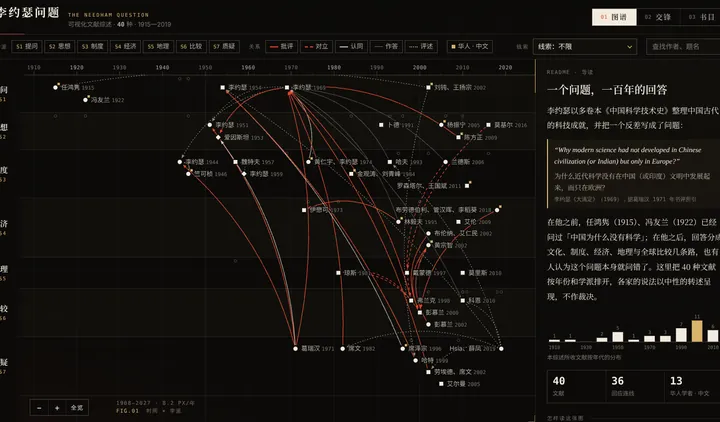 Shu·2The Needham QuestionA visual literature review: why modern science did not arise in China, and whether the question should be asked this way
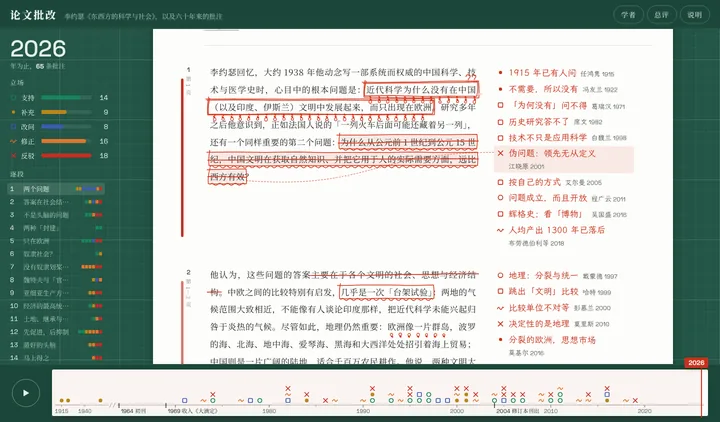 Shu·3Paper Review: Joseph Needham’s “Science and Society in East and West”The red-ink notes that 60 years of scholars have left on Needham’s most-cited paper
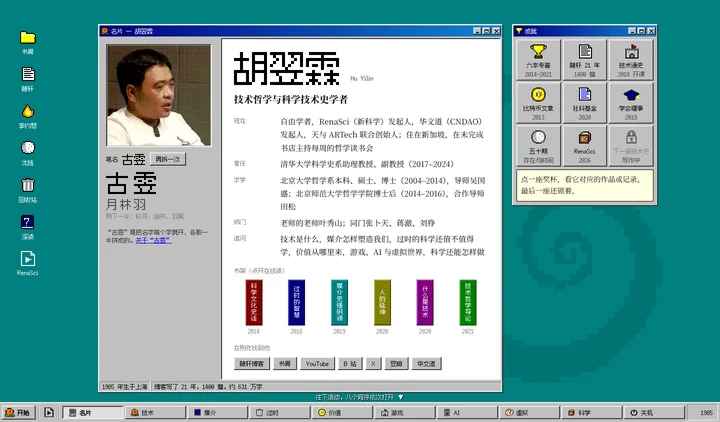 Shu·4Hu Yilin’s Scholar CardAn old Windows-style desktop where eight programs open one by one
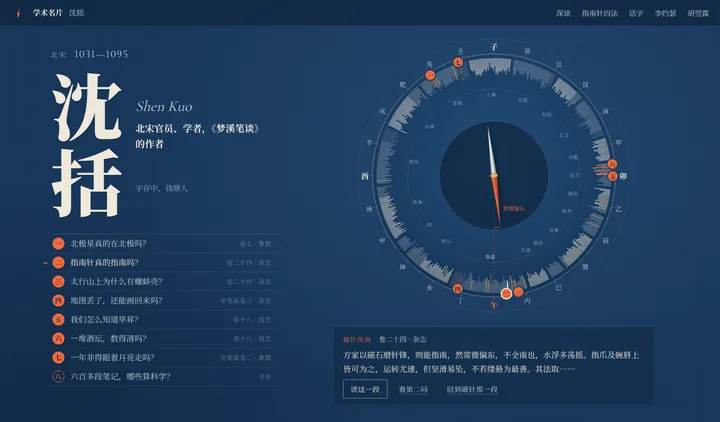 Ya·3Shen Kuo’s Scholar CardAlways Slightly East: turn a compass laid out from the Dream Pool Essays
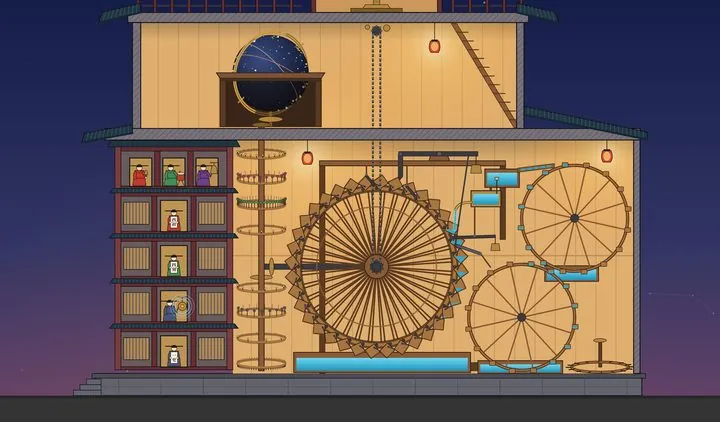 Ya·6The Water-Powered Astronomical Clock TowerA cutaway look at an astronomical clock tower driven by water
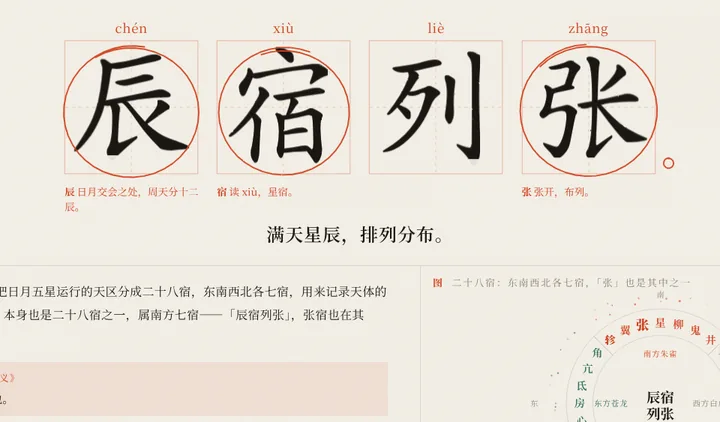 Shu·1The Thousand Character Classic: One Line, One SceneAll 250 lines written out and annotated, one by one; a panorama of the 1,000 characters, from which you can even assemble your name