Tian·1Questions to Heaven: Astronomy and Calendars
Cutting the Circle
How Liu Hui closed in on π, one cut at a time
- Accession no.
- Tian·1
- Category
- Interactive works
- Period
- Wei–Jin to Northern and Southern Dynasties
- Directed by
- Hu Yilin
- Made by
- Claude Opus 5.5
- Similar commission
- from S$18.75
About the exhibit
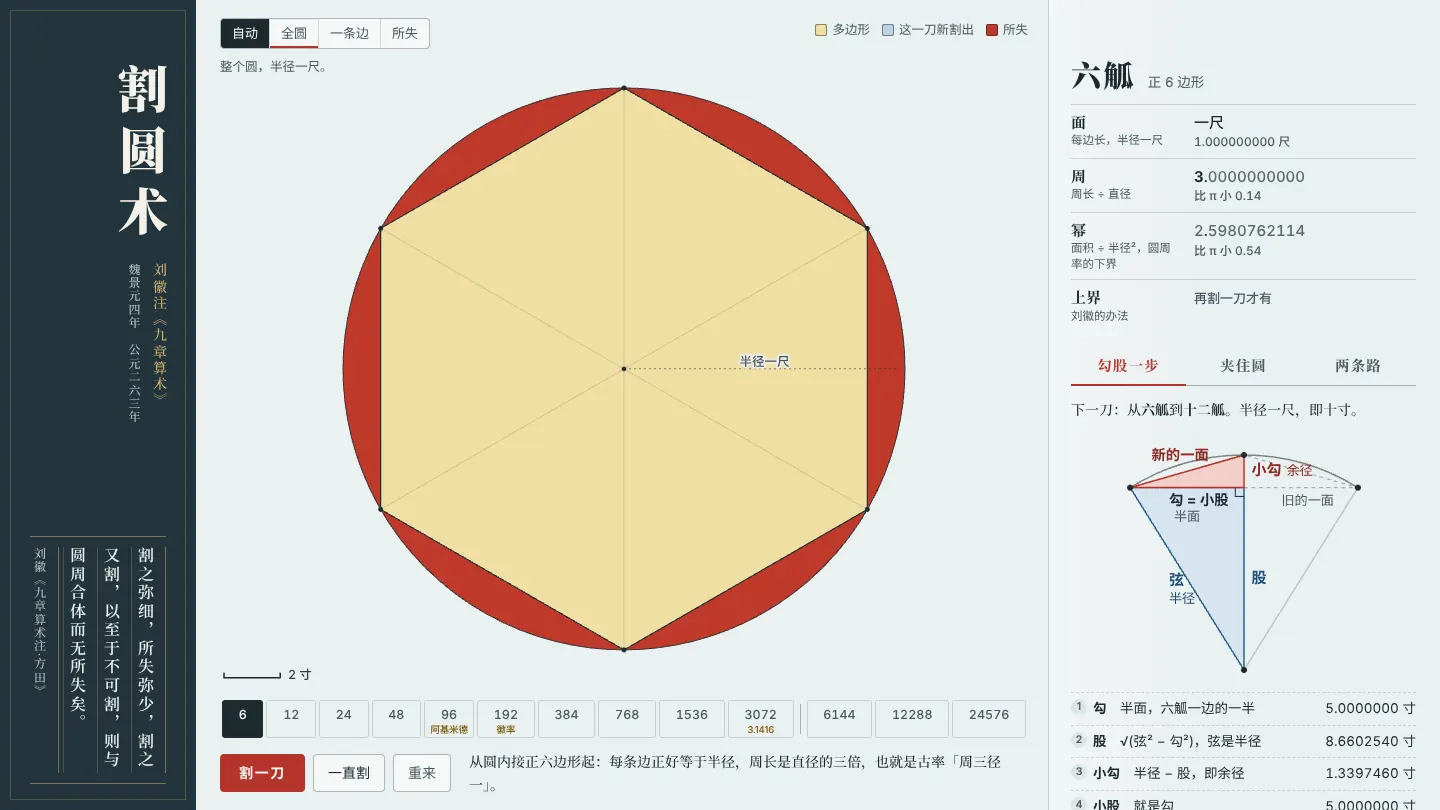
The Nine Chapters on the Mathematical Art finds the area of a circle by the rule “half the circumference times half the diameter gives the area in square bu”. In the fourth year of the Jingyuan era of the Wei (263), Liu Hui wrote a commentary on the book, setting out both to show why this rule holds and to find a more accurate value of π. Starting from a regular hexagon inscribed in the circle, he used the gougu (right-triangle) rule to derive from one side the side of a polygon with twice as many sides, and went on cutting up to a polygon of 192 sides. He also showed that the area of the circle must be greater than that of the 192-sided polygon, but less than that area plus one “difference area” (chami); on this basis he took π as 157/50, a value later called the “Hui ratio”. The commentary goes on to obtain 3927/1250, that is 3.1416, from a polygon of 3,072 sides; scholars disagree over whether this passage is Liu Hui’s own.
More than 500 years earlier, Archimedes had taken another route in Measurement of a Circle: he trapped the circumference between the perimeters of inscribed and circumscribed regular polygons and, cutting to 96 sides, obtained 223/71 < π < 22/7. One compared perimeters and the other areas, yet both used the same set of side lengths and reached almost the same bounds. About 200 years after Liu Hui, Zu Chongzhi of the Southern Dynasties narrowed π to between 3.1415926 and 3.1415927, and gave the “approximate ratio” 22/7 and the “close ratio” 355/113, as recorded in the Treatise on Harmonics and the Calendar of the Book of Sui; his own book, the Zhui Shu, has long been lost, and his exact method can only be guessed at today. In 1424, al-Kashi of Samarkand used a polygon of 3×2²⁸ sides to calculate π to 16 decimal places. Closing in on π is a road that many civilisations have travelled, each on its own.
How this work was made
All the values on the page are calculated live. The radius is taken as 1 chi (10 cun). With each cut, following Liu Hui’s steps, half of the old side (the gou, one leg) and the radius (the xian, the hypotenuse) give the gu, the other leg; the radius minus the gu gives the small gou; and the small gou and the small gu then give the new side. The area is found by the rule “one side times the radius” and cross-checked against values computed directly with trigonometric functions. The circle and polygons are drawn with true geometry; when “what is lost” is too thin to see with the naked eye, the picture can switch to a vertically magnified view, with the magnification always shown; this view is illustrative. Liu Hui’s fractions for the 192-sided polygon and the results of Archimedes and Zu Chongzhi are based on the sources below.
Sources and references
- Liu Hui, Commentary on the Nine Chapters on the Mathematical Art, “Field Measurement”, note on the rule for circular fields
- Nine Chapters on the Mathematical Art, “Field Measurement”, rule for circular fields
- Book of Sui, Treatise on Harmonics and the Calendar, entry on Zu Chongzhi
- Archimedes, Measurement of a Circle
- Al-Kashi, Treatise on the Circumference (1424)
Want something like this? See how to commission an interactive teaching page →
Spotted an error in the history, data or sources? Please write to [email protected].
 Xu·1Heavenly CraftSix hands-on exhibits of ancient science and technology
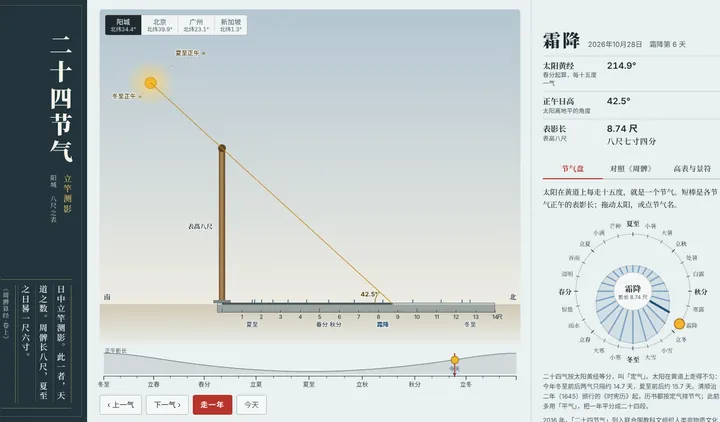 Tian·2The 24 Solar Terms: Measuring the Gnomon’s ShadowAn 8-chi gnomon and a year of shadows
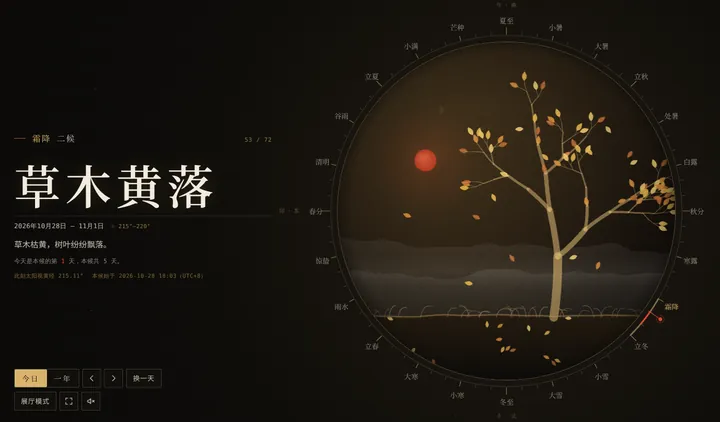 Tian·4The 72 PentadsFive days to a pentad: 72 generated vignettes cycling through a whole year
 Tian·5Guo Shoujing and the Simplified ArmillaAn armillary sphere split into two instruments that do not block each other; turn the double declination ring to sight a star