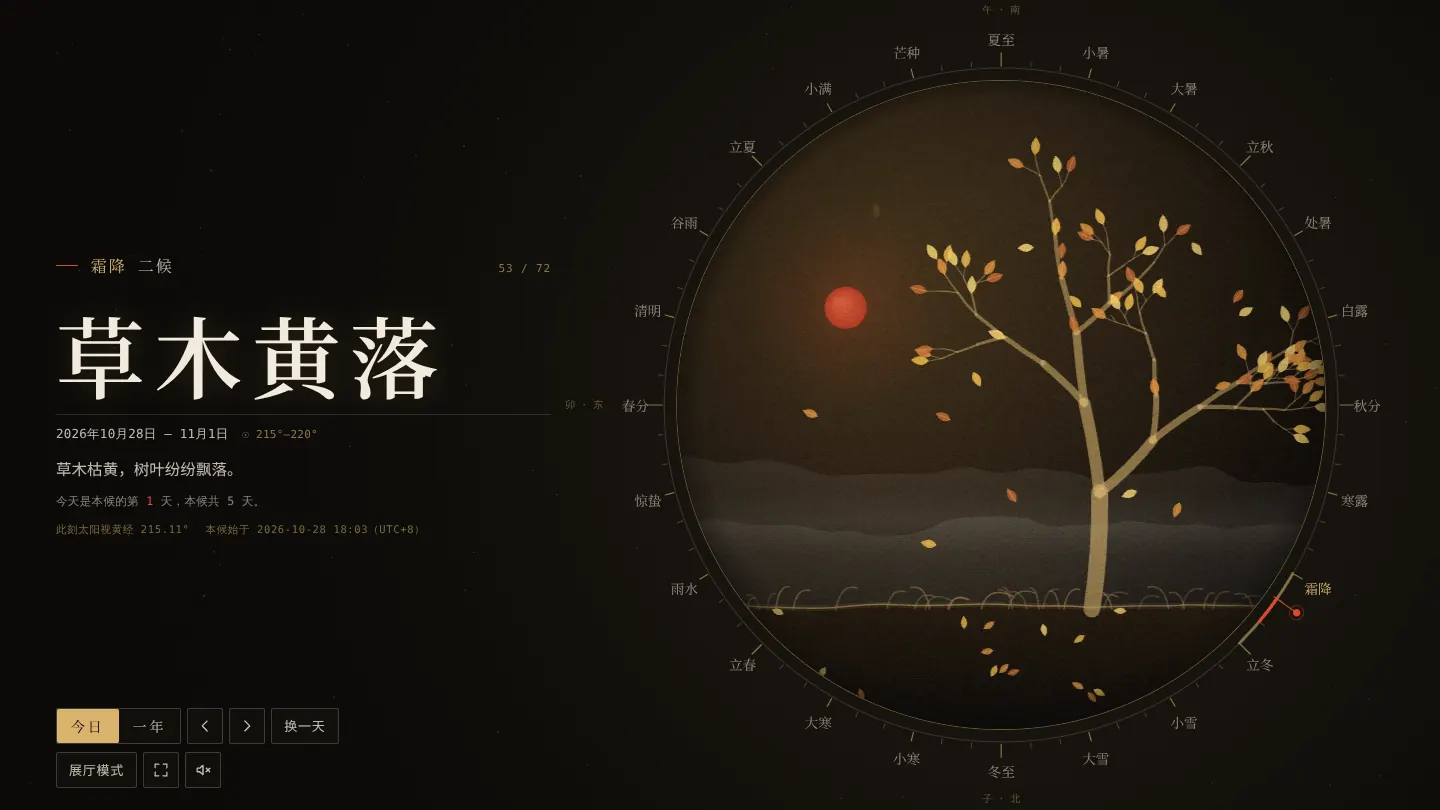
Tian·4Questions to Heaven: Astronomy and Calendars
The 72 Pentads
Five days to a pentad: 72 generated vignettes cycling through a whole year
- Accession no.
- Tian·4
- Category
- Motion and generative art
- Period
- Pre-Qin to Yuan
- Directed by
- Hu Yilin
- Made by
- Claude Opus 5.5
- Similar commission
- from S$18.75
About the exhibit
Each of the 24 solar terms is divided into three pentads, making 72 pentads in a year. Each pentad takes its name from a sign of the season in nature: “The east wind melts the ice”, “Peach trees begin to blossom”, “The swallows arrive”, “Rotting grass turns into fireflies”, “The wild geese come”, “Chrysanthemums bloom yellow”, “Lakes and marshes freeze through”… People in the past watched the changes in birds and beasts, insects and fish, plants and the weather, and read the season from them.
In the preface to his Collected Explanations of the 72 Pentads of the Monthly Ordinances, Wu Cheng of the Yuan says that the 72 pentads were first recorded by Lü Buwei in the Annals of Lü Buwei, then included by Han scholars in the “Monthly Ordinances” of the Book of Rites, and later entered in the calendar under the Northern Wei. The “Explanation of the Seasonal Instructions” in the Lost Book of Zhou uses the phrase “five days later” to set the 72 pentads one by one into the 24 solar terms. The pentad names here follow the Collected Explanations, which explains the 72 pentads one at a time; the names in common use today are largely the same as its. Only a few variants, all checked, are noted. For example, for “Fish rise, bearing the ice on their backs”, the Lost Book of Zhou has “Fish come up to the ice”; for “The wheat harvest comes”, it has “Slight heat comes”; for “Hawks begin to strike” (鹰始击), it has “Young hawks learn to fly”, and today the name is usually written 鹰始挚 or 鹰始鸷; and “Crickets keep to the walls” is today usually “Crickets keep to the eaves”.
A few pentads record old beliefs and are not to be taken literally: “Hawks turn into cuckoos”, “Field mice turn into quail”, “Rotting grass turns into fireflies”, “Sparrows enter the sea and become clams”, “Pheasants enter the sea and become giant clams”; all are ancient explanations of why birds, beasts, insects and fish appear and disappear with the seasons. The vignettes for these pentads show only gold dust swirling, gathering and scattering into shapes, not a real transformation. Others are remarkably accurate: for “Père David’s deer shed their antlers”, present-day observation shows that these deer mostly shed their hard antlers around the winter solstice.
How this work was made
The dates are calculated live in the browser: the Earth’s heliocentric longitude is found from a truncated series of the VSOP87 planetary theory (after Meeus, Astronomical Algorithms), and corrections for nutation, aberration and ΔT then give the Sun’s apparent longitude. Each time the Sun’s apparent longitude advances by 5°, a new pentad begins, the first pentad of each term beginning at the solar term itself; days are reckoned in Beijing time (the same as Singapore time). Computed with the same algorithm, the solar terms in 14 years between 2008 and 2027 all fall within one minute of the times published by the National Astronomical Observatory of Japan, and all match the dates published by the Hong Kong Observatory. Pentads divided in this way last four to six days, not always exactly five.
All 72 vignettes are drawn in real time by code on a canvas, without a single image file: wind, rain, snow, ice, clouds, thunder and lightning, rainbows, sun and moon, and dozens of kinds of birds, beasts, insects, fish and plants all come from one set of drawing tools, combined by parameters into pictures of gold lines on an ink-dark ground. The work opens on today’s pentad; “Year” mode loops from this pentad on, four to eight seconds per pentad; “Exhibition mode” hides the controls so that the work can play on a large screen indefinitely. When the system is set to reduce motion, the picture stays almost still.
Sources and references
- Wu Cheng (Yuan), Collected Explanations of the 72 Pentads of the Monthly Ordinances (Wikisource text)
- Lost Book of Zhou, “Explanation of the Seasonal Instructions” (Wikisource text)
- Book of Rites, “Monthly Ordinances”
- Jean Meeus, Astronomical Algorithms (truncated VSOP87 series, nutation and aberration)
- F. Espenak and J. Meeus, polynomial expressions for ΔT (NASA Eclipse Web Site)
- National Astronomical Observatory of Japan, Rekiyoko (Calendar Summary), 2008–2027 (times of the 24 solar terms)
- Hong Kong Observatory, dates and times of the 24 solar terms (2013, 2014, 2016, 2026)
- National Astronomical Observatory of Japan, Koyomi Wiki, “The 72 Pentads”
- Ding Yuhua et al., “The first discovery and study of summer shedding of bony antlers in Père David’s deer”, Chinese Journal of Wildlife, 2018
- N. B. Davies, J. A. Welbergen: Cuckoo–hawk mimicry? An experimental test, Proc. R. Soc. B, 2008
Want something like this? See how to commission an online exhibition →
Spotted an error in the history, data or sources? Please write to [email protected].
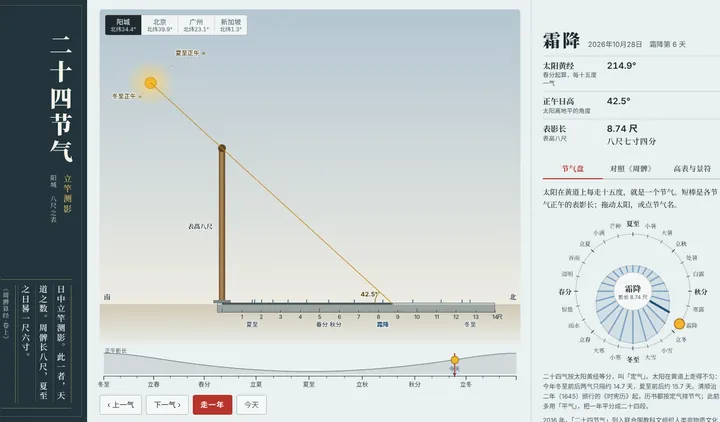 Tian·2The 24 Solar Terms: Measuring the Gnomon’s ShadowAn 8-chi gnomon and a year of shadows
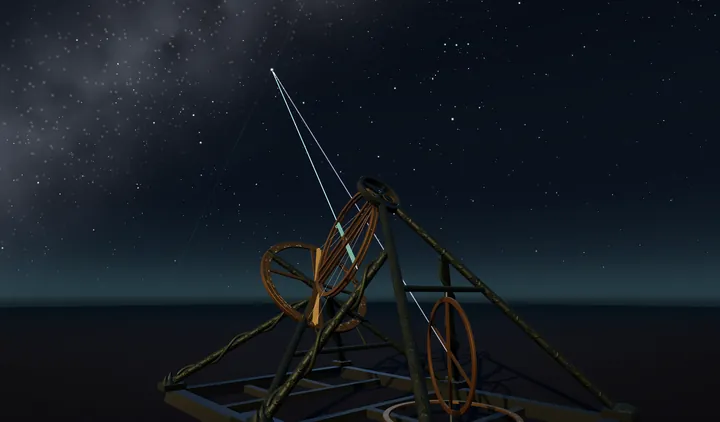 Tian·5Guo Shoujing and the Simplified ArmillaAn armillary sphere split into two instruments that do not block each other; turn the double declination ring to sight a star
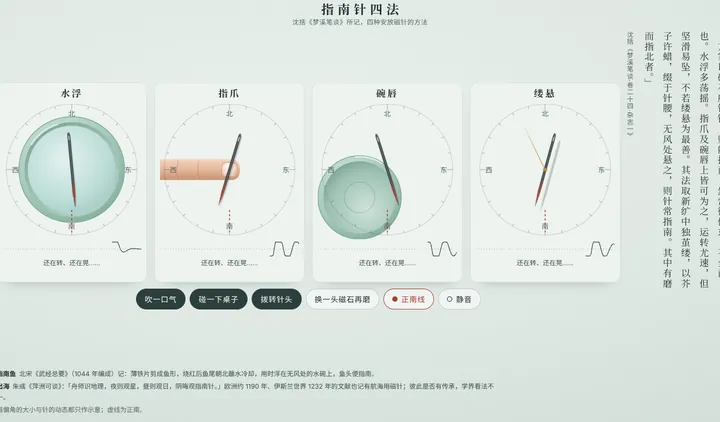 Hai·2Four Ways to Hang a Compass NeedleFour ways to mount a needle, recorded by Shen Kuo
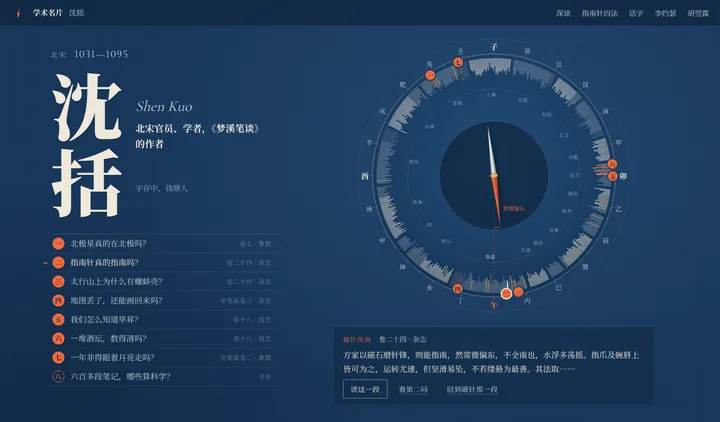 Ya·3Shen Kuo’s Scholar CardAlways Slightly East: turn a compass laid out from the Dream Pool Essays
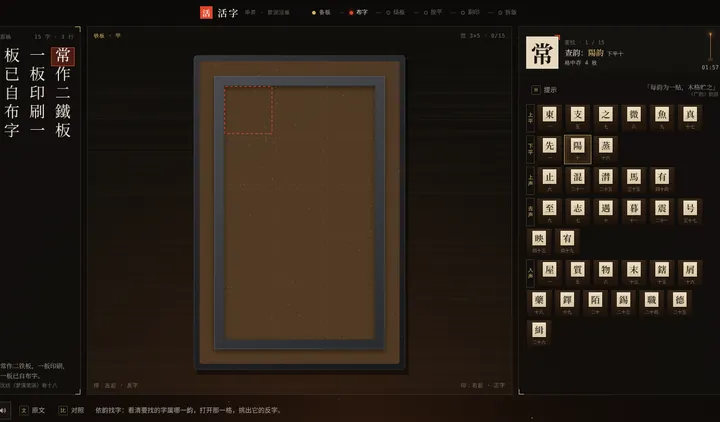 Ya·5Movable Type: Bi Sheng’s Clay TypeSet a plate of clay movable type by hand, as recorded in the Dream Pool Essays
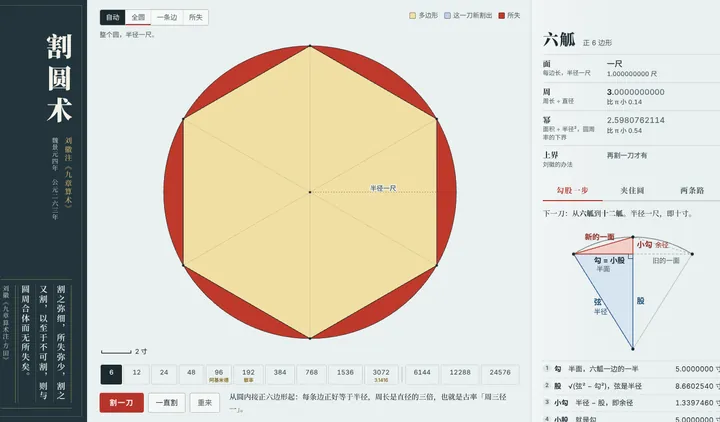 Tian·1Cutting the CircleHow Liu Hui closed in on π, one cut at a time