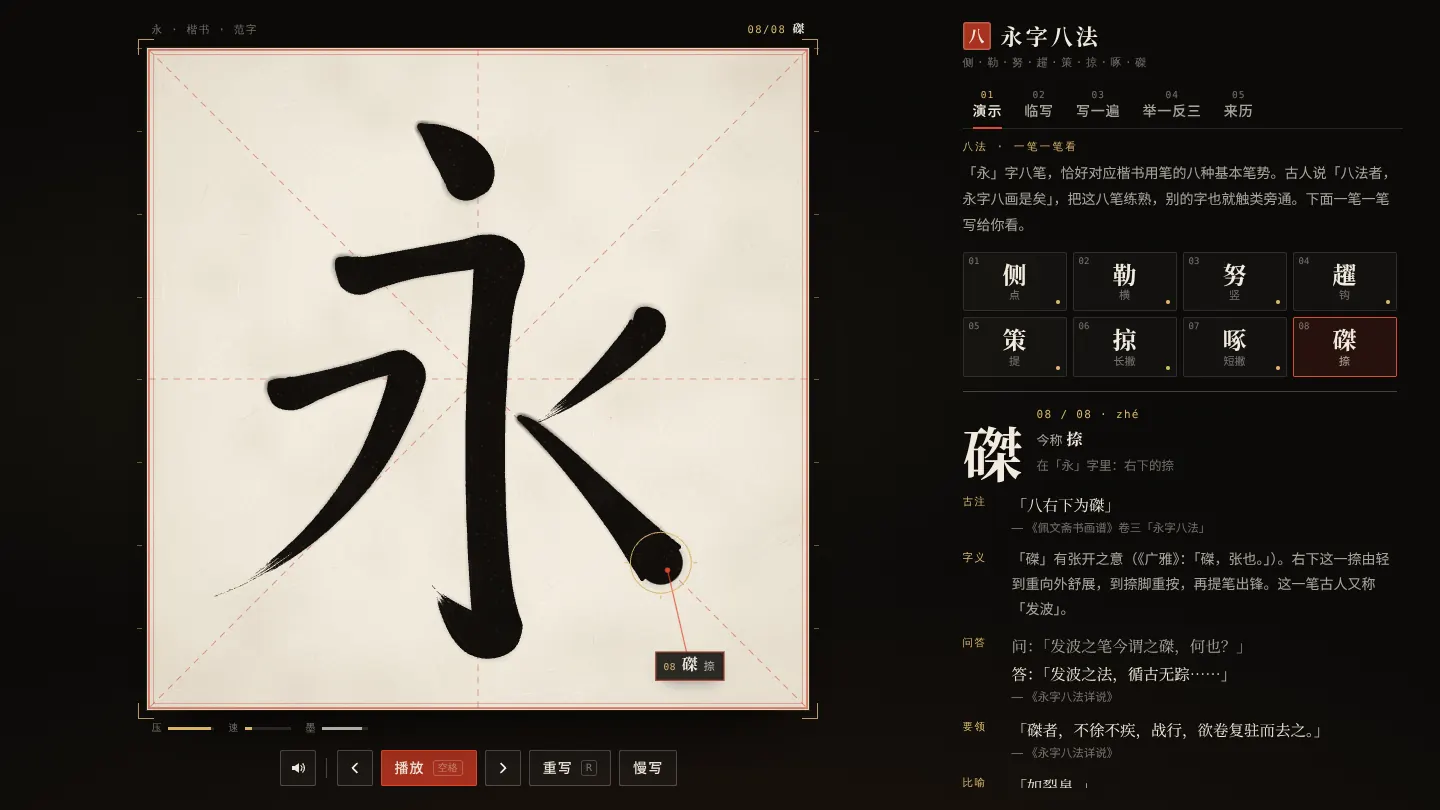
The Eight Strokes of Yong
A simulated brush writes the character 永 for you stroke by stroke, then invites you to copy it yourself
- Accession no.
- Zi·2
- Location
- Writing and Seals
- Category
- Interactive works
- Period
- Wei–Jin to Yuan
- Directed by
- Hu Yilin
- Made by
- Claude Opus 5.5
- Similar commission
- from S$18.75
About the exhibit
The “Eight Strokes of Yong” is a method the ancients used to teach brushwork in regular script: the eight strokes of the character 永 correspond exactly to eight basic movements of the brush. The dot is “tilt”, the horizontal “rein”, the vertical “strain”, the hook “kick”, the rising stroke at upper left “whip”, the long left-falling stroke at lower left “sweep”, the short left-falling stroke at upper right “peck”, and the right-falling stroke at lower right “split”. As an old text says, “The eight methods are simply the eight strokes of the character 永.” Master these eight and the rest follows by analogy.
All eight names are metaphors. A Detailed Explanation of the Eight Strokes of Yong, which comes from the Song writer Chen Si’s Blossoms from the Garden of Calligraphy and is reproduced in the Qing Peiwen Studio Compendium of Calligraphy and Painting, explains them one by one in questions and answers: why the dot is called “tilt” and the horizontal “rein”. “Why is the dot called ‘tilt’ and not ‘dot’?” “Because the brush tip looks back to the right: sensing the danger in its momentum, one sets it on a tilt. Hence the name ‘tilt’.” The Yuan writer Chen Yizeng, in Essential Secrets of the Hanlin, likens “rein” to “using the reins to check a horse”, “whip” to “a whip urging a horse on”, and “sweep” to “a fine-toothed comb sweeping through hair”. All quotations in the work have been checked against the Siku Quanshu editions of these books and are given in simplified characters.
Where the method came from, the old books disagree. Li Yangbing of the Tang said that Wang Xizhi spent 15 years “working on the character 永 alone”. The Secret Classic says the eight methods were set out by Zhiyong, a Sui-dynasty monk and descendant of Wang Xizhi, who passed them on to Yu Shinan. The Song-dynasty Ink Pond Collection records “Zhang Xu’s Transmission of the Eight Strokes of Yong”. And the Secret Classic of the Jade Hall, attributed to Zhang Huaiguan, traces the method further back still, to Cui Yuan of the Eastern Han. None of these accounts amounts to more than “tradition has it”.
In the work, a simulated brush writes 永 in stroke order, one method at a time, each shown with its modern name, the meaning of its old name and the explanation from the calligraphy treatises. In “Copy” you can trace each stroke in a practice grid with diagonal guides; when you lift the brush, the outline of the model is laid over your stroke and a similarity score is given. In “Write it out” you can write the whole character and save it as a PNG. “By analogy” shows how the eight methods recur in 水 (water), 江 (river) and 木 (tree).
How this work was made
The model character is not taken from any font: each of the eight strokes is a centre line traced by hand, and every point on it records the width of the brush tip and the speed of the stroke. The brush on screen has 30 “bristles”, each carrying its own ink and turning with the direction of the stroke. The faster the stroke, the less the ink and the finer the tip, the more bristles lift off the paper, leaving streaks of “flying white” that follow the movement of the brush. At each step a layer of pale ink is printed along the edge of the stroke to imitate ink bleeding into xuan paper. The fibres of the paper and the practice grid are also generated by code. When you copy, the thickness of the stroke comes from your writing speed (or from pen pressure, if you use a pressure-sensitive stylus); the score compares the direction, position, overlap and length of your strokes with the model, and is only a rough guide. The sound of the brush is synthesised live with WebAudio. Everything is computed in the browser; nothing external is loaded and nothing is uploaded.
Sources and references
- Chen Si (comp.), Blossoms from the Garden of Calligraphy (Shuyuan Jinghua): chapter 2, “The Eight Strokes of Yong”; chapter 19, Lu Xie, Marvellous Secrets of Calligraphy Practice; chapter 20, Han Fangming, Essentials of Brush Instruction (Southern Song; Siku Quanshu edition)
- Zhu Changwen, The Ink Pond Collection (Mochi Bian), chapter 2, with Zhang Huaiguan’s Secret Classic of the Jade Hall and “Zhang Xu’s Transmission of the Eight Strokes of Yong” (Northern Song; Siku Quanshu edition)
- Sun Yueban et al., Imperial Peiwen Studio Compendium of Calligraphy and Painting (Yuding Peiwenzhai Shuhua Pu): chapter 3, “The Eight Strokes of Yong” and “A Detailed Explanation of the Eight Strokes of Yong”; chapter 4, Chen Yizeng, Essential Secrets of the Hanlin (Qing; Siku Quanshu edition)
- Xu Shen, Explaining Graphs and Analysing Characters (Shuowen Jiezi)
- Zhang Yi, Expanded Erya (Guangya): “Explaining Old Words”
Want something like this? See how to commission an interactive teaching page →
Spotted an error in the history, data or sources? Please write to [email protected].
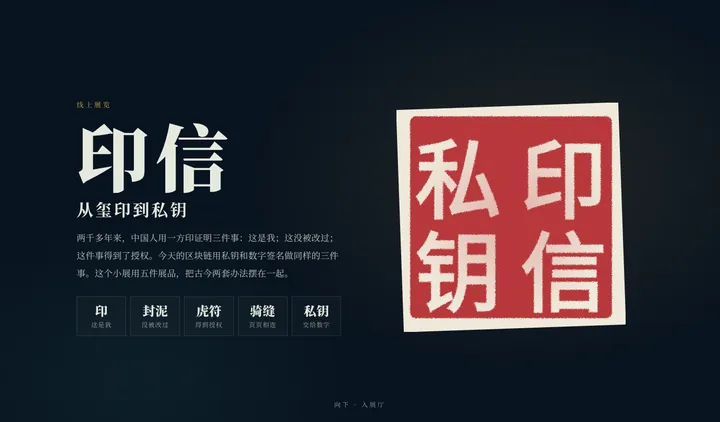 Zi·1Seals: From Imperial Seals to Private KeysFive exhibits that set two systems of “proof”, ancient and modern, side by side
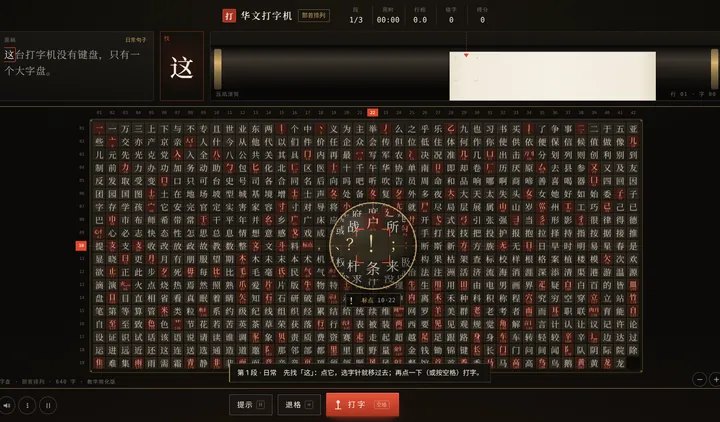 Ji·1The Chinese TypewriterFind and type characters on the tray, and compare two arrangements
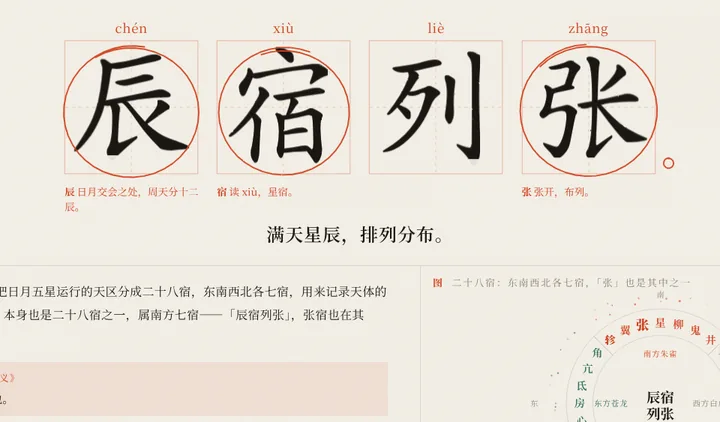 Shu·1The Thousand Character Classic: One Line, One SceneAll 250 lines written out and annotated, one by one; a panorama of the 1,000 characters, from which you can even assemble your name