Ji·1Chinese Characters and Computing
The Chinese Typewriter
Find and type characters on the tray, and compare two arrangements
- Accession no.
- Ji·1
- Location
- Chinese Characters and Computing
- Category
- Games
- Period
- Modern era
- Directed by
- Hu Yilin
- Made by
- Claude Opus 5.5
- Similar commission
- from S$18.75
About the exhibit
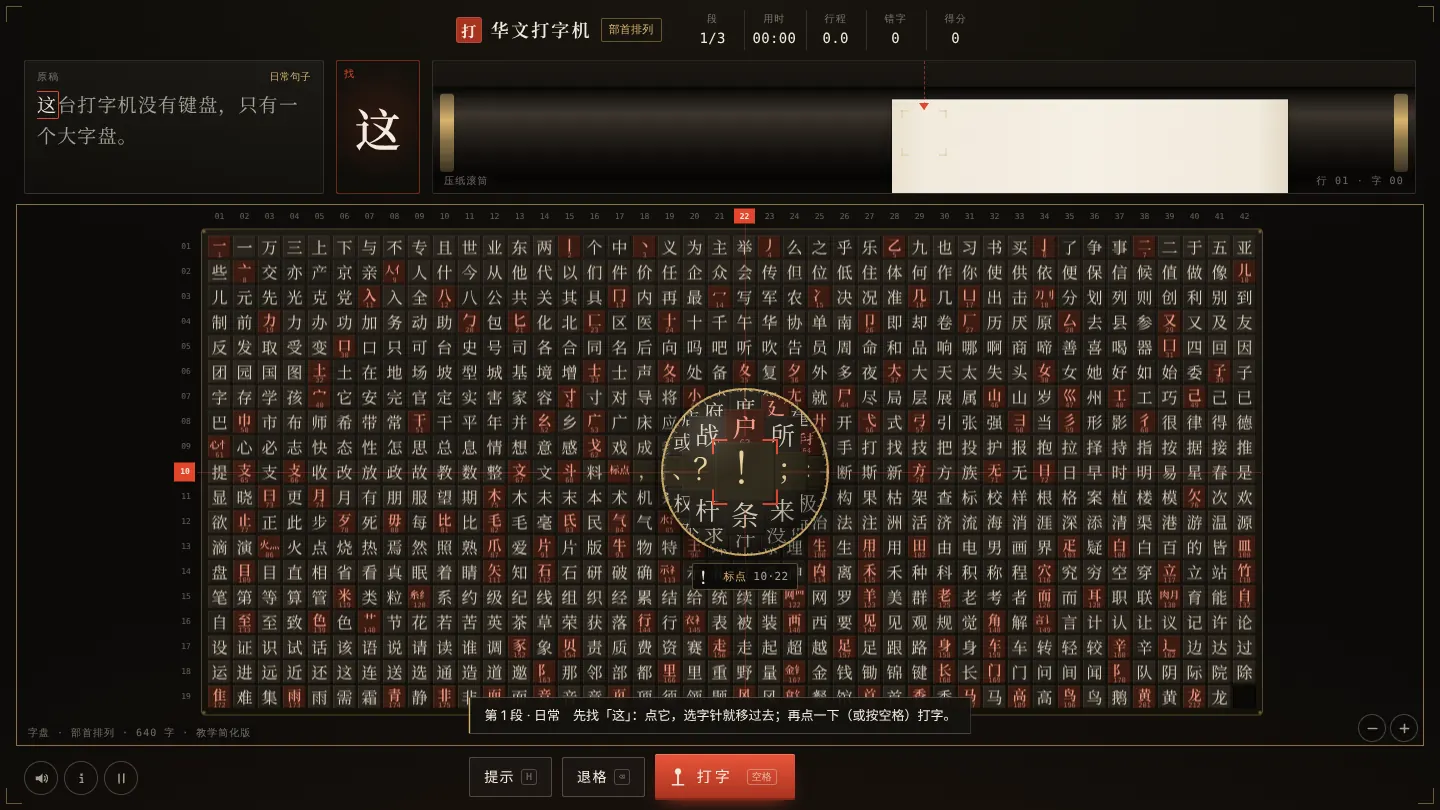
A Western typewriter has one key for each letter. Chinese characters run to tens of thousands, far too many for one key each. In the early 20th century, Chinese inventors took another route: they kept only the common characters and laid out individual pieces of metal type on a flat bed called the “character tray”. With the left hand, the typist slid the tray from side to side; with the right, they moved the selector arm over the character wanted and pressed the typing lever. The machine lifted that piece of type out of the tray, struck it onto the paper and put it back in its place.
In the 1910s, Zhou Houkun, then a student at the Massachusetts Institute of Technology, set out to design a Chinese typewriter; in 1916 American newspapers reported on his prototype, which used about 4,000 common characters. He returned to China the same year, and the Commercial Press in Shanghai backed him in turning the prototype into a product, but it never went into production. After he left, the Commercial Press engineer Shu Zhendong took over and improved the design, producing the “Shu-style Chinese Typewriter”, which went into production in batches around 1919 and became the first mass-produced Chinese typewriter. According to the historian Thomas S. Mullaney, the Commercial Press also sent people to what is now Southeast Asia to sell the machine to the Chinese communities there; in 1926 it was shown at the world’s fair in Philadelphia.
A typewriter of this kind held about 2,500 common characters on its tray; rarer characters were kept in type boxes alongside, to be fetched when needed. Trays left the factory arranged the way dictionaries of the time were: first by radical, then within each radical by the number of strokes. In the 1950s, Chinese typists began rearranging their own trays, placing characters often used together next to each other, so that typing a word moved the selector only one or two squares. They called this arrangement lianxiang, “association”; some called it “radial” arrangement. Mullaney describes it as what we would now call a “natural language” arrangement, even “predictive text”: before computers and mobile phones, typists were already keeping the next likely character close at hand. According to his research, by rearranging their trays the most skilled typists raised their speed from around 20 characters a minute to around 60.
This work puts you at the tray: move the selector, find the next character on the tray and press the typing lever. Each round has three passages: an everyday sentence, idioms and sayings, and a piece of poetry or classical prose. After each passage, it calculates the shortest distance the selector would have to travel for the same text on each of the two trays, the “radical arrangement” and the “associative arrangement”.
How this work was made
The tray is a simplified teaching tray: 640 characters and 7 punctuation marks in 42 columns and 19 rows. The characters were picked by frequency from wordfreq, an open word-frequency list for modern Chinese, with the characters needed for the game’s passages added. The “radical arrangement” follows the 214 radicals of the Kangxi Dictionary, by radical first and then by the number of strokes outside the radical; radicals and stroke counts come from Unihan, Unicode’s database of Chinese characters, simplified characters are placed under their corresponding radicals, and the red squares are radical labels. The “associative arrangement” is computed: the same word-frequency list shows which characters are used most and which often follow one another within a word, and simulated annealing then swaps positions again and again so that typing a typical passage takes the selector along as short a path as possible. Not one sentence of the game’s passages was used in arranging the trays, and the punctuation sits in the same place at the centre of both, so the comparison is fair: everyday sentences save a good deal of travel on the associative tray, poetry and prose save less, and a few passages even travel further.
The distances in the results are all calculated on the spot: starting from the home position and going in order to the square of each character, measuring straight-line distances in units of one square. The tray, selector, magnifier and paper are all drawn by code; the magnifier is a fisheye lens, so every square under it can be seen and clicked. Each typed character comes out slightly askew, with a random depth of ink; a mistake means pressing “Backspace”, brushing on a coat of correction fluid and typing again. Sounds are synthesised live in the browser: the soft tick of the selector moving, the clack of the type striking, the bell at the end of a line and the ratchet of the carriage return. There is no sound until your first click or tap, and it can be turned off at any time. Your best scores are stored only in your own browser; the game collects and uploads no data.
Sources and references
- Thomas S. Mullaney, The Chinese Typewriter: A History, MIT Press, 2017
- Thomas S. Mullaney, “The Moveable Typewriter: How Chinese Typists Developed Predictive Text during the Height of Maoism”, Technology and Culture, vol. 53, no. 4, 2012
- Thomas S. Mullaney, “Chinese Typewriters”, The Mao Era in Objects (object biography)
- China Comes to MIT: Hou-Kun Chow (Zhou Houkun)
- Unicode Consortium, Unihan Database (kRSUnicode: radicals and additional strokes)
- Robyn Speer et al., wordfreq 3.1 (Chinese word-frequency data)
Spotted an error in the history, data or sources? Please write to [email protected].
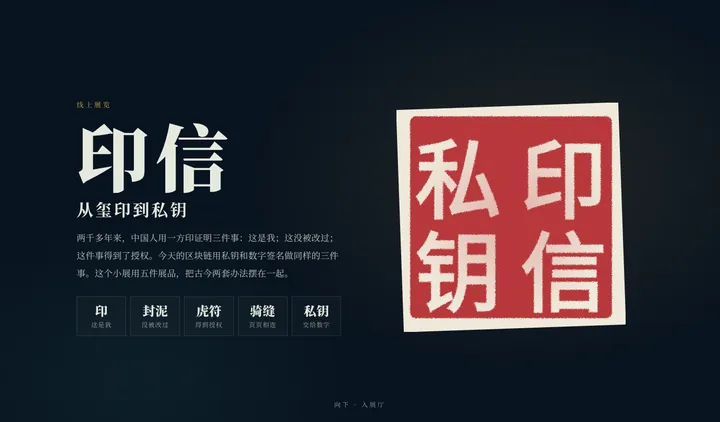 Zi·1Seals: From Imperial Seals to Private KeysFive exhibits that set two systems of “proof”, ancient and modern, side by side
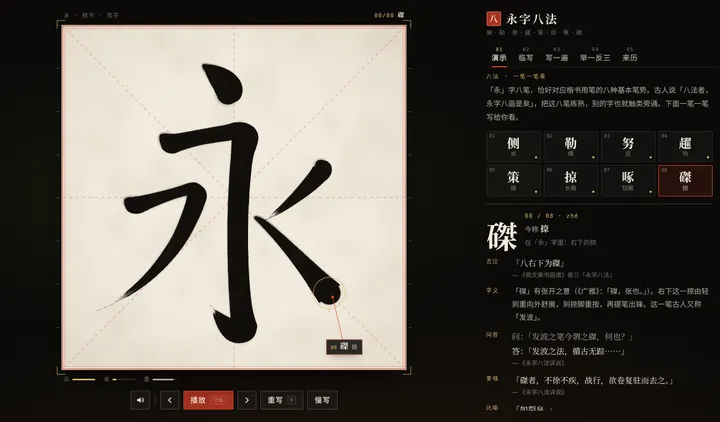 Zi·2The Eight Strokes of YongA simulated brush writes the character 永 for you stroke by stroke, then invites you to copy it yourself
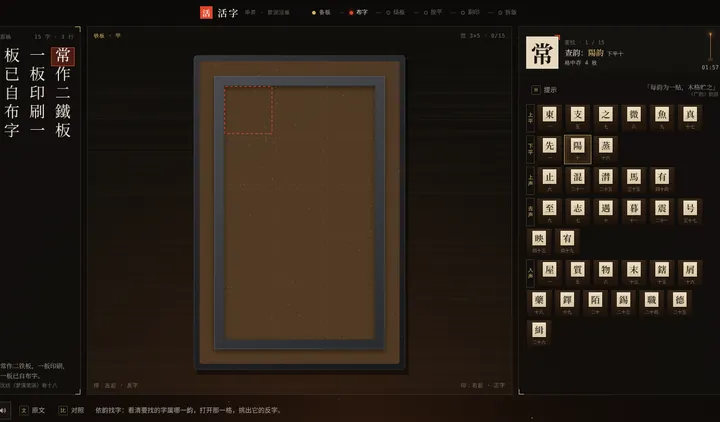 Ya·5Movable Type: Bi Sheng’s Clay TypeSet a plate of clay movable type by hand, as recorded in the Dream Pool Essays
 Shu·1The Thousand Character Classic: One Line, One SceneAll 250 lines written out and annotated, one by one; a panorama of the 1,000 characters, from which you can even assemble your name