Xuan·3Divining Doubt: From Oracle Bones to the Blockchain
Yarrow-Stalk Divination
Divide in two, hang one, count by fours, set aside the remainder
- Accession no.
- Xuan·3
- Category
- Interactive works
- Period
- Zhou–Song
- Directed by
- Hu Yilin
- Made by
- Claude Opus 5.5
- Similar commission
- from S$25
About the exhibit
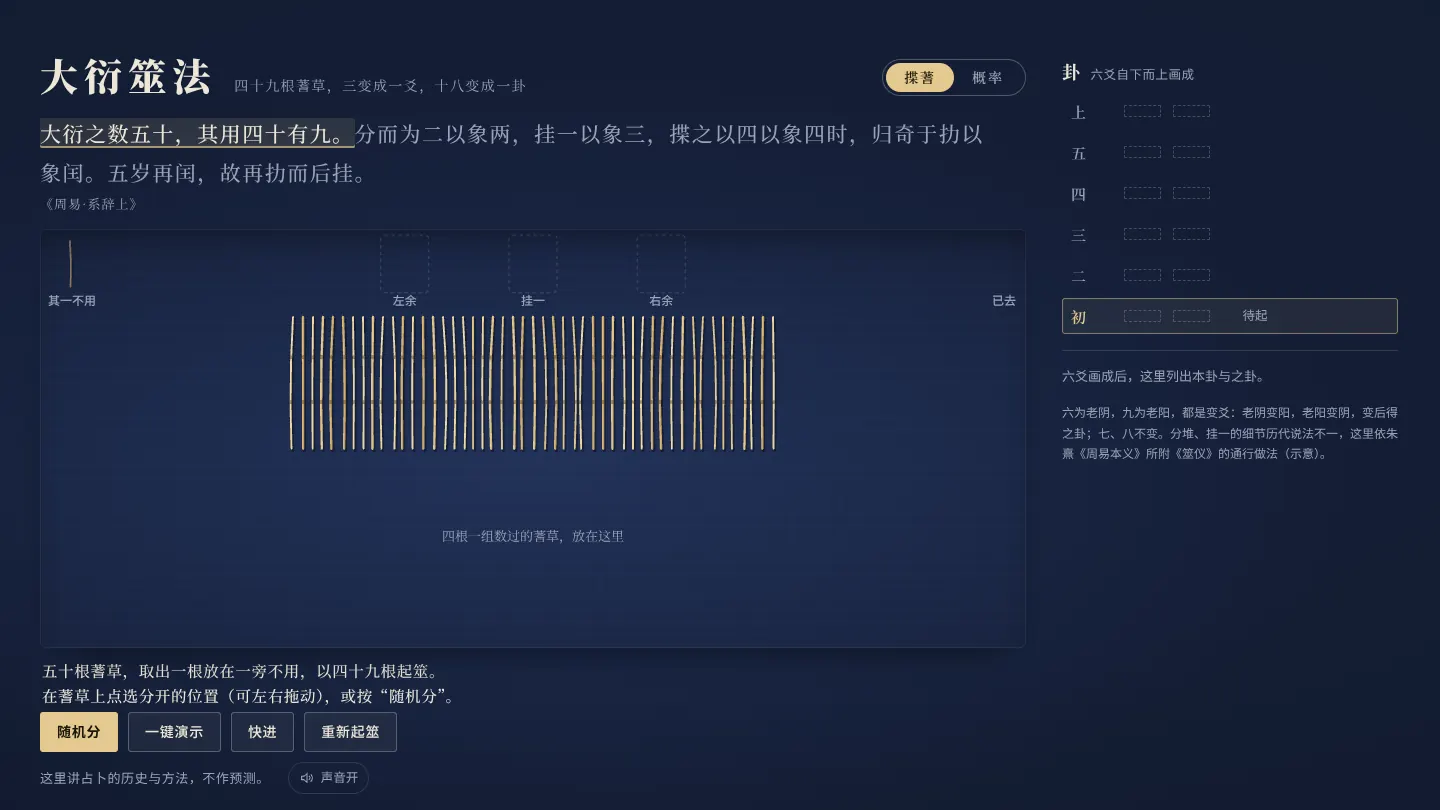
The first part of the Great Commentary (Xici) of the Book of Changes records how to cast a hexagram with yarrow stalks: “The number of the great expansion is fifty, of which forty-nine are used. They are divided in two to represent the two modes; one is hung up to represent the three powers; they are counted off by fours to represent the four seasons; the remainder is set aside between the fingers to represent the intercalary month. In five years there are two intercalary months, so the remainder is set aside twice, and then one is hung up again.” Of the 50 yarrow stalks, one is taken out and not used. The other 49 are divided into two piles; one stalk is taken from the right-hand pile and hung up; each pile is counted off in fours, and the one to four stalks left over are set aside. This is one “change”.
After three changes, 36, 32, 28 or 24 stalks remain; divided by four, these give 9, 8, 7 or 6. A nine is old yang, an eight young yin, a seven young yang and a six old yin. Six lines drawn from the bottom up make a hexagram, the primary hexagram (ben gua). Old yang and old yin are changing lines; turning each into its opposite gives the resulting hexagram (zhi gua). The names and order of the hexagrams follow the received text of the Book of Changes.
The odds in this method are not symmetrical: the chances of a six, seven, eight or nine are 1/16, 5/16, 7/16 and 3/16. In later times three copper coins were often used instead of yarrow stalks, which changes the odds to 1/8, 3/8, 3/8 and 1/8. Both methods give a changing line one time in four, and yin and yang half the time each; the difference is that with yarrow stalks, old yang comes up three times as often as old yin. The details of dividing the piles and hanging one stalk have been understood differently over the centuries; this work follows the common practice of the Divination Ritual appended to Zhu Xi’s Original Meaning of the Book of Changes.
How this work was made
Each of the 49 yarrow stalks is drawn individually, and every step is a real division and a real count by the rules: the visitor chooses where to split the pile, hanging one, counting by fours and setting aside the remainder are shown in turn, and the matching line of the Great Commentary lights up at the same time; how many stalks each change removes and how many remain for each line are recorded on the right. The names and order of the 64 hexagrams follow the received text of the Book of Changes and were checked one by one against the hexagram table used by other works in this hall. In every simulation in the probability panel, the stalks are split at random and counted off in fours, and the coins are tossed one at a time; the results converge on the theoretical values.
Sources and references
- Book of Changes, “Great Commentary” (Xici), Part One
- Zhu Xi, “Divination Ritual” (Shiyi), appended to The Original Meaning of the Book of Changes (Zhouyi Benyi)
- Book of Changes, received order and names of the hexagrams (Wang Bi edition)
Want something like this? See how to commission an interactive teaching page →
Spotted an error in the history, data or sources? Please write to [email protected].
 Xuan·1Casting a Hexagram on the BlockchainCasting a hexagram by the yarrow-stalk method from a Bitcoin block hash
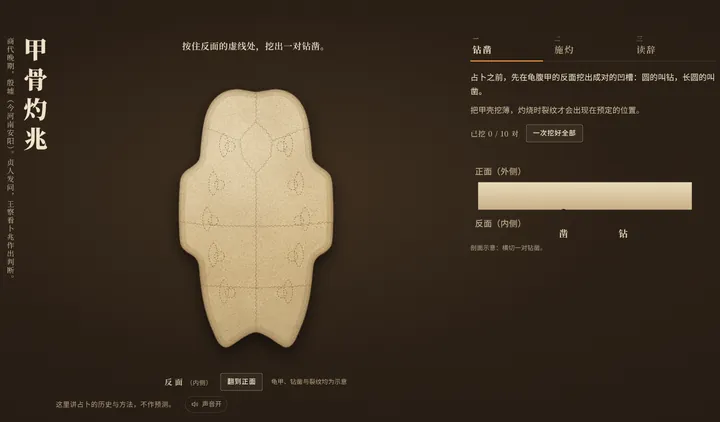 Xuan·2Cracking Oracle BonesDrilling, burning, reading: the three steps of Shang turtle-shell divination