Xuan·2Divining Doubt: From Oracle Bones to the Blockchain
Cracking Oracle Bones
Drilling, burning and reading: the three steps of Shang turtle-shell divination
- Accession no.
- Xuan·2
- Category
- Interactive works
- Period
- Shang
- Directed by
- Hu Yilin
- Made by
- Claude Opus 5.5
- Similar commission
- from S$25
About the exhibit
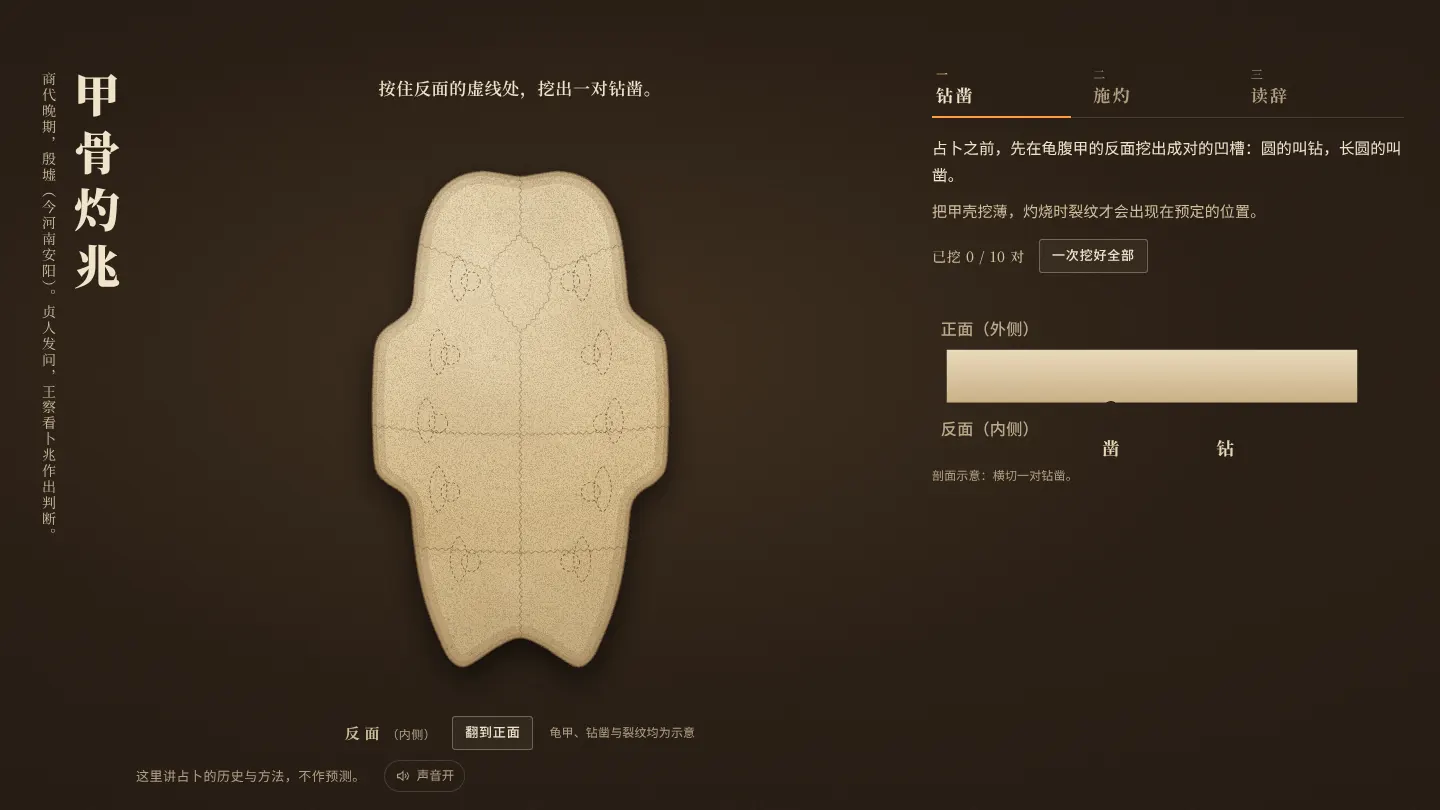
At Yinxu, the late Shang site at present-day Anyang in Henan, large numbers of turtle shells and animal bones used in divination have been excavated. Before a divination, pairs of hollows were cut into the back of a turtle’s plastron: the round ones are called zuan (drillings) and the oblong ones zao (chiselled hollows). Once the shell had been thinned, fire was applied to the drilled hollows; the heated shell cracked, and a crack appeared on the front. This is the zhao, the omen crack: a longer vertical line with a shorter branch running off to one side. The Shuowen Jiezi, in its section on bu, says: “Bu 卜: to burn and crack a turtle shell. It depicts a turtle shell being scorched. Another explanation: it depicts the vertical and crosswise lines of the crack in the shell.”
A diviner put forward the matter in question, the king examined the cracks and made a judgement, and the course of the divination was carved beside the crack. A complete divination inscription can be divided into four parts: the preface records the date and the diviner, the charge records the matter asked about, the prognostication records the king’s judgement, and the verification adds what later came to pass. The work reads a divination about the coming ten-day week on the front of no. 6057 in Heji (Collected Oracle Bone Inscriptions): “Crack-making on guisi day, Que divining: In the coming ten days, no disaster? The king read the cracks and said: There will be calamity; there may be troubling news. On the fifth day, dingyou, troubling news did indeed come from the west. Zhi Guo reported: The Tufang have attacked our eastern border and harmed two settlements; the Gongfang have also raided the fields of our western border.” The transcription follows the conventional reading and is simplified.
The Shang counted ten days as a xun and often divined on the gui day at the end of each xun whether the next xun would bring disaster; counting from guisi, the fifth day is indeed dingyou. Whether the charge is a question at all is still debated among scholars.
How this work was made
The plastron is drawn after the outline, scute grooves and bone sutures of a real one, and its surface texture is generated by code; the positions and number of the hollows, and the cracks, are illustrative. Each time fire is applied, a new crack is generated: the vertical line runs along the long axis of the chiselled hollow and the branch springs from one side of the drilling, with different lengths, bends and angles every time. A cross-section diagram explains why the hollows make the crack appear in a predetermined place. The inscription is entered following the standard transcription, with its four parts marked in different colours so that each can be read against its explanation; the character 𢀛, which has no glyph in common fonts, is supplied as an image. All the graphics are drawn live in the browser, and no external resources are loaded.
Sources and references
- Xu Shen, Shuowen Jiezi, chapter 3B, section on bu
- Guo Moruo (chief editor) and Hu Houxuan (general editor), Heji (Collected Oracle Bone Inscriptions), Zhonghua Book Company, 1978–1982, no. 6057
- Dong Zuobin, “Conjectures on Shang Turtle-Shell Divination”, Preliminary Reports of Excavations at Anyang, no. 1, 1929
- David N. Keightley, Sources of Shang History: The Oracle-Bone Inscriptions of Bronze Age China, University of California Press, 1978
Want something like this? See how to commission an interactive teaching page →
Spotted an error in the history, data or sources? Please write to [email protected].
 Xuan·1Casting a Hexagram on the BlockchainCasting a hexagram by the yarrow-stalk method from a Bitcoin block hash
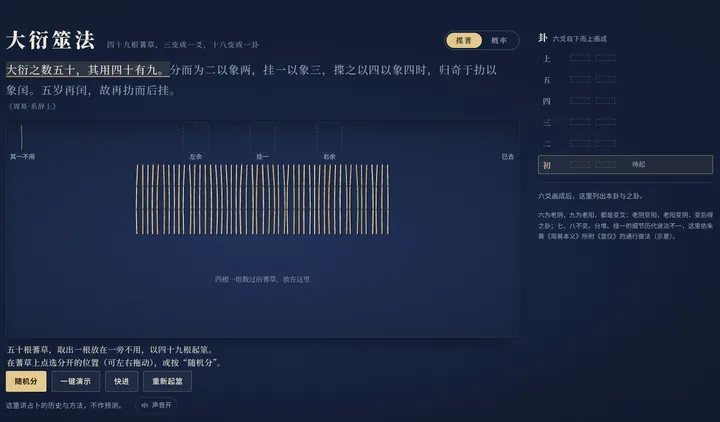 Xuan·3Yarrow-Stalk DivinationDivide in two, hang one, count by fours, set aside the remainder