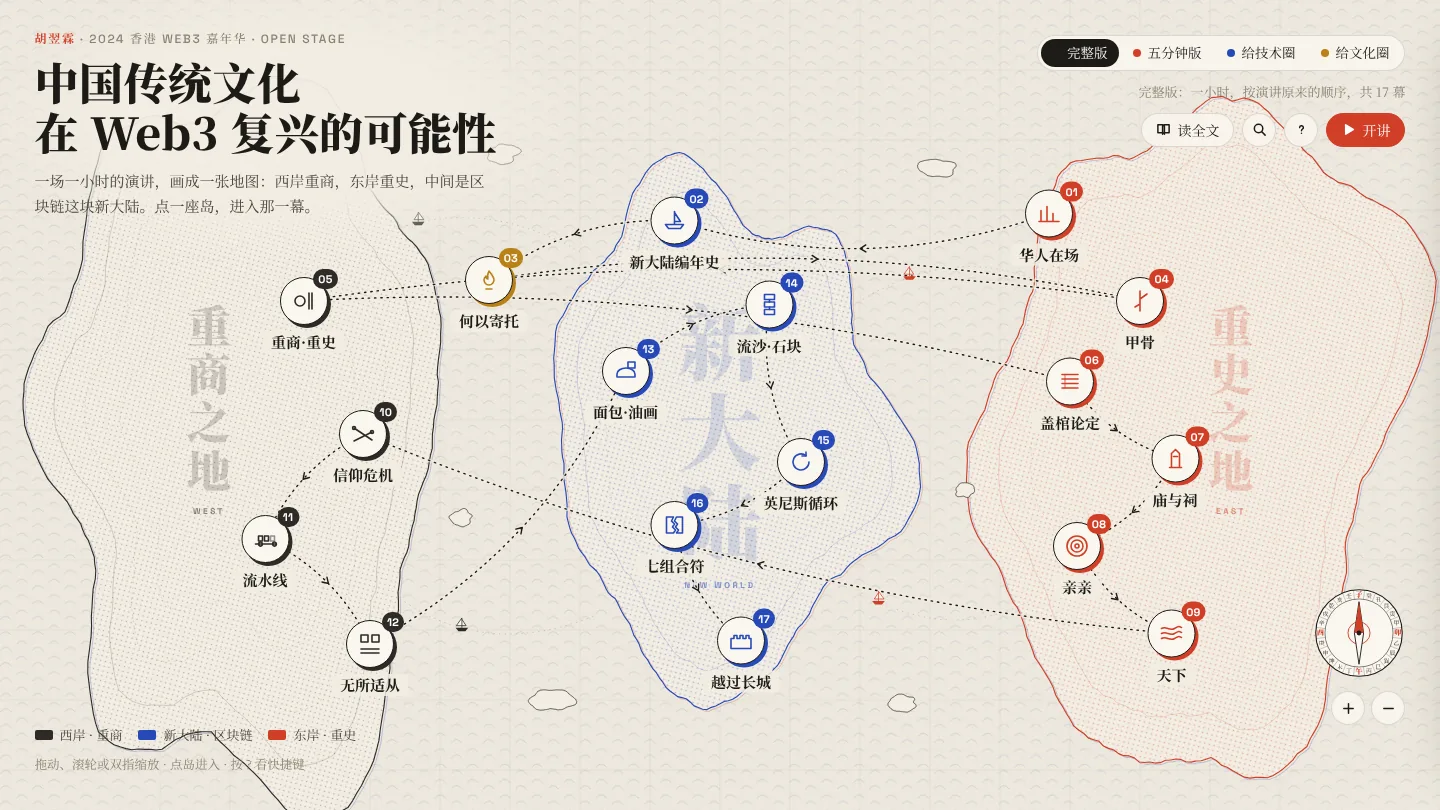
Jiang·1Lecture HallFeatured
Can Chinese Tradition Be Revived in Web3?
An hour-long talk, drawn as a map you can present or play with
- Accession no.
- Jiang·1
- Location
- Lecture Hall
- Category
- Web presentations
- Period
- Shang to present
- Directed by
- Hu Yilin
- Made by
- Claude Opus 5.5
- Similar commission
- from S$25
About the exhibit
In April 2024 Hu Yilin gave an hour-long talk, “Can Chinese Tradition Be Revived in Web3?”, on the Open Stage at the Hong Kong Web3 Festival. The talk begins with the place of the Chinese in the crypto world: from the early mining rigs and exchanges to today’s developers, the Chinese have always been a major force in this “no man’s land”. Borrowing from the history of the great voyages of discovery, he divides the opening-up of blockchain into five stages (exploration, pioneering, colonisation, the revolution for independence and the counter-attack on the Old World) and argues that we are roughly at the colonial stage, in the position of the Mayflower. And so he asks: what kind of faith can we hold?
The argument follows the two paths by which writing came into being. Writing in Mesopotamia is thought to have begun with clay tokens used for keeping accounts, and at its root Western culture leans towards commerce and contract. The oracle bones of Yinxu record divination, sacrifice, ritual and events, in what Li Zehou called the “shaman-historian tradition”, and at its root Chinese culture leans towards recording history and handing it down. So for the Chinese the “judge” is the historian and the record, and immortality lies in the histories, the imperial ancestral temple, ancestral halls, genealogies and the incense kept burning by descendants. Social bonds run from the bottom up and from near kin outwards, extending all the way to tianxia, “all under heaven”: all things are nurtured together without harming one another, and the ways run side by side without colliding.
The talk then turns to the crisis of faith in the modern West: science and technology have shaken belief in anything transcendent; the society of labourers that Arendt described turns people into interchangeable parts; Meyrowitz saw electronic media flatten the differences between places; and Stiegler reminds us that information can be remembered as well as calculated. In a fluid, ever-shifting digital world, blockchain offers a solid timescale on which public memory can be inscribed, and in the world of Web3 an echo can be found for each of these elements of Chinese tradition: ancestor worship, the shaman-historian tradition, a concern with this world, clan associations, “the world belongs to all”, the Zhou order of many states, and a society of rites and music. Finally he asks: is there a place for Chinese characters in Web3?
The 17 islands on the map are laid out by the talk’s argument: the west coast holds the scenes on Western civilisation and modernity, the east coast those on Chinese tradition, and the New World in between holds blockchain and the information age. In every scene you can open the matching passage of the transcript, and “Read the full text” has the complete transcript of the talk. Public data used in the scenes include the Cambridge Centre for Alternative Finance’s Bitcoin mining map (each country’s share of hash rate, 2019–2022), Electric Capital’s 2024 breakdown of developers by region, religious identification in the US General Social Survey (GSS) for 1972 and 2018, when each of the Twenty-Four Histories was compiled and the period it covers, a chronology of the Chinese Rites controversy, and live blocks from the Bitcoin network.
Sources and references
- Hu Yilin, “Can Chinese Tradition Be Revived in Web3?”, transcript of the talk on the Open Stage at the Hong Kong Web3 Festival 2024, Suixuan (yilinhut.net), 2024-04-29: https://yilinhut.net/2024/04/29/9557.html
- Hu Yilin, slides for the talk “Can Chinese Tradition Be Revived in Web3?” (30 slides), 2024.
- Cambridge Centre for Alternative Finance (CCAF), Cambridge Bitcoin Electricity Consumption Index — Bitcoin Mining Map: https://ccaf.io/cbnsi/cbeci/mining_map
- Liam Frost, "You can now watch Bitcoin being mined around the world", Decrypt, 2020-05-06 (the first CCAF mining map: average monthly share by country, September 2019 to April 2020): https://decrypt.co/27879/you-can-now-watch-bitcoin-being-mined-around-the-world
- Cambridge Judge Business School, "New data reveals timeline of China's bitcoin mining exodus", 2021-07-15 (data for September 2019 and April 2021): https://www.jbs.cam.ac.uk/2021/new-data-reveals-timeline-of-chinas-bitcoin-mining-exodus/
- Cambridge Judge Business School, "Bitcoin mining – an (un)surprising resurgence?", 2022-05-17 (data for August and September 2021 and January 2022; map data up to January 2022): https://www.jbs.cam.ac.uk/2022/bitcoin-mining-new-data-reveal-a-surprising-resurgence/
- The Paper, “For the First Time, the State Council Publicly Calls for a ‘Crackdown on Bitcoin Mining and More’: What Will the Impact Be?”, 2021-05-24 (the 51st meeting of the State Council’s Financial Stability and Development Committee, 2021-05-21): https://www.thepaper.cn/newsDetail_forward_12798654
- Electric Capital, "Asia Leads in Crypto Developers While the U.S. Continues to Lose Ground" (preview of the 2024 Developer Report), 2024-10-31: https://www.developerreport.com/developer-report-geography
- CCTV News app, “‘Piecing Together’ → ‘Decoding’: Digital Technology Brings Oracle Bone Script to Life!”, reposted by Guangming Online, 2024-06-22 (more than 160,000 inscribed oracle bones from Yinxu, about 4,500 distinct characters, about a third of them deciphered): https://m.gmw.cn/2024-06/22/content_1303770998.htm
- Heji (Collected Oracle Bone Inscriptions), transcription of piece no. 12870, as quoted in Chen Tongsheng, “A Century of Literary Research on Oracle-Bone Divination Inscriptions: Reflections and Prospects”, Guangming Daily, 2019-09-05: http://www.chinawriter.com.cn/n1/2019/0905/c419387-31337175.html
- Wu Jing, Essentials of Government of the Zhenguan Era: “Literature and History” (words of Chu Suiliang and Liu Ji in the 13th year of Zhenguan), Project Gutenberg edition: https://www.gutenberg.org/ebooks/25347
- Quotations from classical texts: Zuo Commentary: Duke Xiang, Year 24; Mencius: “Gaozi I”; Wen Tianxiang, “Crossing the Lingding Sea”; Book of Rites: “The Conveyance of Rites”; Book of Rites: “The Doctrine of the Mean”; Gu Yanwu, Record of Daily Knowledge: “The Zhengshi Era”; Kong Yingda, Correct Meaning of the Zuo Commentary on the Spring and Autumn Annals; Xu Shen, Explaining Graphs and Analysing Characters (Shuowen Jiezi).
- Wikipedia, "Complaint tablet to Ea-nasir" (UET V 81, c. 1750 BC, British Museum): https://en.wikipedia.org/wiki/Complaint_tablet_to_Ea-nasir
- Wikipedia, "Bulla (seal)" (hollow clay balls in which tokens were sealed): https://en.wikipedia.org/wiki/Bulla_(seal)
- Chinese Wikipedia, “Twenty-Four Histories” (when each history was compiled and the period it covers): https://zh.wikipedia.org/wiki/二十四史
- Wikipedia, "Chinese Rites controversy" (the events of 1645, 1656, 1704, 1715, 1721, 1742 and 1939): https://en.wikipedia.org/wiki/Chinese_Rites_controversy
- Wikipedia, "Matteo Ricci" (reached Macau in 1582 and Beijing in 1601): https://en.wikipedia.org/wiki/Matteo_Ricci
- CNN, "There are now as many Americans who claim no religion as there are evangelicals and Catholics, a survey finds", 2019-04-13; accompanying chart by Will Houp, with data from Ryan P. Burge’s analysis of the General Social Survey (GSS), also shown on slide 14 of the talk.
- Friedrich Nietzsche, The Gay Science (Die fröhliche Wissenschaft), 1882, section 125.
- Hannah Arendt, The Human Condition, University of Chicago Press, 1958.
- Joshua Meyrowitz, No Sense of Place: The Impact of Electronic Media on Social Behavior, Oxford University Press, 1985.
- Harold A. Innis, Empire and Communications, Clarendon Press, 1950; The Bias of Communication, University of Toronto Press, 1951.
- Zhao Tingyang, The Tianxia System: An Introduction to the Philosophy of World Institutions, Jiangsu Education Publishing House, 2005; The Contemporaneity of Tianxia: The Practice and Imagination of World Order, CITIC Press, 2016.
- Dates of the inventions of Newcomen, Watt, Trevithick, Stephenson, Swan, Edison, Benz and Ford: the corresponding Wikipedia articles.
- China News Service, “China’s First Email: ‘Across the Great Wall We Can Reach Every Corner in the World’”, 2003-07-17: https://www.chinanews.com/n/2003-07-17/26/325209.html
- Xinhua, “This Email, Sent 39 Years Ago, Began China’s Internet Story”, 2026-09-14: https://www.news.cn/politics/20260914/795f6ece45a343819919061f37a06978/c.html
- Unicode Consortium, Unihan Database (the kMainlandTelegraph and kMandarin fields), Unicode 18.0: https://www.unicode.org/charts/unihan.html
- Wikipedia, "Chinese telegraph code" (Septime Auguste Viguier’s New Telegraph Book, the Chinese code book compiled in the early 1870s): https://en.wikipedia.org/wiki/Chinese_telegraph_code
- Bitcoin block data (live): the public APIs of mempool.space and blockstream.info; the headline from The Times in the coinbase of the genesis block (2009-01-03); supply calculated by the halving rule of the Bitcoin protocol (halving every 210,000 blocks).
Want something like this? See how to commission a talk website or a literature review →
Spotted an error in the history, data or sources? Please write to [email protected].
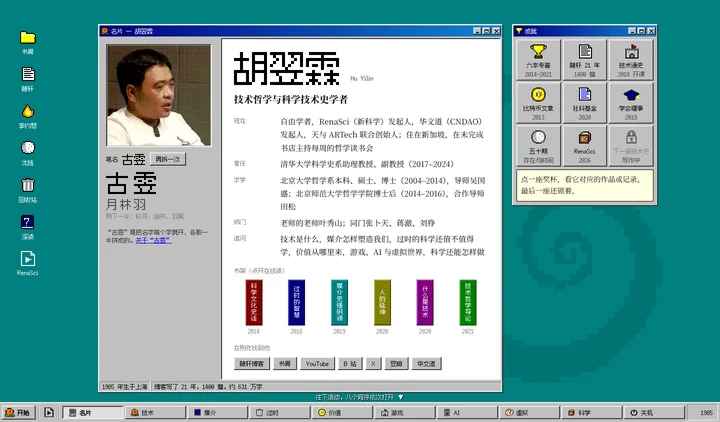 Shu·4Hu Yilin’s Scholar CardAn old Windows-style desktop where eight programs open one by one
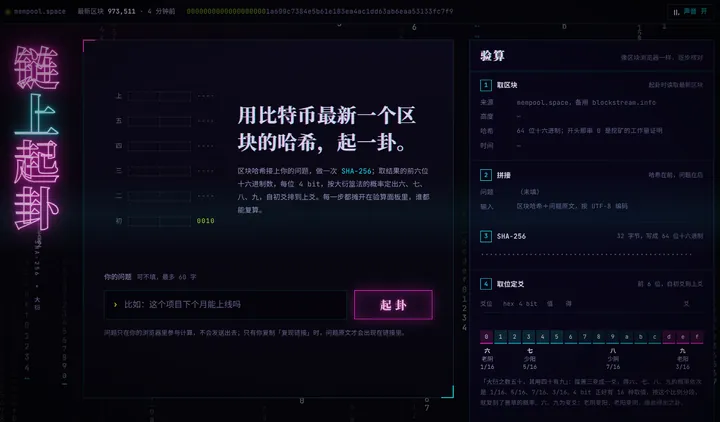 Xuan·1Casting a Hexagram on the BlockchainCasting a hexagram by the yarrow-stalk method from a Bitcoin block hash
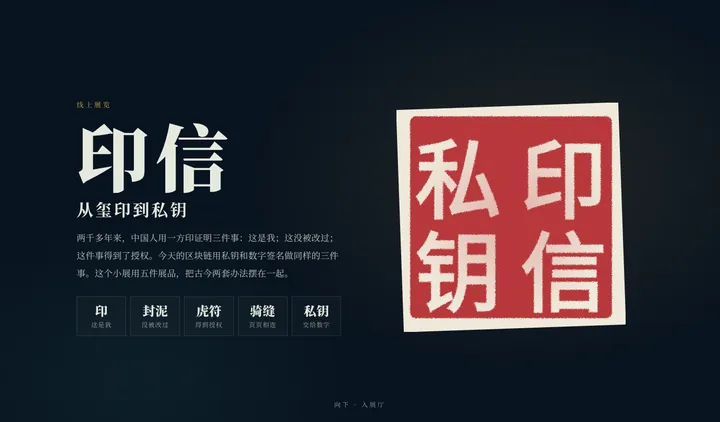 Zi·1Seals: From Imperial Seals to Private KeysFive exhibits that set two systems of “proof”, ancient and modern, side by side
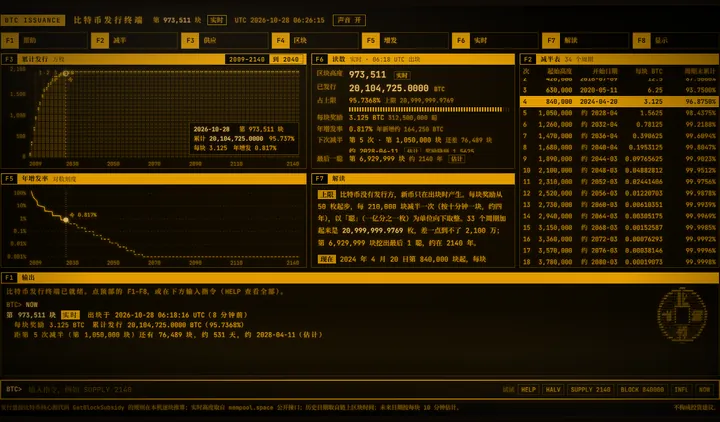 Xin·1Bitcoin Issuance TerminalBitcoin’s issuance, worked out from the rules in its source code
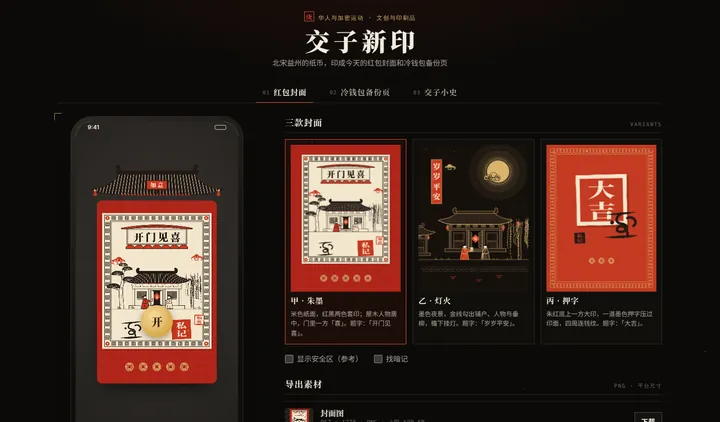 Xin·2A New Print of JiaoziNorthern Song paper money from Yizhou, printed as today’s red-packet covers and cold-wallet backup sheets
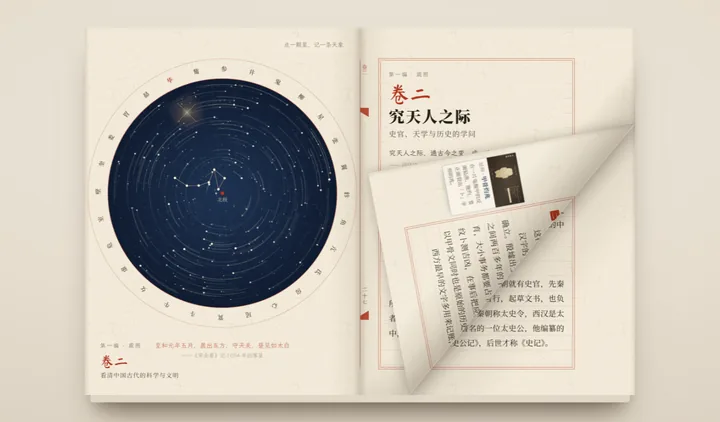 Shu·6Reviving Chinese Civilisation in the Age of TechnologySelected essays from Suixuan: a thread-bound book you can page through and annotate
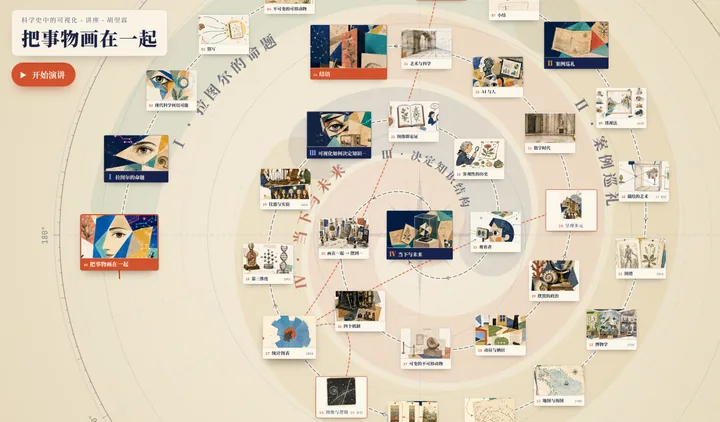 Jiang·2Drawing Things TogetherVisualisation in the History of Science
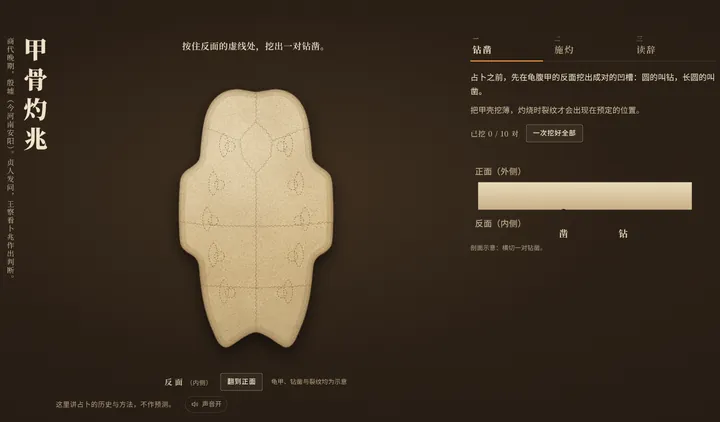 Xuan·2Cracking Oracle BonesDrilling, burning, reading: the three steps of Shang turtle-shell divination
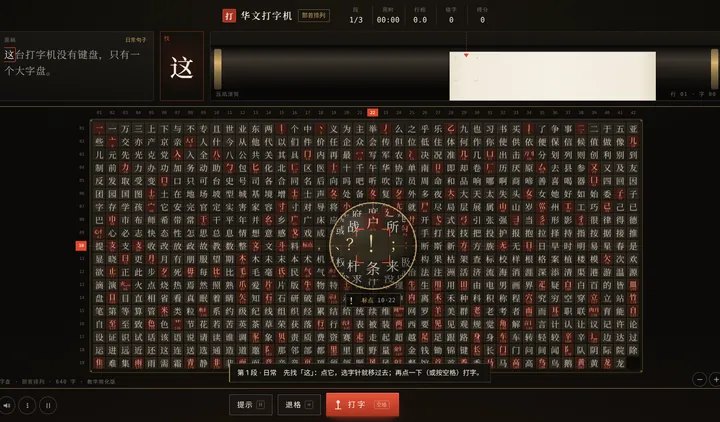 Ji·1The Chinese TypewriterFind and type characters on the tray, and compare two arrangements
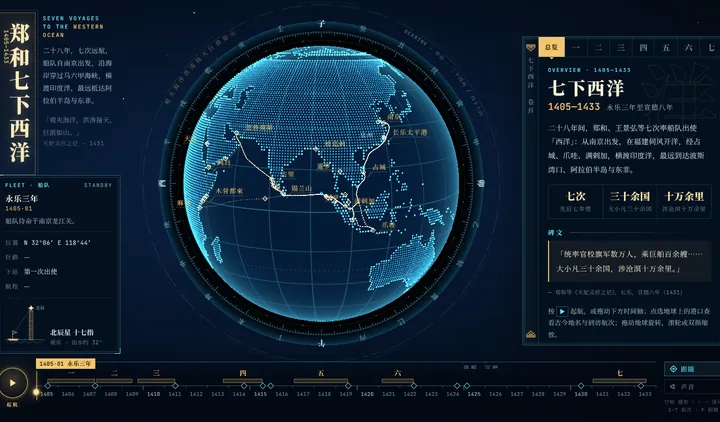 Hai·1Zheng He’s Seven VoyagesSeven voyages, drawn on a globe you can turn