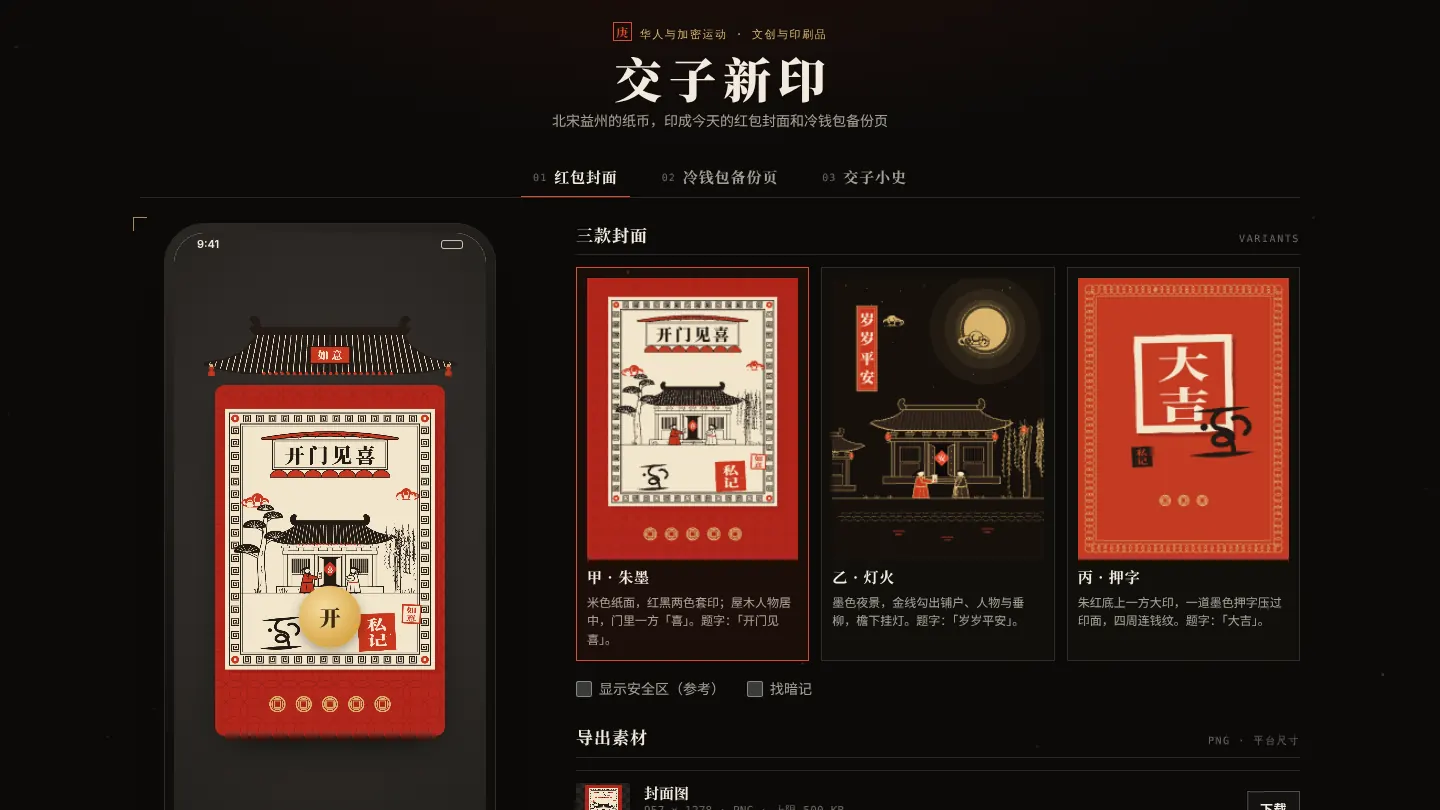
Xin·2The Chinese and the Crypto Movement
A New Print of Jiaozi
The paper money of Northern Song Yizhou, printed as today’s red packet covers and cold-wallet backup sheets
- Accession no.
- Xin·2
- Category
- Merchandise and print
- Period
- Song
- Directed by
- Hu Yilin
- Made by
- Claude Opus 5.5
- Similar commission
- from S$12.50
About the exhibit
Jiaozi were paper money used around Yizhou (present-day Chengdu) in the Northern Song. The Shu region ran on iron coins, and iron coins are heavy. Li Tao’s Long Draft Continuation of the Comprehensive Mirror for Aid in Government records: “At first, because iron coins were heavy, the people of Shu privately made notes, called jiaozi, for the convenience of trade; 16 wealthy households managed them.” The earliest jiaozi were issued jointly by wealthy private households. Li You’s Facts of the Song Dynasty records that these notes were “all printed on the same kind of paper, the printed design showing houses, trees and figures, with the shop’s signature mark and each shop’s own secret marks, vermilion and black interspersed, as private marks”. In the 11th month of the first year of Tiansheng (by the Western calendar already January 1024), the court issued an edict “first establishing the Yizhou Jiaozi Office”, and from the second month of the following year the notes were issued by the government. No generally accepted surviving jiaozi or printing block has been found to this day.
This work takes up the ideas of “houses, trees and figures” and “vermilion and black interspersed” to make two things that are useful today. The first is three original sets of WeChat red packet covers: Vermilion and Ink, Lamplight, and Signature Mark. Each set has four assets — cover image, cover pendant, bubble pendant and cover story — which can be previewed in an illustrative phone-style interface and exported as PNG files at the pixel sizes the platform requires. Each set also hides a “secret mark”; turn on “Find the secret mark” to reveal it. The second is a Bitcoin cold-wallet backup sheet in the style of a jiaozi: you can generate 12 or 24 BIP39 mnemonic words in the browser (from the English or Simplified Chinese word list) and print them on a sheet with a meander border, a small scene of houses, trees and figures, and a red seal; or you can print blank boxes only and write in by hand words generated elsewhere. When the words are generated, the first receiving address (BIP84) and its QR code are also given, so you can check them against your wallet.
Signature marks and secret marks were to jiaozi what signatures and private keys are to Bitcoin. This is an analogy, not history: Song secret marks depended on secrecy, and once someone saw through them they could be forged; the method of verifying a digital signature is completely public, yet forging one requires the private key.
How this work was made
All the designs are drawn by code: the same set of paths is drawn onto a canvas to export the red packet assets and output as SVG so that the backup sheet prints as vector graphics. The asset sizes follow the requirements of the WeChat red packet cover platform (as reported by several sources; the platform’s latest templates take precedence): cover image 957×1278, no more than 500 KB; cover pendant 1053×1746; bubble pendant 480×384; cover story image 750×1250. The last three are each no more than 300 KB. The designs are all newly drawn and do not copy any actual printing block or any banknote now in circulation.
The entropy for the mnemonic comes from the browser’s crypto.getRandomValues, or you can supply your own (dice rolls, hexadecimal and so on), processed the same way as in Ian Coleman’s BIP39 tool. The checksum and the seed (PBKDF2-HMAC-SHA512, 2048 rounds) are computed with the browser’s WebCrypto where available, and otherwise with a pure-JS implementation included in the page; addresses are derived with secp256k1, BIP32 and bech32 written with BigInt. The two word lists were generated by script, unaltered, from trezor/python-mnemonic and match the bitcoin/bips repository byte for byte. All the algorithms pass the official BIP39 test vectors and the BIP84 test vectors, and on 240 sets of random mnemonics they were checked one by one against two independent libraries, bip_utils and embit. The QR code encoder was also written from scratch.
The page does not connect to the internet and stores nothing; click “Clear” or leave the page, and the words are erased. There is also a self-contained offline HTML version (with its SHA-256 checksum) that you can download to an offline computer to generate and print there. The online page is only for trying it out.
Sources and references
- Li Tao, Long Draft Continuation of the Comprehensive Mirror for Aid in Government, chapter 101 (wuwu day, 11th month, first year of Tiansheng: “first establishing the Yizhou Jiaozi Office”)
- Li You, Facts of the Song Dynasty, chapter 15, “Finance” (“the printed design showing houses, trees and figures, with the shop’s signature mark and each shop’s own secret marks, vermilion and black interspersed, as private marks”)
- Fei Zhu, Treatise on Paper Money, as quoted in Extensive Records of Shu, chapter 67 (official jiaozi “beginning in the second month of the second year [of Tiansheng]”)
- He Ping, “The Trust Mechanism behind the Emergence of Chengdu’s ‘Jiaozi’ and the Historical Significance of the Issue of ‘Official Jiaozi’”, Guangming Daily, 11 September 2023
- Wang Shen, “First Encounter with Paper Money: Written on the 1,000th Anniversary of the Issue of State Jiaozi”, The Paper, 8 April 2024 (the wuwu day of the 11th month of the first year of Tiansheng falls on 12 January 1024 in the Western calendar)
- “W.E. Talk | Liu Fangjian and Luo Tianyun: Why Was Jiaozi, the World’s Earliest Paper Money, Born in Chengdu?”, chinanews.com, 13 December 2024 (no generally accepted jiaozi or printing block for them has yet been found)
- Asset requirements for WeChat red packet covers (platform specifications as reported by several sources): Tencent Cloud Developer Community, “A Complete Guide to Making WeChat Red Packet Covers”, 2024; SMZDM, 2024 (cover pendant 1053×1746); Tencent Cloud Developer Community, 2025 (bubble pendant 480×384); Woshipm, 2025 (cover story 750×1250)
- BIP39, BIP32, BIP84, BIP173, BIP350 (github.com/bitcoin/bips); trezor/python-mnemonic test vectors
- Ian Coleman, BIP39 Mnemonic Code Converter (handling of user-supplied entropy)
- Trezor Blog, “Protect your wealth: 7 steps to secure your wallet backup”
Spotted an error in the history, data or sources? Please write to [email protected].
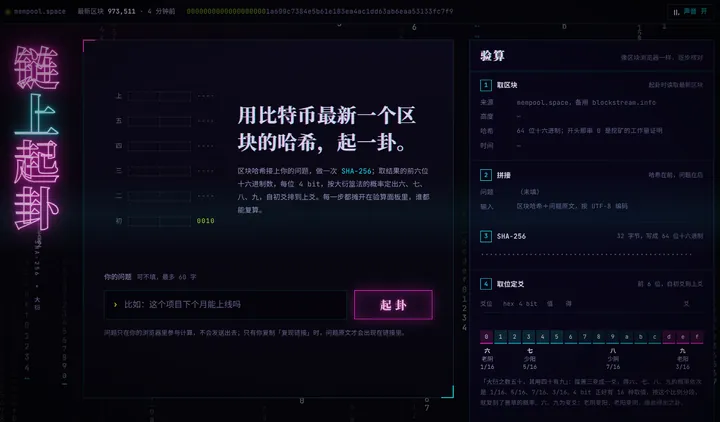 Xuan·1Casting a Hexagram on the BlockchainCasting a hexagram by the yarrow-stalk method from a Bitcoin block hash
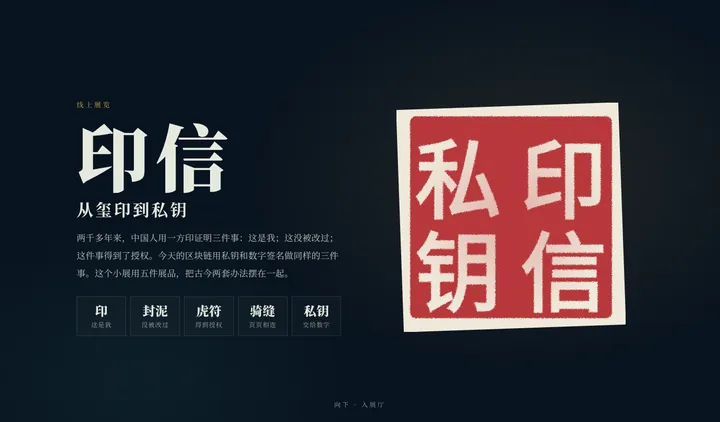 Zi·1Seals: From Imperial Seals to Private KeysFive exhibits that set two systems of “proof”, ancient and modern, side by side
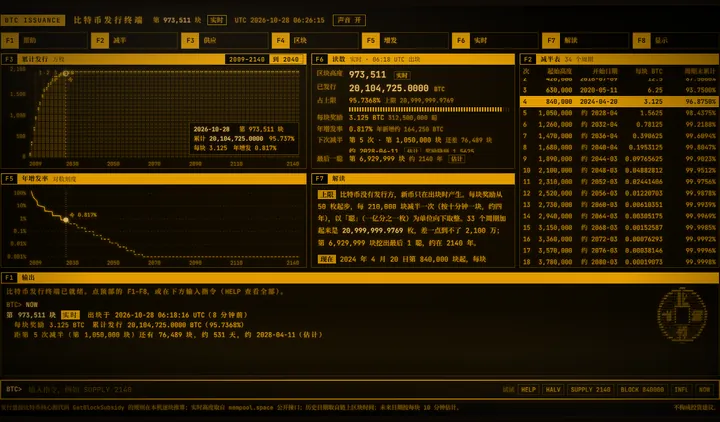 Xin·1Bitcoin Issuance TerminalBitcoin’s issuance, worked out from the rules in its source code
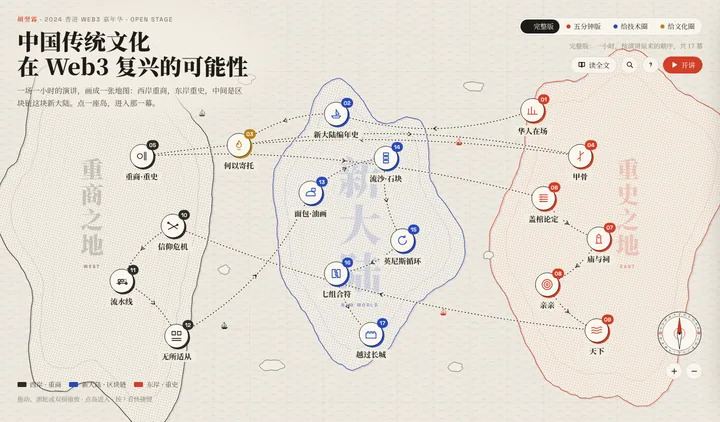 Jiang·1Can Chinese Tradition Be Revived in Web3?An hour-long talk, drawn as a map you can present or play with
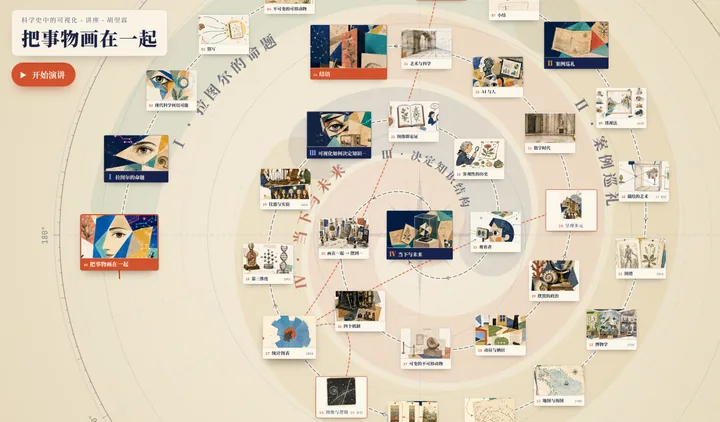 Jiang·2Drawing Things TogetherVisualisation in the History of Science