Jiang·2Lecture Hall
Drawing Things Together
Visualisation in the History of Science
- Accession no.
- Jiang·2
- Location
- Lecture Hall
- Category
- Web presentations
- Period
- Modern to contemporary
- Directed by
- Hu Yilin
- Made by
- Claude Opus 5.5
- Similar commission
- from S$25
About the exhibit
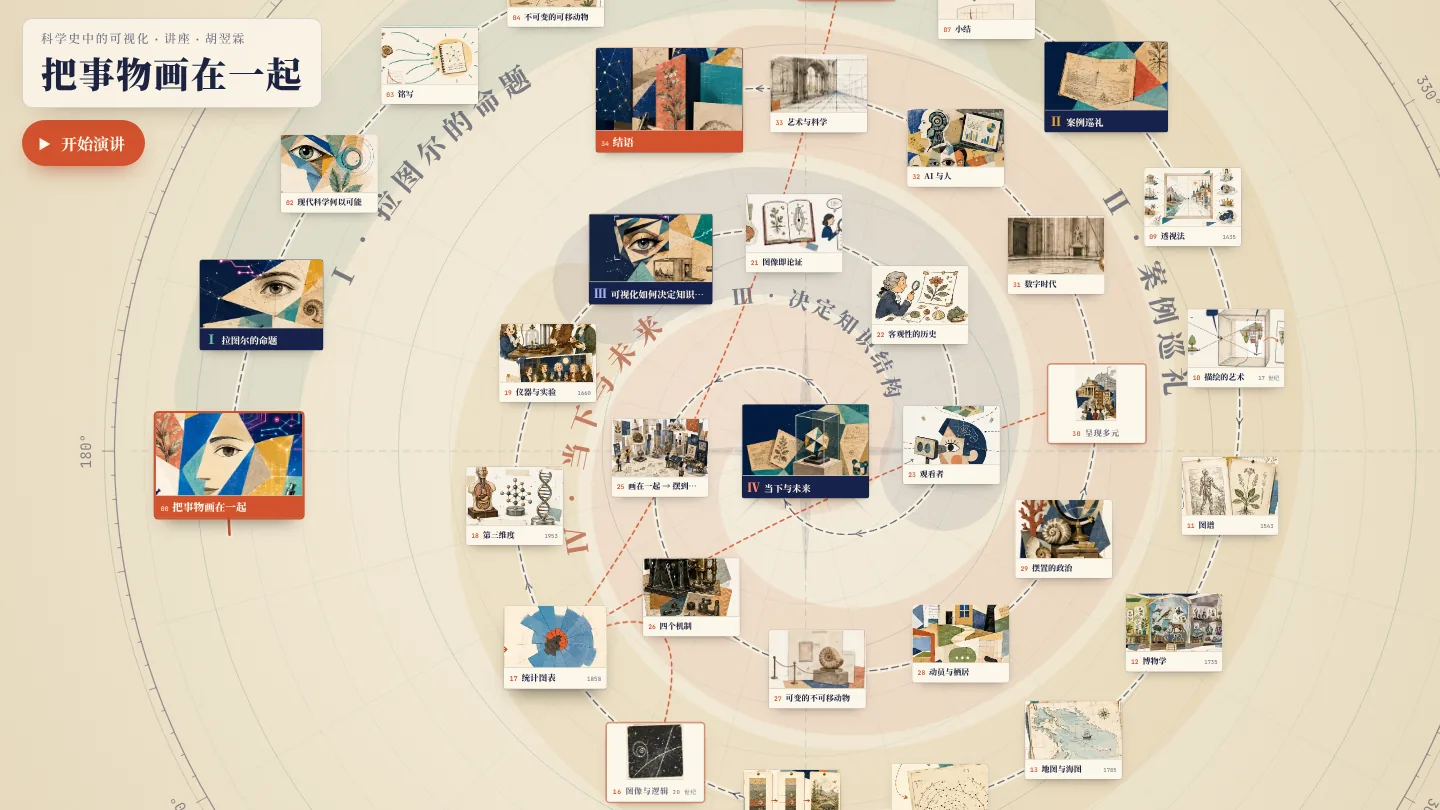
This is a lecture by Hu Yilin. Its title is borrowed from a celebrated essay by the sociologist of scientific knowledge Bruno Latour, first published in 1986 as “Visualisation and Cognition: Thinking with Eyes and Hands” and reprinted in 1990 as “Drawing Things Together” in Representation in Scientific Practice, edited by Michael Lynch and Steve Woolgar. The lecture is in four acts and, with the cover and the conclusion, runs to 35 pages laid out along a double spiral: the first three acts are about how science “draws things together”, the fourth about how museums “place things together”.
Act I: Latour’s thesis. Why did modern science emerge in Europe in the 16th and 17th centuries? The usual answers appeal to grand causes: a new mind, a new method, a new economy. Latour suggests looking first at what scientists are actually doing with their hands. They are constantly producing traces on paper — charts, maps, star catalogues, curves, photographs, specimen labels, instrument readings — which together he calls “inscriptions”. Good inscriptions are “immutable mobiles”: wherever they are taken, their internal relations stay unchanged; they can be rescaled, copied and superimposed, and merged with text and with geometry. Perspective provides “optical consistency”, so that cities, landscapes, stars and machines can all be projected onto the same kind of flat surface. Inscriptions converge, layer upon layer, on “centres of calculation”, until they are finally compressed into a single number.
Act II: A tour of cases. The perspective construction in Alberti’s On Painting (1435); the Dutch “art of describing” and the camera obscura; Vesalius’s On the Fabric of the Human Body (1543) and Fuchs’s herbal (1542), in which prints allowed images to be reproduced exactly for the first time; Linnaeus’s Systema Naturae (1735), which sorted plants into 24 classes by their stamens; La Pérouse’s voyage (1785–1788), during which local people on Sakhalin drew the island and the mainland in the sand and, as the tide was about to wash it away, a young man drew it in pencil in La Pérouse’s notebook; Lesseps, who later carried the journals and charts across Siberia back to Paris; Tycho Brahe’s star catalogue and the elliptical orbit Kepler arrived at on paper; the correlation of strata, and pictures reconstructing “deep time”; the two traditions Galison describes, cloud-chamber photographs and counters; the statistical graphics of Playfair (1786, 1821) and Nightingale (1858); Watson and Crick’s 1953 model of the DNA double helix; and Boyle’s air pump (1660) and the public witnessing made possible by experimental reports.
Act III: How visualisation determines the structure of knowledge. Pictures are not illustrations to a text but the argument itself: in Sidereus Nuncius (1610) Galileo used the bright points beyond the line between light and dark to argue that there are mountains on the Moon. Daston and Galison’s Objectivity distinguishes three epistemic virtues, truth-to-nature, mechanical objectivity and trained judgement: “objectivity” itself has a history. Crary’s Techniques of the Observer shows that the optical toys and stereoscopes of the 19th century turned the observer into an object of study.
Act IV: The present and the future. If science draws the world onto paper, the science museum lays paper out again as a world. The lecture calls this “reverse inscription” and proposes four mechanisms for it: making things material, operable, process-based and public. As a counterpart to “immutable mobiles”, it proposes “variable immobiles”. It distinguishes the “mobilisation” of visualisation from the “dwelling” of spatialisation and, drawing on what Husserl in The Crisis of European Sciences calls the “life-world”, sees spatialisation as the way to reconnect science with the life-world. It looks back at the museum’s several origins, from the Mouseion of Alexandria and the cabinet of curiosities to the public museum, and cites Wu Guosheng’s view that the rise of the museum in the modern era is bound up with the inner logic of modernity. It then compares the museum definitions adopted by the International Council of Museums (ICOM) in 2007 and 2022, discusses presence in the digital age and the place of people in scholarship in the age of AI, and finally returns to the reunion of art and science.
The figures on the web page. All the historical images discussed in the lecture have been redrawn in code, and every page is hands-on. Where the numbers can be traced to a source, they are used as they stand: the 25 rows of figures in the “Table of the Condensation of the Air” from Boyle’s A Defence of the Doctrine Touching the Spring and Weight of the Air (1662); the wheat prices and wages in Playfair’s chart of 1821 and the monthly annualised death rates in Nightingale’s diagrams of 1858, taken from the HistData data sets compiled by M. Friendly and others; the DNA double helix, built to the dimensions given in Watson and Crick’s paper (34 ångströms and 10 base pairs per turn); and the ports of call and dates of La Pérouse’s ships, compiled from the account of the voyage published in 1797 and Lesseps’s travel journal of 1790, with coastlines from Natural Earth’s public-domain data. The three ICOM definitions are given in the original English, with a free Chinese translation. Kepler’s “observations” are worked backwards from Kepler’s laws, and the lunar surface, the cloud-chamber tracks, the strata and the leaves are generated by program: all of these are illustrative, not original images. The illustrations on each page were generated by Hu Yilin with ChatGPT for this lecture; the text in them has been removed for the web page.
Sources and references
- Hu Yilin, slides for the lecture “Drawing Things Together: Visualisation in the History of Science” (36 slides), third version. The full-page illustrations in the slides were generated by Hu Yilin with ChatGPT; this work crops them and removes their text to use them as the illustrations for its pages.
- Bruno Latour, “Visualisation and Cognition: Thinking with Eyes and Hands”, Knowledge and Society: Studies in the Sociology of Culture Past and Present 6 (1986): 1–40.
- Bruno Latour, “Drawing Things Together”, in Michael Lynch & Steve Woolgar (eds.), Representation in Scientific Practice, Cambridge, MA: MIT Press, 1990, pp. 19–68.
- Bruno Latour, Science in Action: How to Follow Scientists and Engineers through Society, Cambridge, MA: Harvard University Press, 1987 (chapter 6, “Centres of Calculation”).
- Tessa Morris-Suzuki, “The Telescope and the Tinderbox: Rediscovering La Pérouse in the North Pacific”, East Asian History 39 (2014): https://eah.anu.edu.au/39/Morris-Suzuki/index.html
- William M. Ivins Jr., On the Rationalization of Sight, New York: Metropolitan Museum of Art, 1938.
- William M. Ivins Jr., Prints and Visual Communication, Cambridge, MA: Harvard University Press, 1953.
- Leon Battista Alberti, De pictura (On Painting), 1435.
- Samuel Y. Edgerton, The Renaissance Rediscovery of Linear Perspective, New York: Basic Books, 1975.
- Samuel Y. Edgerton, The Heritage of Giotto’s Geometry: Art and Science on the Eve of the Scientific Revolution, Ithaca: Cornell University Press, 1991.
- Svetlana Alpers, The Art of Describing: Dutch Art in the Seventeenth Century, Chicago: University of Chicago Press, 1983.
- Andreas Vesalius, De humani corporis fabrica libri septem (On the Fabric of the Human Body), Basel: Oporinus, 1543.
- Leonhart Fuchs, De historia stirpium commentarii insignes, Basel: Isingrin, 1542.
- Sachiko Kusukawa, Picturing the Book of Nature: Image, Text, and Argument in Sixteenth-Century Human Anatomy and Medical Botany, Chicago: University of Chicago Press, 2012.
- Carl Linnaeus, Systema Naturae (The System of Nature), Leiden, 1735.
- Georg Dionysius Ehret, Methodus plantarum sexualis in Sistemate naturae descripta, Leiden, 1736.
- Gerardus Mercator, Nova et aucta orbis terrae descriptio ad usum navigantium emendate accommodata, Duisburg, 1569.
- L. A. Milet-Mureau (ed.), Voyage de La Pérouse autour du monde, Paris, 1797.
- Jean-Baptiste Barthélemy de Lesseps, Journal historique du voyage de M. de Lesseps, Paris, 1790; English translation: Travels in Kamtschatka, during the Years 1787 and 1788, London, 1790.
- Linda Hall Library, “Scientist of the Day: Barthélemy de Lesseps”: https://www.lindahall.org/about/news/scientist-of-the-day/barthelmy-de-lesseps/
- Natural Earth, 1:110m Land (public domain), in the TopoJSON version from world-atlas.
- Tycho Brahe, Astronomiae instauratae mechanica, Wandsbek, 1598.
- Johannes Kepler, Astronomia nova (New Astronomy), Prague, 1609.
- Martin J. S. Rudwick, Scenes from Deep Time: Early Pictorial Representations of the Prehistoric World, Chicago: University of Chicago Press, 1992.
- William Smith, A Delineation of the Strata of England and Wales, with Part of Scotland, London, 1815.
- Henry De la Beche, Duria Antiquior, 1830.
- Peter Galison, Image and Logic: A Material Culture of Microphysics, Chicago: University of Chicago Press, 1997.
- William Playfair, The Commercial and Political Atlas, London, 1786.
- William Playfair, A Letter on Our Agricultural Distresses, Their Causes and Remedies, London, 1821.
- Florence Nightingale, Notes on Matters Affecting the Health, Efficiency, and Hospital Administration of the British Army, London, 1858.
- Michael Friendly et al., HistData: Data Sets from the History of Statistics and Data Visualization (R package; data sets Wheat and Nightingale): https://cran.r-project.org/package=HistData
- Soraya de Chadarevian & Nick Hopwood (eds.), Models: The Third Dimension of Science, Stanford: Stanford University Press, 2004.
- J. D. Watson & F. H. C. Crick, “Molecular Structure of Nucleic Acids: A Structure for Deoxyribose Nucleic Acid”, Nature 171 (1953): 737–738.
- Robert Boyle, New Experiments Physico-Mechanicall, Touching the Spring of the Air, and Its Effects, Oxford, 1660.
- Robert Boyle, A Defence of the Doctrine Touching the Spring and Weight of the Air, London, 1662 (“A Table of the Condensation of the Air”).
- Steven Shapin & Simon Schaffer, Leviathan and the Air-Pump: Hobbes, Boyle, and the Experimental Life, Princeton: Princeton University Press, 1985.
- Jenny Uglow, The Lunar Men: The Friends Who Made the Future, London: Faber & Faber, 2002.
- Michael Lynch & Steve Woolgar (eds.), Representation in Scientific Practice, Cambridge, MA: MIT Press, 1990.
- Caroline A. Jones & Peter Galison (eds.), Picturing Science, Producing Art, New York: Routledge, 1998.
- Galileo Galilei, Sidereus nuncius (The Starry Messenger), Venice, 1610.
- Lorraine Daston & Peter Galison, Objectivity, New York: Zone Books, 2007.
- Jonathan Crary, Techniques of the Observer: On Vision and Modernity in the Nineteenth Century, Cambridge, MA: MIT Press, 1990.
- Charles Wheatstone, “Contributions to the Physiology of Vision. Part the First. On Some Remarkable, and Hitherto Unobserved, Phenomena of Binocular Vision”, Philosophical Transactions of the Royal Society of London 128 (1838): 371–394.
- Edmund Husserl, Die Krisis der europäischen Wissenschaften und die transzendentale Phänomenologie, 1936.
- “Dialogue | Why Tsinghua Is Building a Science Museum, and Why This Age Needs Science Museums” (interview with Wu Guosheng), The Paper, 18 December 2020.
- ICOM (International Council of Museums), Museum Definition (adopted at the 2007 General Conference in Vienna; proposed at the 2019 General Conference in Kyoto, where the vote was postponed; adopted by the Extraordinary General Assembly in Prague on 24 August 2022): https://icom.museum/en/resources/standards-guidelines/museum-definition/
- Léon Foucault, “Démonstration physique du mouvement de rotation de la Terre au moyen du pendule”, Comptes rendus hebdomadaires des séances de l’Académie des sciences 32 (1851): 135–138.
Want something like this? See how to commission a talk website or a literature review →
Spotted an error in the history, data or sources? Please write to [email protected].
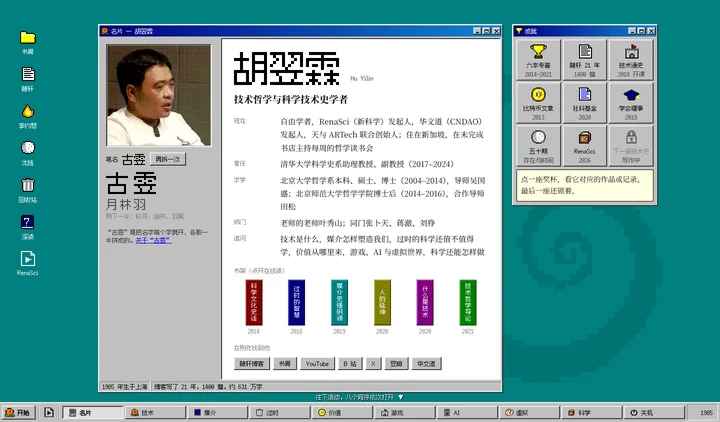 Shu·4Hu Yilin’s Scholar CardAn old Windows-style desktop where eight programs open one by one
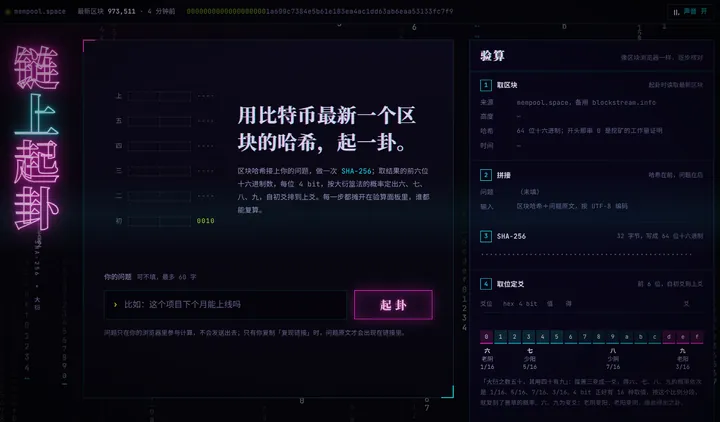 Xuan·1Casting a Hexagram on the BlockchainCasting a hexagram by the yarrow-stalk method from a Bitcoin block hash
 Zi·1Seals: From Imperial Seals to Private KeysFive exhibits that set two systems of “proof”, ancient and modern, side by side
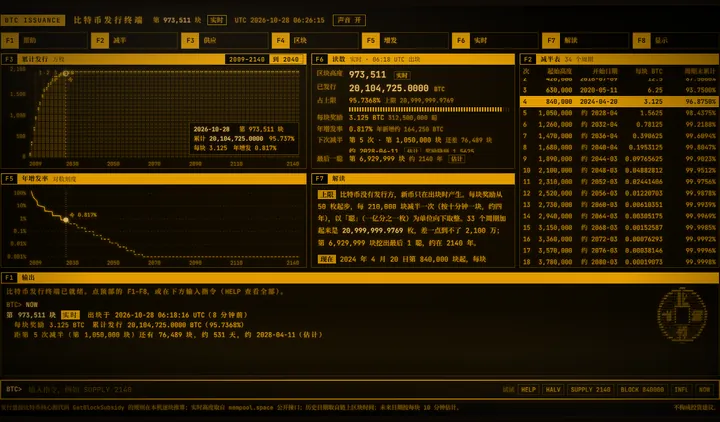 Xin·1Bitcoin Issuance TerminalBitcoin’s issuance, worked out from the rules in its source code
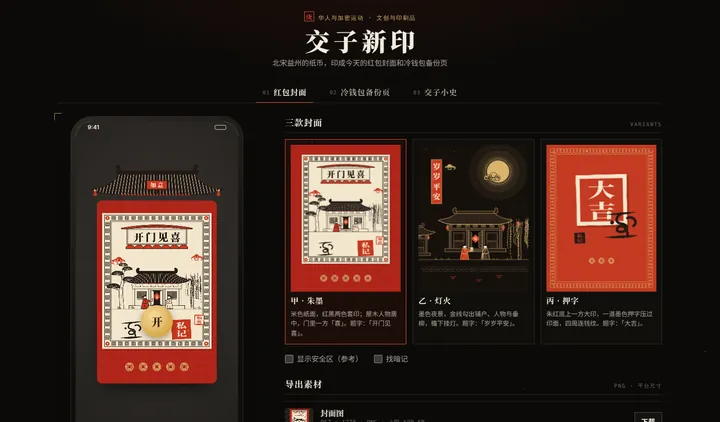 Xin·2A New Print of JiaoziNorthern Song paper money from Yizhou, printed as today’s red-packet covers and cold-wallet backup sheets
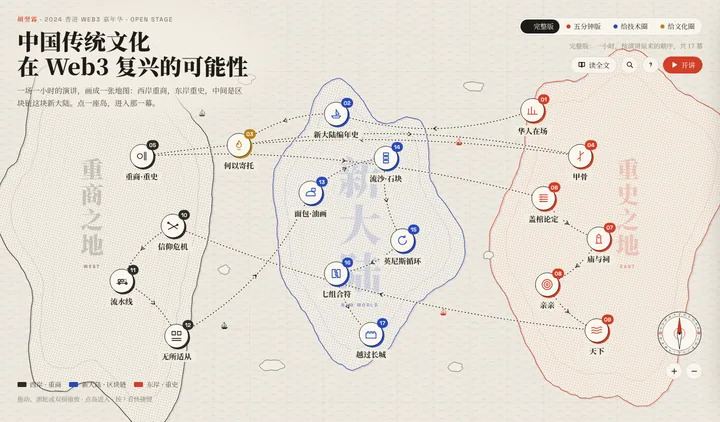 Jiang·1Can Chinese Tradition Be Revived in Web3?An hour-long talk, drawn as a map you can present or play with
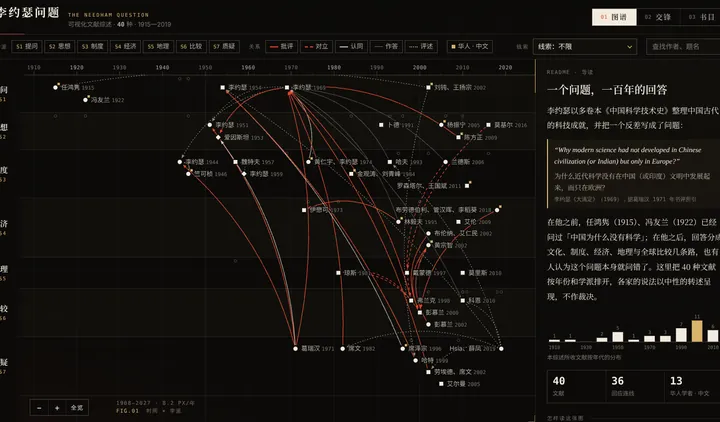 Shu·2The Needham QuestionA visual literature review: why modern science did not arise in China, and whether the question should be asked this way
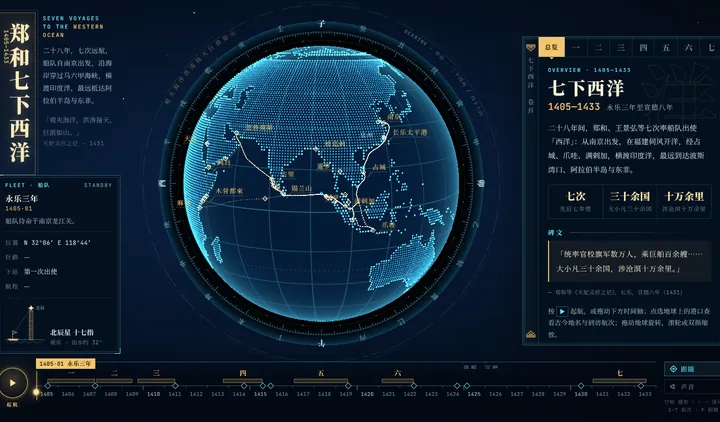 Hai·1Zheng He’s Seven VoyagesSeven voyages, drawn on a globe you can turn
 Tian·5Guo Shoujing and the Simplified ArmillaAn armillary sphere split into two instruments that do not block each other; turn the double declination ring to sight a star
 Hai·4Crossing the Ocean by the StarsMeasuring star heights with a star board to tell how far north or south the ship is