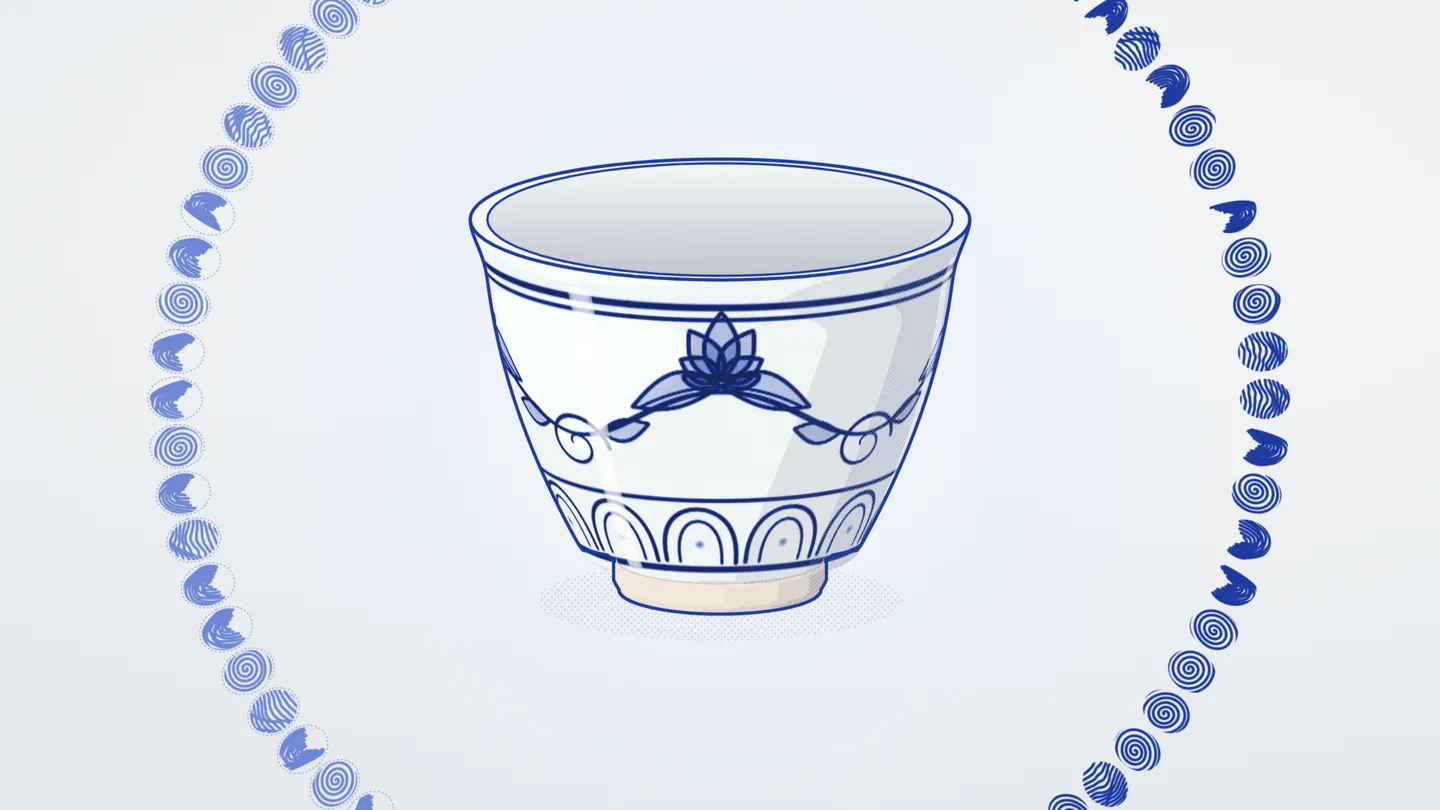
Tao·3Shaping Clay into Vessels: Pottery and Porcelain
Seventy-Two Hands
Make a Jingdezhen blue-and-white cup by hand, step by step, following The Exploitation of the Works of Nature (Tiangong Kaiwu)
- Accession no.
- Tao·3
- Category
- Interactive works
- Period
- Ming
- Directed by
- Hu Yilin
- Made by
- Claude Opus 5.5
- Similar commission
- from S$18.75
About the exhibit
The Exploitation of the Works of Nature (Tiangong Kaiwu) is a work by Song Yingxing of the Ming dynasty, printed in 1637, the 10th year of the Chongzhen reign. In the book’s middle part, the chapter “Ceramics” covers roof tiles, bricks, jars and white porcelain; its section “White Porcelain” first surveys white clays and kilns in various regions, then describes porcelain-making at Jingdezhen, in Fuliang County, Raozhou Prefecture, in detail. Song Yingxing says that Jingdezhen “has been a place for firing wares from antiquity to the present, yet it produces no white clay”. The clay was brought from two mountains in Wuyuan and Qimen: Gaoliang Mountain yields “non-glutinous rice clay”, “hard by nature”, and Kaihua Mountain yields “glutinous rice clay”, “soft and sticky by nature”; “only when the two clays are combined can porcelain be made”.
He then records how a single cup comes into being. Equal parts of the two clays go into a mortar and are pounded for a day; then they are settled in water in a vat, and the fine material floating on top is poured off into a second vat and then a third, separating coarse, medium and finest grades. The clay is poured into a brick pit right beside the kiln to dry, then mixed again with clean water. The potter’s wheel is an upright post buried 3 chi in the ground and standing about 2 chi above it, with one disc at the top and one at the bottom, spun with a short bamboo stick; on the top disc sits a helmet-shaped form carved from sandalwood. Cups and plates are made “with no fixed mould”: the thumb holds down the base of the clay, which is “turned thin and drawn up around the thumb”, and the cup takes shape; when a beginner spoils one, he will “break the piece and use the clay again”. The cup is then turned over onto the helmet form and pressed once, dried a little, pressed again, and dried until very white and dry; dipped once in water, it is set wet on the helmet form and trimmed twice with a sharp knife. A note in the original says that if the hand trembles as the knife passes, the fired cup will have a “sparrow mouth”. Chips and gaps are mended, rings are drawn as it spins on the wheel, and then it is painted or inscribed.
The blue pigment for painting bowls “is always the one substance, wumingyi” (a cobalt ore), and comes in three grades. The top grade, from the prefectures of Qu and Xin, is called Zhe pigment and costs 24 taels of silver per dan; the middle grade, from Shanggao, costs half as much; the low grade, from Fengcheng, is worth only three-tenths as much. The pigment is first calcined over charcoal: the top grade comes out of the fire the colour of kingfisher feathers, and 1 jin yields only 7 liang. It is then ground fine in a mortar and mixed with water for painting: “when ground, it is black; in the fire it turns blue-green”. After painting, a few mouthfuls of water are sprayed over the piece, and then the glaze is applied (the book writes glaze with the character 锈, ‘rust’): first swirled round the inside, then the outside is dipped once, and the glaze flows evenly over it by itself. The pieces are packed into saggars, each resting on its own clay pad, with the empty space beneath packed firmly with sand; a note in the original says that if the hand holds a piece a little too firmly during packing, it comes out of the kiln with a “dented mouth”. The 12 round holes in the kiln roof are called sky windows. The fire is first fed at the kiln door for 10 shichen (double hours), its heat attacking from below; then wood is thrown in through the sky windows for 2 shichen, so the heat goes down from above. A piece is lifted out with an iron fork to check the firing, and “once it is confirmed to be fully fired, the fuel is cut off and the fire stopped”.
The section ends: “In all, the work on one cup passes through 72 hands before it becomes a finished vessel, and even so the finer details cannot all be told.” The book does not list what the 72 are. The work counts out, one by one, the actions the original describes: 39 in all, grouped into 10 stages. Each time you complete one, one of the 72 fingerprints beside the cup lights up; the other 33 are left for the “finer details” the original does not name.
What is illustrative
The order of the steps and every figure the text gives follow the original: equal parts of the two clays, a day of pounding, three vats to separate the clay, a wheel buried 3 chi deep and about 2 chi high, two passes of the knife, the sources and prices of the three grades of pigment, the 12 sky windows, 10 shichen of fire at the door and 2 through the sky windows. The following are conjecture or simplification. The original does not say whether the clay was pounded with a hand pestle or by some other means; it is drawn as a stone mortar and pestle. The three vats set out from high to low, the cup being made from the finest clay, and the clay cracking as it dries in the brick pit are all illustrative. The wheel is drawn to the dimensions in the original, but the cup is enlarged; the original does not show clearly what the helmet form looks like. What the action of “pressing” involves, and how far the piece is dried while still “keeping it moist”, the original covers in a single line; the work marks it with a guide line. That the foot ring is cut with the second pass of the knife, and where the chips and gaps are, are also illustrative.
The original gives no colour for each of the three grades of pigment after firing, only their colours after calcining (kingfisher-feather, faintly blue, nearly earth-brown), and the work infers from these. Where the rings are drawn, and how the piece is held when “dipping a finger to coat the rim”, are conjecture. The original does not say how a dozen or so small cups are arranged in a saggar, how the saggars are stacked in the kiln, or what the kiln’s proportions are; whether the fire is “fierce” enough is shown on a gauge and is not a real measurement. Nor does the original say how long the kiln must cool or how it is opened. The “sparrow mouth” and “dented mouth” are drawn as imagined; the original’s notes say only that a hand that shakes under the knife makes a sparrow mouth, and a slightly heavy grip when packing the saggar makes a dented mouth. Counting the original as 39 actions is this work’s own reading.
Sources and references
- Song Yingxing, The Exploitation of the Works of Nature (Tiangong Kaiwu), chapter 2, “Ceramics: White Porcelain”; Ming woodblock edition held by Peking University Library (CADAL digital scan, Internet Archive identifier 02095377.cn)
- Song Yingxing, The Exploitation of the Works of Nature (Tiangong Kaiwu), Project Gutenberg e-text (eBook #25273)
Want something like this? See how to commission an interactive teaching page →
Spotted an error in the history, data or sources? Please write to [email protected].
 Hai·1Zheng He’s Seven VoyagesSeven voyages, drawn on a globe you can turn
 Tao·1Ringing Like a Chime StonePorcelain and glass, East and West
 Tao·2Kiln TransformationA glaze laboratory: mix the glaze, watch the fire, open the kiln
 Tao·4The Porcelain Sea RoadBring up a ship’s cargo and see how it changed both shores
 Ya·5Movable Type: Bi Sheng’s Clay TypeSet a plate of clay movable type by hand, as recorded in the Dream Pool Essays