Tao·4Shaping Clay into Vessels: Pottery and PorcelainFeatured
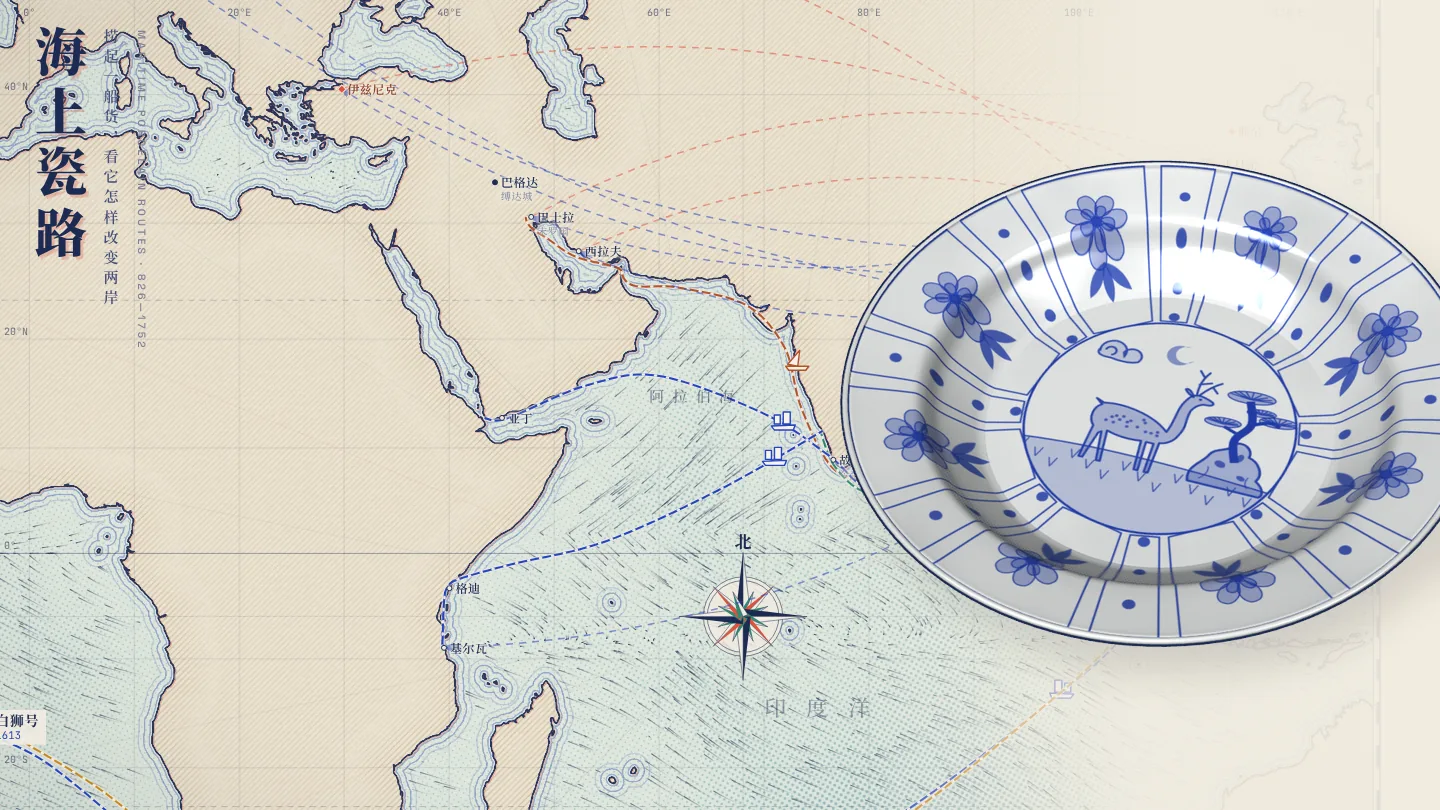
The Porcelain Sea Road
Bring up a ship’s cargo and see how it changed both shores
- Accession no.
- Tao·4
- Category
- Interactive works
- Period
- Tang to Qing
- Directed by
- Hu Yilin
- Made by
- Claude Opus 5.5
- Similar commission
- from S$50
About the exhibit
From the 9th to the 18th century, Chinese porcelain was exported by sea in great quantities. Sailing ships came and went with the monsoons: the Song writer Zhu Yu records in his Pingzhou Ketan (Table Talk at Pingzhou) that the seagoing ships of Guangzhou “set out in the 11th and 12th months, with the north wind, and come back in the 5th and 6th months, with the south wind”, and that their cargo was “mostly ceramics, the small nested inside the large, with hardly a gap left”. When a ship sank, its whole cargo stayed on the seabed just as it was, and became the surest evidence of this route.
Six wrecks are marked on the chart. The Belitung (Batu Hitam) wreck is an Arab-style sewn-plank ship found off Belitung Island, Indonesia, in 1998. A Changsha ware bowl on board is inscribed “16th day of the 7th month of the 2nd year of Baoli” (826). About 60,000 pieces were recovered, including about 57,500 pieces of Changsha ware and about 55,000 bowls, as well as Yue ware celadon, northern white wares, white wares splashed with green, three Gongxian blue-and-white dishes, and objects of gold and silver. The Nanhai No. 1 is a Southern Song merchant ship found in 1987 in the waters off Yangjiang, Guangdong. In 2007 it was enclosed, together with the sediment around it, in a steel caisson and lifted whole; more than 180,000 objects (pieces or sets) have been recovered, about 160,000 of them ceramics, from kilns at Jingdezhen, Longquan, Dehua, Cizao and elsewhere. The Northwest Continental Slope No. 1 wreck of the South China Sea, found in 2022 at a depth of about 1,500 metres, is a ship of the Zhengde reign of the Ming. Its remains are estimated at more than 100,000 pieces, mostly Jingdezhen blue-and-white, with Islamic-style blue-and-white and fahua ware as well; the No. 2 wreck nearby carried logs from mainland Southeast Asia and was sailing towards China. The Witte Leeuw was a ship of the Dutch East India Company that sank in 1613 off St Helena in the South Atlantic during a fight with Portuguese ships. Found in 1976, it yielded about 290 intact pieces of porcelain and 200 to 300 kilograms of sherds, mostly kraak porcelain from private kilns at Jingdezhen. The Götheborg, a ship of the Swedish East India Company, struck a rock and sank in 1745 within sight of the port of Gothenburg; excavations from 1986 to 1992 brought up several tonnes of porcelain sherds and about 300 intact pieces. The Geldermalsen, a ship of the Dutch East India Company, struck a reef and sank south-west of Batam in 1752 with 686,997 pounds of tea and 203 chests of porcelain on board. In 1985 it was salvaged commercially and the site was destroyed; the cargo was auctioned in Amsterdam the following year.
Once porcelain reached the far shore, it was often imitated and reworked, and influence could also flow the other way. In the 9th century, Iraqi potters coated earthenware with a white tin glaze to imitate Chinese white porcelain, and painted on the white glaze in cobalt blue; a lozenge-and-palm-leaf design from Iraq reached China, where the Gongxian kilns, using cobalt that may have come from Iran, made the earliest complete Chinese blue-and-white porcelain known today and sold it on to West Asia. The Changsha kilns catered to the taste of West Asian buyers, applying date palms, lions, and foreign musicians and dancers to their ewers. From the Yuan dynasty on, Jingdezhen blue-and-white depended on cobalt imported from Persia, and Yongle-period tankards copied Near Eastern metalwork; in turn, large Yuan and early Ming blue-and-white dishes entered the collections of the Ottoman court, and Yongle dishes painted with grapes became the most important models for the potters of Iznik. In East Africa, the domes of the Great Mosque at Kilwa and the mosques and tombs of Gedi were set with Chinese porcelain. In Europe, after the Dutch captured the Portuguese merchant ship Santa Catarina in 1603, this kind of blue-and-white with decorated panels came to be called “kraak porcelain” and found its way into Dutch still-life painting; when supplies were cut off at the end of the 1640s, the potters of Delft painted “Chinese-style” blue-and-white on tin-glazed earthenware. In the 18th century, Europeans in turn sent shapes, patterns and family coats of arms to China to be made to order.
The routes and monsoon flow lines are illustrative, and the monsoons are drawn only in broad outline. The wreck scenes, objects and patterns are illustrations drawn from the sources listed, not photographs of the artefacts; numbers of pieces, dates and kilns follow the sources listed, and where accounts differ, one of them has been chosen.
Sources and references
- Zhu Yu, Pingzhou Ketan (Table Talk at Pingzhou), chapter 2 (Wikisource)
- New Book of Tang, Treatise on Geography 7B, quoting Jia Dan’s “Sea Route from Guangzhou to the Foreign Lands” (Wikisource)
- National Heritage Board, Singapore, Roots.sg: Sunken Treasure: A Ninth Century Shipwreck, https://www.roots.gov.sg/stories-landing/stories/sunken-treasure-a-ninth-century-shipwreck/story
- Asian Civilisations Museum collection, 2005.1-00475: Blue-and-white dish with lozenge and foliate motifs, Roots.sg, https://www.roots.gov.sg/collection-landing/listing/1311745
- Asian Civilisations Museum, press release: The Lost Dhow: A Discovery from the Maritime Silk Route, 2014
- Regina Krahl, John Guy, J. Keith Wilson, Julian Raby (eds.), Shipwrecked: Tang Treasures and Monsoon Winds, Washington, DC: Arthur M. Sackler Gallery, Smithsonian Institution; Singapore: National Heritage Board, Singapore Tourism Board, 2010
- John Guy, “Rare and Strange Goods: International Trade in Ninth-Century Asia”, in Shipwrecked: Tang Treasures and Monsoon Winds, 2010, https://asia-archive.si.edu/wp-content/uploads/2017/10/02Guy.pdf
- Regina Krahl, “Tang Blue-and-White”, in Shipwrecked: Tang Treasures and Monsoon Winds, 2010, https://asia-archive.si.edu/wp-content/uploads/2017/10/15Krahl.pdf
- Shipwrecked: Tang Treasures and Monsoon Winds, Special Souvenir Edition (text by Alison Effeny), Arthur M. Sackler Gallery et al., 2010, https://archive.asia.si.edu/Shipwrecked/downloads/01Intro.pdf
- Chen Kelun, “Behind the ‘Batu Hitam’ Shipwreck: Porcelain Treasures from the Wreck and the Tang Ceramics Trade”, The Paper, 2020-10-04, https://www.thepaper.cn/newsDetail_forward_9338068
- Sparking a Colorful Commercial Revolution, China Daily, 2026-02 (reposted on the Hunan Provincial Government portal), https://www.hunantoday.cn/news/xhn/202602/31530755.html
- Wang Kaihao, Ancient Chinese shipwreck yields over 180,000 cultural relics, China Daily, 2019-08-06, https://global.chinadaily.com.cn/a/201908/06/WS5d498a06a310cf3e3556436b.html
- Huang Yao, Deng Ruixuan and Meng Yifei, “‘Classical Splendour’ Asleep for More than 800 Years in the Depths of the South China Sea”, Xinhua Daily Telegraph, 2020-06-26 (reposted on Chinese Social Sciences Net)
- Xu Wenpeng, Chen Zhitao, Xiao Dashun, Ye Daoyang, Yang Zelin, “Unveiling maritime trading practices: micro-provenance analysis of Dehua-style porcelain from the Nanhai I shipwreck”, Antiquity 99 (404): 517–535, 2025, doi:10.15184/aqy.2024.204
- UNESCO Silk Roads Programme: The Nanhai No. 1 shipwreck, https://en.unesco.org/silkroad/silk-road-themes/underwater-heritage/nanhai-no-1-shipwreck
- Qin Dashu, “An Important Discovery in China’s Deep-Sea Archaeology”, People’s Daily, 2023-08-19, page 7
- CCTV News, “Extent of the Northwest Continental Slope No. 1 and No. 2 Wrecks in the South China Sea Mapped; 928 Objects Recovered”, 2024-06-13 (reposted on Tide News), https://tidenews.com.cn/news.html?id=2820741
- Rijksdienst voor het Cultureel Erfgoed, MaSS (Maritime Stepping Stones): Witte Leeuw; Geldermalsen, https://mass.cultureelerfgoed.nl/witte-leeuw, https://mass.cultureelerfgoed.nl/geldermalsen
- C. L. van der Pijl-Ketel, “Chinese ceramics salvaged from the Witte Leeuw (1613) and other early seventeenth-century shipwrecks”, Aziatische Keramiek, 2024-08-19, https://aziatischekeramiek.nl/en/learn/7571-chinese-ceramics-salvaged-from-the-witte-leeuw-1613-and-other-early-seventeenth-century
- Rijksmuseum, NG-1977-118-W: Porcelain and pepper from the VOC trading ship the Witte Leeuw, https://www.rijksmuseum.nl/en/collection/NG-1977-118-W
- Rijksmuseum, AK-RBK-1975-129: Plate with an image of The Parasol Lady
- Asian Civilisations Museum collection, C-1273: Fragments from ‘Nanking Cargo’, Roots.sg, https://www.roots.gov.sg/collection-landing/listing/1011592
- Jan-Erik Nilsson, gotheborg.com: The Wästfelt Excavation 1986–1993; Shipwreck Götheborg, https://gotheborg.com/project/porcelaincargo.shtml, https://gotheborg.com/glossary/shipwreck_gotheborg.shtml
- Vrak – Museum of Wrecks: 1745 Götheborg, https://www.vrak.se/en/explore/dive-deep-among-the-wrecks/1700-talet/1745-gotheborg
- Wikipedia: Götheborg (ship); Santa Catarina (ship); Kraak ware; Delftware; Blue and white pottery (citing Robert Finlay, The Pilgrim Art, 2010)
- The Metropolitan Museum of Art, 63.159.4: Bowl Emulating Chinese Stoneware, https://www.metmuseum.org/art/collection/search/451715
- The Metropolitan Museum of Art, 91.1.102: Plate with Grapes, https://www.metmuseum.org/art/collection/search/444455
- Jeffrey H. Munger and Alice Cooney Frelinghuysen, “East and West: Chinese Export Porcelain”, Heilbrunn Timeline of Art History, The Metropolitan Museum of Art, 2003, https://www.metmuseum.org/essays/east-and-west-chinese-export-porcelain
- British Museum, 1950,0403.1: Tankard, https://www.britishmuseum.org/collection/object/A_1950-0403-1
- British Museum, 1968,0422.27: Dish, https://www.britishmuseum.org/collection/object/A_1968-0422-27
- The National Gallery, London: Dutch Flower Painting in Detail, https://nationalgallery.org.uk/exhibitions/past/dutch-flowers/dutch-flower-painting-in-detail
- Art Gallery of New South Wales: Craze for kraak, https://www.artgallery.nsw.gov.au/artboards/rembrandt/craze-for-kraak/item/erlx88/
- UNESCO World Heritage Centre: Ruins of Kilwa Kisiwani and Ruins of Songo Mnara, https://whc.unesco.org/en/list/144
- UNESCO World Heritage Centre: Historic Town and Archaeological Site of Gedi, 2024, https://whc.unesco.org/en/list/1720
- Coastlines: Natural Earth 1:50m land data (world-atlas, ISC licence)
Want something like this? See how to commission an interactive teaching page →
Spotted an error in the history, data or sources? Please write to [email protected].
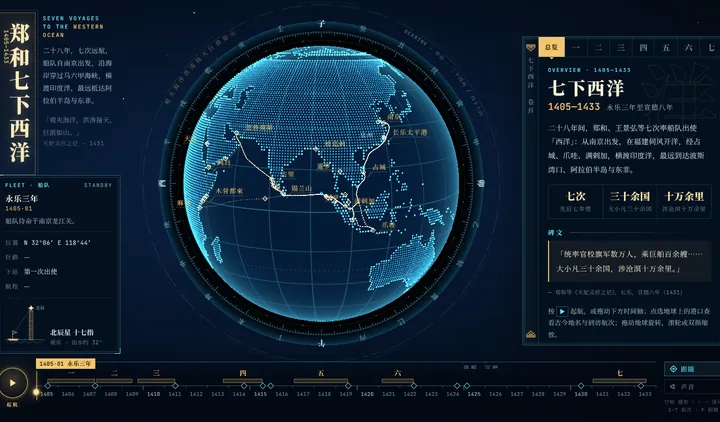 Hai·1Zheng He’s Seven VoyagesSeven voyages, drawn on a globe you can turn
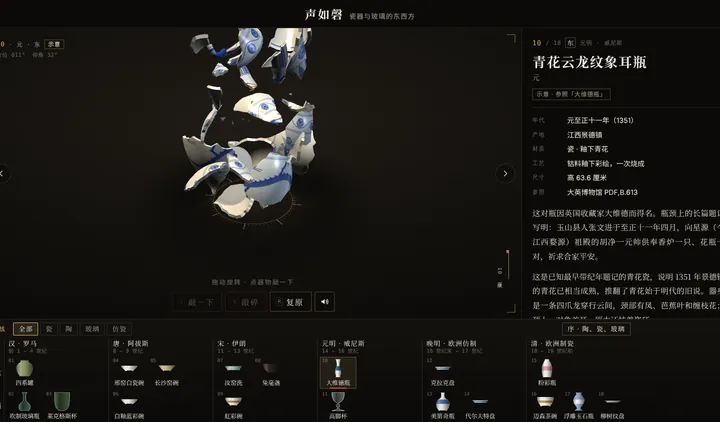 Tao·1Ringing Like a Chime StonePorcelain and glass, East and West
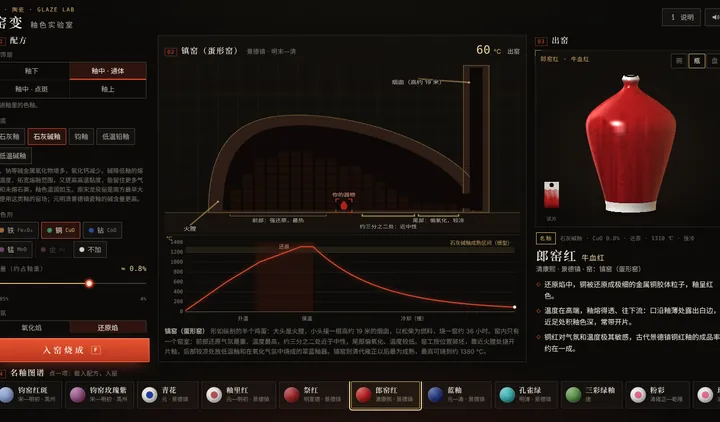 Tao·2Kiln TransformationA glaze laboratory: mix the glaze, watch the fire, open the kiln
 Tao·3Seventy-Two HandsFollowing The Exploitation of the Works of Nature, make a Jingdezhen blue-and-white cup by hand, stage by stage
 Hai·4Crossing the Ocean by the StarsMeasuring star heights with a star board to tell how far north or south the ship is