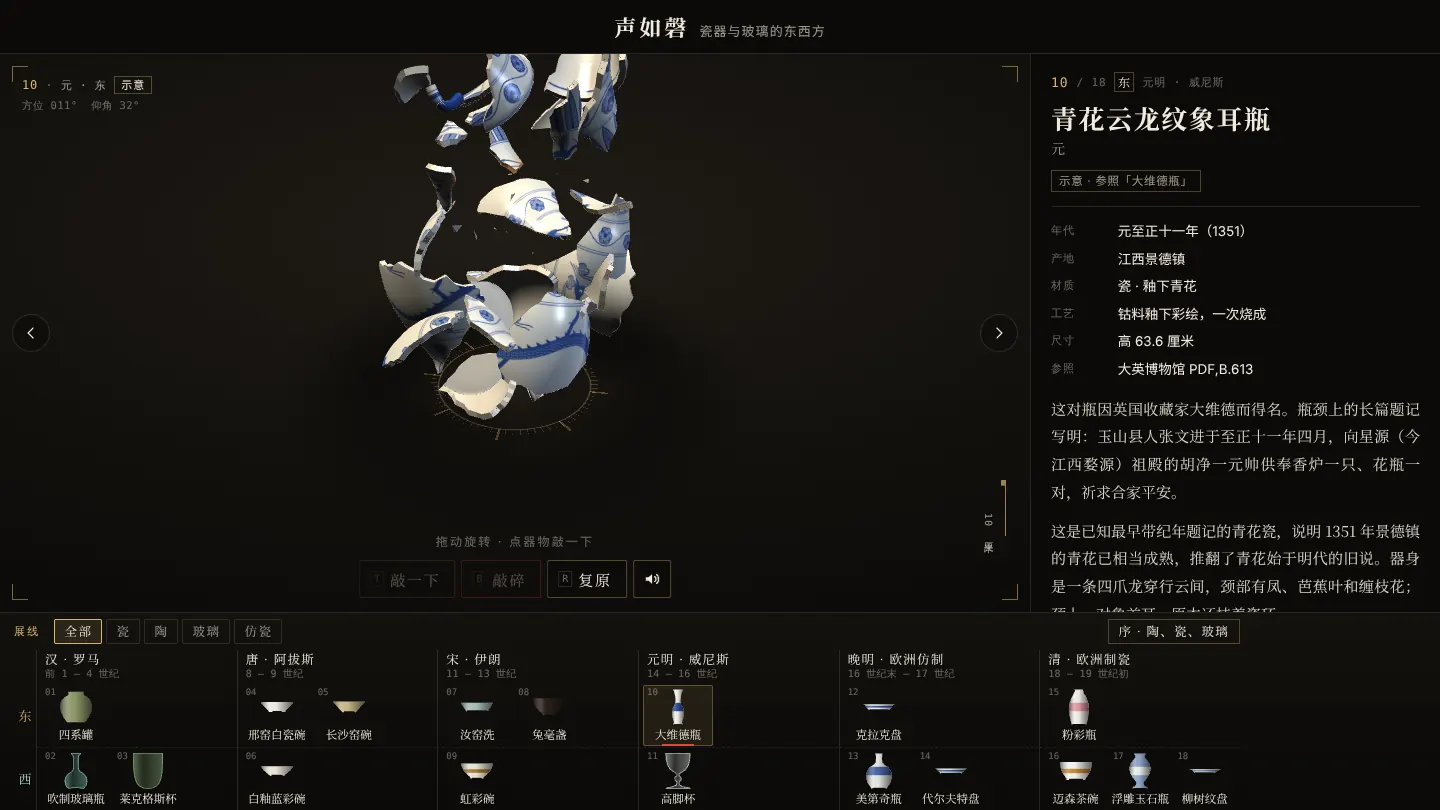
Tao·1Shaping Clay into Vessels: Pottery and PorcelainFeatured
Ringing Like a Chime Stone
Porcelain and glass, East and West
- Accession no.
- Tao·1
- Category
- Online exhibitions
- Period
- Han–Qing
- Directed by
- Hu Yilin
- Made by
- Claude Opus 5.5
- Similar commission
- from S$50
About the exhibit
In the Eastern Han, the Yue kilns of eastern Zhejiang produced celadon; sherds excavated from Eastern Han kiln sites are estimated to have been fired at 1260–1300°C. At about the same time, craftsmen on the eastern shore of the Mediterranean invented glassblowing, in the early 1st century BCE. For nearly 2,000 years after that, the East fired clay into porcelain that rings and the West blew sand into clear glass, each beautiful in its own way, and each constantly imitating and trading with the other.
This online exhibition shows 18 objects as counterparts across six periods: Eastern Han celadon facing Roman blown glass and the British Museum’s Lycurgus Cup; Tang white porcelain from the Xing kilns and a painted Changsha ware bowl facing a white-glazed bowl painted in blue from Basra (Abbasid potters, imitating Chinese white porcelain, covered earthenware with a white tin glaze and painted cobalt blue over it); Song Ru ware and a Jian tea bowl facing a lustre-painted fritware bowl from Kashan in Iran; the Yuan blue-and-white David Vases (1351) facing Venetian cristallo glass; late Ming kraak export porcelain facing Medici porcelain from Florence and tin-glazed imitations from Delft in the Netherlands; Qing famille rose facing Meissen hard-paste porcelain, Wedgwood jasperware and the willow pattern on English bone china.
Every object can be turned by dragging, struck with a click, shattered and restored. Once it is broken, the fracture shows what it is made of: a porcelain body is white, dense and vitrified; the white of tin-glazed earthenware is only a thick layer of glaze on the surface, over a porous earthenware body; the body of fritware is grains of quartz; glass has neither body nor glaze, and breaks with smooth, sharp edges. The labels also include an “Introduction” on the differences between pottery, porcelain and glass, on how the name kaolin travelled to Europe from the village of Gaoling near Jingdezhen, and on where the phrase “ringing like a chime stone” comes from.
How this work was made
Every object is made by rotating a single profile curve. The profiles follow dimensions published by museums or the usual proportions of similar pieces; the inner wall is the outer curve, smoothed and offset inward by the wall thickness, and lugs, handles and other attachments are swept separately from small tubes. Glaze colours, crackle, blue-and-white, famille rose enamels, lustre, relief and weathering are painted onto textures by code and rendered with WebGL shaders: porcelain glazes reflect the light box of a display case, thick celadon glazes darken at grazing angles, lustre changes colour with the viewing angle, glass is blended semi-transparently according to Fresnel reflection, and the Lycurgus Cup turns from green to red under “Backlight”. All images are illustrative; where they follow pieces in collections, they take only the general shape and decoration.
The sound of each strike is synthesised live in the browser: several groups of partials that are not whole-number multiples of one another, slightly detuned in pairs, decay faster or slower according to the material — porcelain clear and long, stoneware a little shorter, tin-glazed earthenware dull, glass bright. It aims only to be plausible; it is not measured data. When an object shatters, a periodic Voronoi partition centred on the point of impact is made on the parameter plane of the surface of revolution; each shard has an outer wall, an inner wall and broken side walls, and the side walls are coloured in layers in proportion to the thickness of glaze and body. The shards fall as rigid bodies, with impulse collisions and friction against the plinth, and are put to sleep once they come to rest; on “Restore” they fly back along arcs to where they were. The code uses no libraries at all and loads no external resources.
Sources and references
- Lu Yu, The Classic of Tea, chapter 4, “Utensils”
- Du Fu, “Asking Wei Again for Porcelain Bowls from Dayi”
- Zhang Yingwen on Chai ware in Treasures of Pure Seclusion (Qingmi Cang), as quoted in Li Yanzu, “Jade Porcelain, Green Hills: The Art and Culture of Chinese Celadon — Reading A History of Celadon Art”, Aisixiang
- Cai Xiang, Record of Tea, and Emperor Huizong of Song, Treatise on Tea (Daguan Chalun), as cited in Chinese Social Sciences Net, “A Bowl of Spring Colour, a Thousand Years of Elegance”, 2025-10-13
- Zhang Maolin, “The Spirit of Innovation Forged a Thousand Years of Glory for the World’s Porcelain Capital”, Chinese Social Sciences Net, 2024-08-30
- Xinhua report on Yue ware celadon, 2026-02-16; China Intangible Cultural Heritage Network, “Yue Ware Celadon Firing Techniques” (Ⅷ-187)
- Asian Civilisations Museum, Singapore, The Tang Shipwreck gallery; Roots.sg, Bowl with dated inscription, 2005.1-00538
- British Museum: The Lycurgus Cup, 1958,1202.1; Ru ware brush-washer, PDF,A.26; The David Vases, PDF,B.613
- The Metropolitan Museum of Art: “Roman Glass”; “Ceramics along the Silk Road”; “German and Austrian Porcelain in the Eighteenth Century”
- The Metropolitan Museum of Art: Bowl Emulating Chinese Stoneware, 63.159.4; Tea Bowl with Hare’s-Fur Decoration, 29.100.227; Bowl with Leopard, 68.215.10; Ewer (Brocca), 17.190.2046
- Victoria and Albert Museum: Tea bowl and saucer, Meissen, C.39:1, 2-2006; Coffee pot, C.160&A-1937
- Corning Museum of Glass, “Glass Corrosion: Weathering”
- National Gallery of Victoria, “Liquid light: 500 years of Venetian glass”
- Art Gallery of New South Wales, “Craze for kraak”
- Gotheborg.com, Père François Xavier d’Entrecolles
- Wikipedia: Chinese ceramics; Kaolinite; Porcelain; Earthenware; Roman glass; Lycurgus Cup; Xing ware; Tin-glazed pottery; Lustreware; Abbasid ceramics; Fritware; Jian ware; David Vases; Santa Catarina (ship); Medici porcelain; Delftware; Famille rose; Meissen porcelain; Jasperware; Portland Vase; Bone china; Willow pattern
Want something like this? See how to commission an online exhibition →
Spotted an error in the history, data or sources? Please write to [email protected].
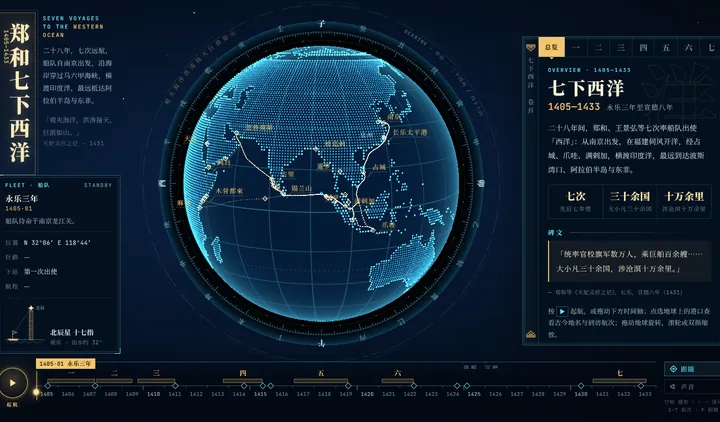 Hai·1Zheng He’s Seven VoyagesSeven voyages, drawn on a globe you can turn
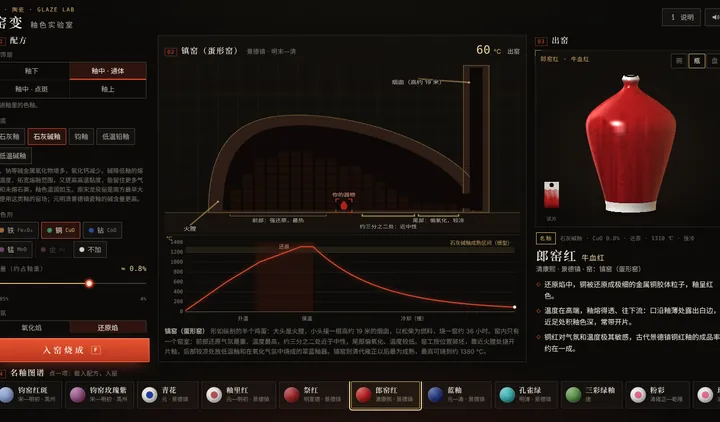 Tao·2Kiln TransformationA glaze laboratory: mix the glaze, watch the fire, open the kiln
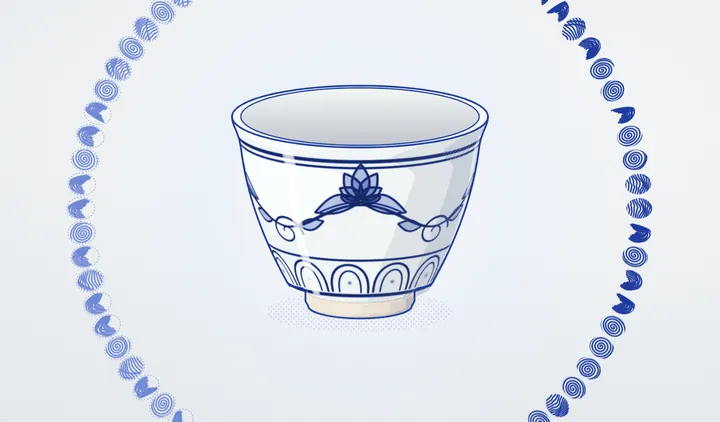 Tao·3Seventy-Two HandsFollowing The Exploitation of the Works of Nature, make a Jingdezhen blue-and-white cup by hand, stage by stage
 Tao·4The Porcelain Sea RoadBring up a ship’s cargo and see how it changed both shores