
You·1Playground
Which Ancient Are You?
12 everyday scenes, 16 ancients
- Accession no.
- You·1
- Location
- Playground
- Category
- Games
- Period
- Spring and Autumn to Ming
- Directed by
- Hu Yilin
- Made by
- Claude Opus 5.5
- Similar commission
- from S$18.75
About the exhibit
This is a little quiz in the CNDAO Playground: what to do on a free afternoon, whether to move house, the one thing you would take to a desert island, what you are doing the night before you must hand in your work first thing in the morning… There are 12 everyday scenes; for each, pick the answer most like you, and see which ancient you resemble most. The questions size you up along four axes: motion and stillness, reason and feeling, company and solitude, constancy and change. Taking one end of each axis gives 16 results, matched to 16 ancients: from Confucius in the Spring and Autumn period and Zhuangzi in the Warring States, through Ban Zhao of the Eastern Han, Tao Yuanming of the Eastern Jin, Zu Chongzhi of the Southern Dynasties, Xuanzang, Li Bai and Du Fu of the Tang, Shen Kuo, Su Shi and Li Qingzhao of the Song, and Guo Shoujing and Huang Daopo of the Yuan, to Zheng He, Zhu Zaiyu and Xu Xiake of the Ming. There are thinkers, poets and a historian, and also mathematicians, astronomers, a navigator and a textile innovator.
Each ancient’s short biography keeps to what the historical record supports: Zheng He took more than 27,800 people on his first voyage to the Western Oceans; Guo Shoujing, in his seventies, asked to retire and go home, but the court would not allow it; Zhu Zaiyu lived alone for 19 years in an earthen hut outside the gate of the princely residence; Li Qingzhao and her husband brewed tea after meals and played at “betting on books”. Uncertain birth and death years are marked “c.”, and Huang Daopo’s dates are unknown. As for who goes in which box, and who counts as whose “kindred spirit” or “rival”, that is our own bit of fun. This is just a little game, not a personality test.
How this work was made
Each question looks mainly at one axis: an option scores 10 points on that axis, and some options also add or take away 3 points on another axis. Each axis has three main questions, so the totals can never tie. We have worked through all 4¹² possible sets of answers: every one of the 16 results can be reached, each accounting for about 5.5% to 6.9%. The order of the options is shuffled every time.
The seal on the results page is laid out by code on a canvas as a four-character intaglio seal, white characters on red, read in columns from the top right; the wear along its edges is generated from the name, so it is the same every time. Each ancient also has a line-drawn emblem, such as Zheng He crossing the ocean by the stars, or Zhu Zaiyu’s 12 pitch-pipes (each shorter than the one before by a factor of the twelfth root of 2). There is also a small sign that shows the four axes as four lines: solid lines for motion, reason, company and constancy, broken lines for stillness, feeling, solitude and change. Its form is borrowed from Yang Xiong’s Canon of Supreme Mystery (Taixuan), in which four lines make up one “head” (shou); in the Taixuan each line can take three forms, but only two are used here. The result card is drawn in the browser as a 1080 × 1350 image; the quiz collects and uploads no data.
Sources and references
- Analects, the chapters “Xue Er”, “Shu Er”, “Xian Jin” and “Yan Yuan”; Records of the Grand Historian, “Hereditary House of Confucius”
- Zhuangzi, “Autumn Floods” and “Discussion on Making All Things Equal”
- Book of the Later Han, “Biographies of Exemplary Women”: “The Wife of Cao Shishu” (Ban Zhao)
- Book of Song, “Biographies of Recluses”: Tao Qian; Tao Yuanming, “Returning Home” and its preface, “Returning to the Fields” and “Drinking Wine”
- Book of Southern Qi, biography of Zu Chongzhi; Book of Song, Treatise on Harmonics and the Calendar; Book of Sui, Treatise on Harmonics and the Calendar
- Huili and Yancong, Biography of the Tripitaka Master of the Great Ci’en Monastery of the Great Tang; Great Tang Records on the Western Regions, related by Xuanzang and written down by Bianji
- New Book of Tang, biography of Li Bai; Li Bai, “Letter to Administrator Pei of Anzhou” and “Drinking Alone by Moonlight”
- New Book of Tang, biography of Du Fu; Du Fu, “Song of My Thatched Hut Torn Apart by the Autumn Wind”, “On the River, Meeting Waters as Mighty as the Sea: A Brief Account”, “Remembering Li Bai on a Spring Day”, “Going from the Capital to Fengxian: Five Hundred Words on My Feelings” and “Song of the Eight Immortals of the Wine Cup”
- History of Song, biography of Shen Kuo; Shen Kuo, Dream Pool Essays, author’s preface and chapter 24, and Supplement to the Dream Pool Essays, chapter 2
- History of Song, biography of Su Shi; Su Shi, “Eating Lychees, Two Poems”
- Li Qingzhao, “Afterword to Records on Bronze and Stone”, “Preface to the Illustrated Manual of Da Ma” and “On Song Lyrics”; History of Song, biography of Li Gefei
- Tao Zongyi, Notes Taken While Resting from the Plough (on Huang Daopo); Wang Feng, Wuxi Collection
- History of Yuan, biography of Guo Shoujing; History of Yuan, Treatise on the Calendar
- History of Ming, biography of Zheng He; History of Ming, “Biographies of the Princes” (Zhu Zaiyu); Zhu Zaiyu, New Account of the Science of the Pitch-Pipes and Essential Meaning of the Standard Pitch-Pipes
- Travel Diaries of Xu Xiake; China Tourism Day (established in 2011 and set on 19 May, the date of the diaries’ opening entry)
Spotted an error in the history, data or sources? Please write to [email protected].
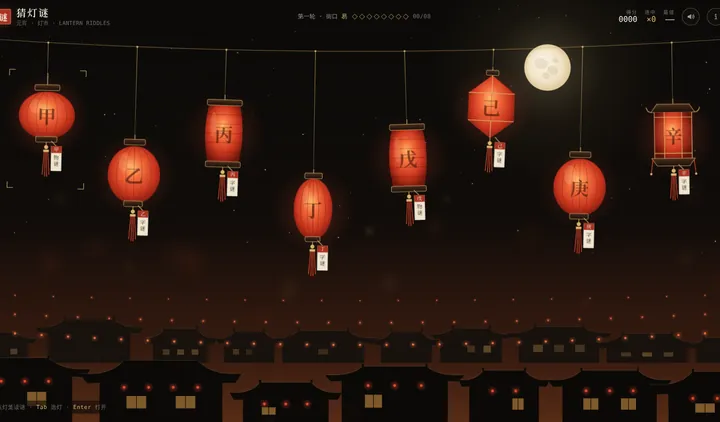 You·2Lantern RiddlesA Lantern Festival fair: three rounds, 24 lanterns
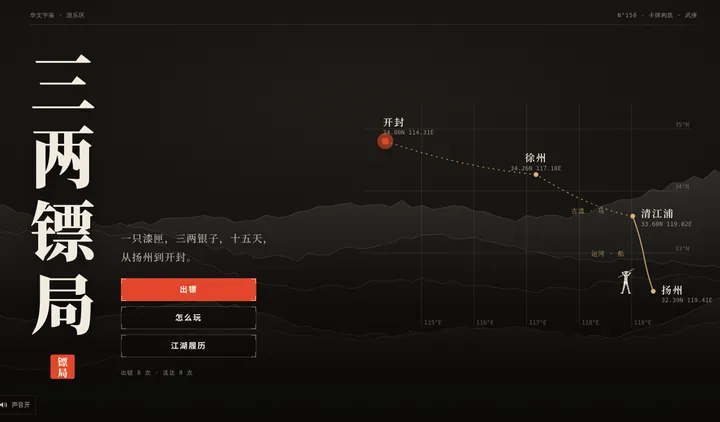 You·3The Three-Tael Escort AgencyA lacquer box to deliver from Yangzhou to Kaifeng
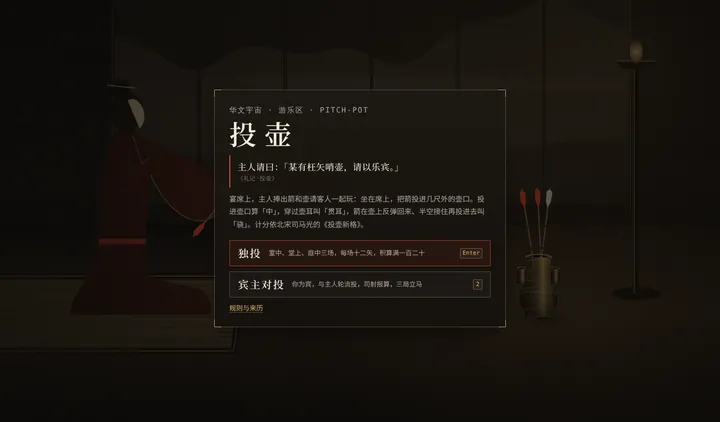 You·4Pitch-Pot12 arrows, one pot, by the rules of the Book of Rites and the New Rules for Pitch-Pot
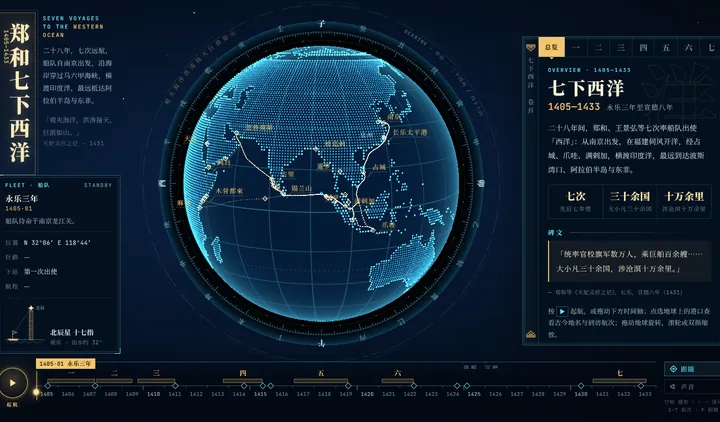 Hai·1Zheng He’s Seven VoyagesSeven voyages, drawn on a globe you can turn
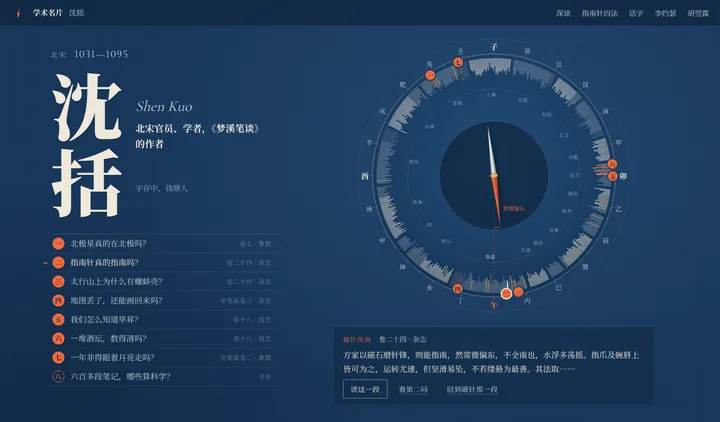 Ya·3Shen Kuo’s Scholar CardAlways Slightly East: turn a compass laid out from the Dream Pool Essays
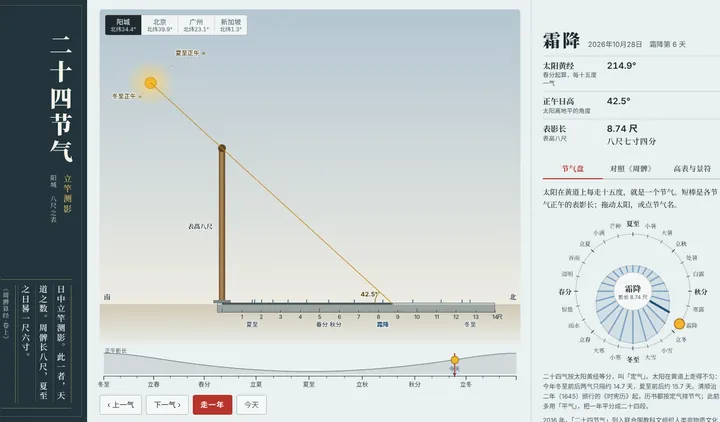 Tian·2The 24 Solar Terms: Measuring the Gnomon’s ShadowAn 8-chi gnomon and a year of shadows
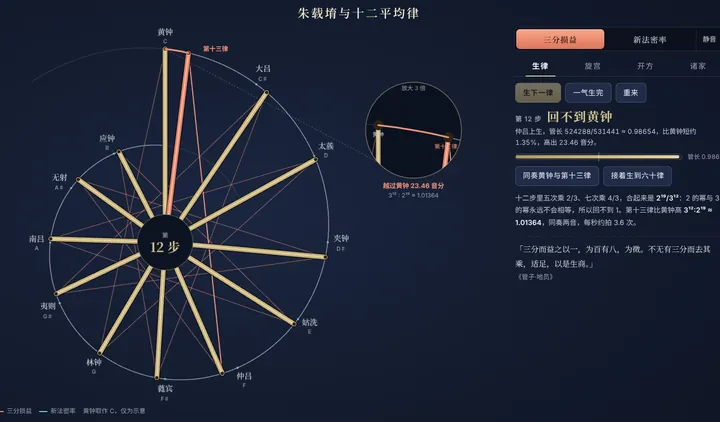 Lü·3Zhu Zaiyu and Equal TemperamentHow the 12 pitches come full circle