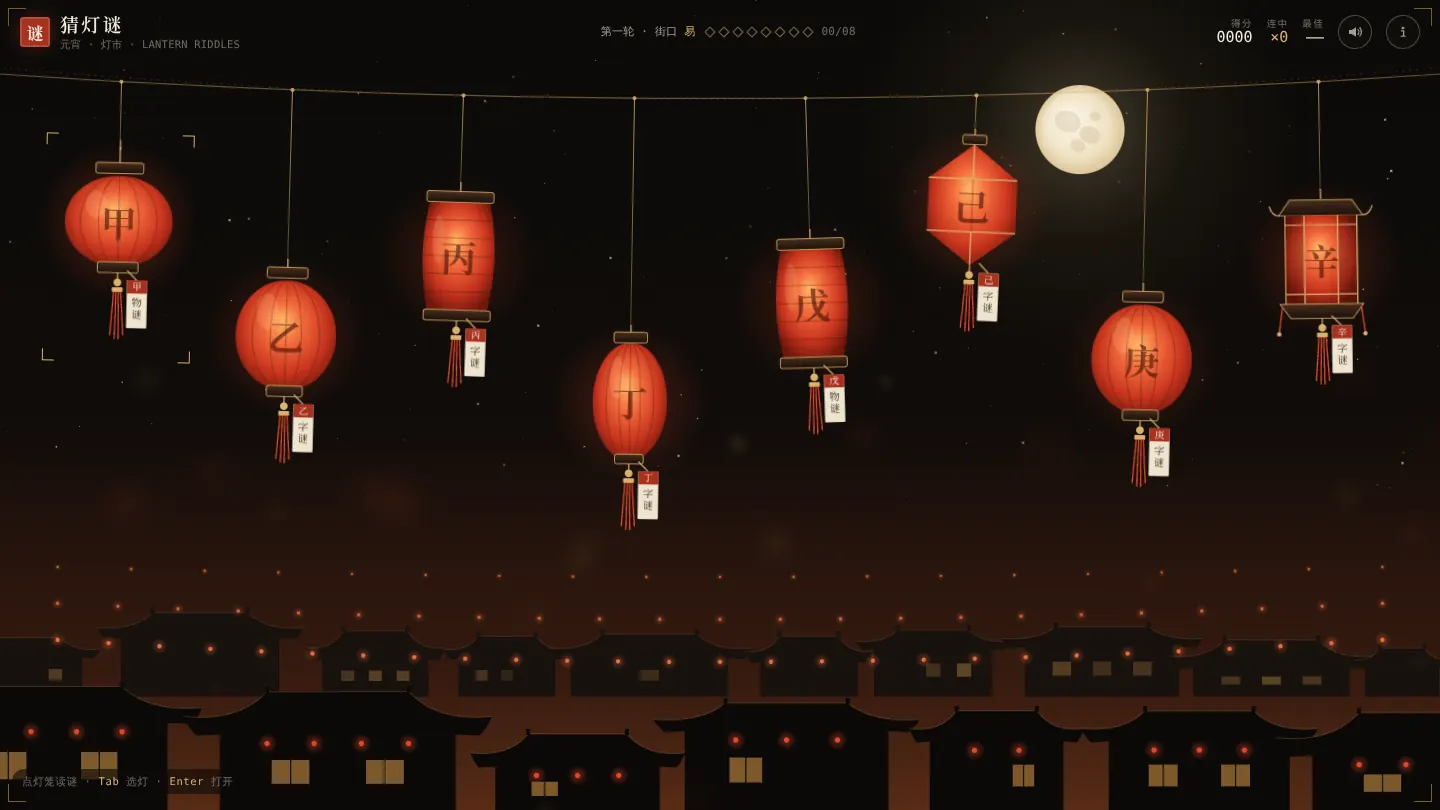
You·2Playground
Lantern Riddles
A Lantern Festival fair: three rounds, 24 lanterns
- Accession no.
- You·2
- Location
- Playground
- Category
- Games
- Directed by
- Hu Yilin
- Made by
- Claude Opus 5.5
- Similar commission
- from S$18.75
About the exhibit
The Lantern Festival falls on the 15th day of the first month, the first full-moon night of the lunar new year. On this night people look at lanterns, eat yuanxiao dumplings and guess lantern riddles: the riddles are written on slips of paper and hung beneath decorated lanterns for passers-by to guess, and whoever solves one takes down the slip and claims a small prize. Lantern riddles are also called “lantern tigers” or “word tigers”, and solving them is “shooting the tiger”. Liu Xie of the Southern Dynasties defined the riddle in “Humour and Enigma”, a chapter of The Literary Mind and the Carving of Dragons: “A riddle turns its words about so as to bewilder.” It is generally held that the custom of writing riddles on lanterns for people to guess had appeared by the Southern Song at the latest, and from the Ming and Qing onwards it became a regular feature of Lantern Festival fairs.
The lantern street has three stretches (the Street Entrance, the Lantern Sheds and the Lantern Hill), each harder than the last, with eight lanterns in each. The riddle bank holds 48 traditional lantern riddles long handed down among ordinary people: 34 character riddles, 10 object riddles and 4 idiom riddles, from which each game draws 24. Character riddles show off the playfulness of Chinese characters best: “one mouth bites off the ox’s tail” is 告 (a tailless 牛 ‘ox’ over 口 ‘mouth’); “a thousand li meet” is 重 (千 ‘thousand’ joined to 里 ‘li’); “spring rain drizzles on, the wife sleeps alone” is 一 (take the sun 日 and the husband 夫 out of 春 ‘spring’, and 一 is left). They take strokes apart, play on components and sometimes borrow a sound. Once a riddle has been guessed, its “Explanation” shows stroke by stroke how the clue fits the answer, and where the look-alike wrong answers go wrong.
How this work was made
The lanterns are all drawn by code, in six styles: round, winter-melon, palace, tube, ribbed-melon and hexagonal. Each has a tassel and a riddle slip hanging from it, and sways gently on two slightly sagging ropes. In order, the lanterns bear the first eight of the Heavenly Stems, 甲, 乙, 丙, 丁 … 辛, which change to the answers once the riddles have been guessed. The night sky, the full moon, the roof ridges and the strings of lights in the distance are painted on a canvas; when a round is over, fireworks go up and sky lanterns rise. The sound is synthesised live in the browser: the bell and chime-stone notes for a right answer and the musical phrase at the end of each round all use the five notes gong, shang, jue, zhi and yu. There is no sound until your first click or tap, and it can be turned off at any time.
Scoring: a right answer at the first try earns the lantern’s full score, 10, 15 and 20 points in the three rounds. After one wrong guess the lantern dims, but you can guess once more, for half the score; miss again and the lantern goes out. Using “Hint” costs half the points, writing in the answer yourself earns 5 extra points, and a run of first-try answers earns a streak bonus. Your best score is stored only in your own browser; the game collects and uploads no data.
Sources and references
- Xu Shen, Explaining Graphs and Analysing Characters (Shuowen Jiezi), on the original meanings of 胖, 料 and 臭
- Liezi, “The Questions of Tang” (the Foolish Old Man of the North Mountain, who “lived facing the mountains”)
- Liu Xie, The Literary Mind and the Carving of Dragons, “Humour and Enigma” (“A riddle turns its words about so as to bewilder”)
Spotted an error in the history, data or sources? Please write to [email protected].
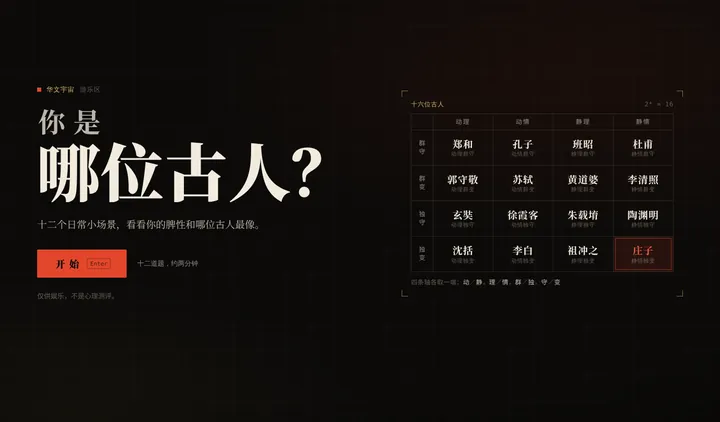 You·1Which Ancient Are You?12 small everyday scenes, 16 ancients
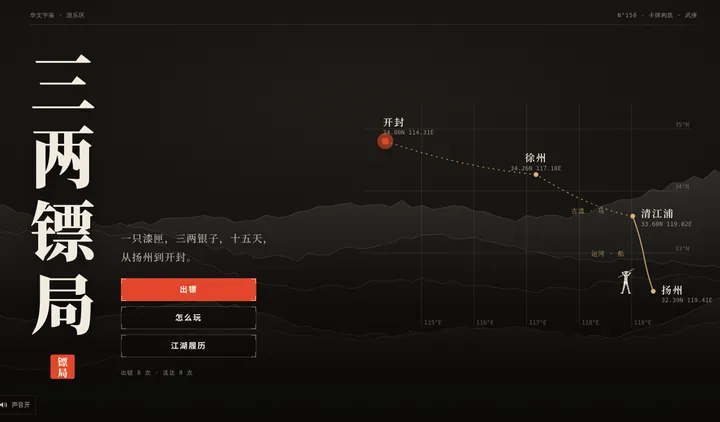 You·3The Three-Tael Escort AgencyA lacquer box to deliver from Yangzhou to Kaifeng
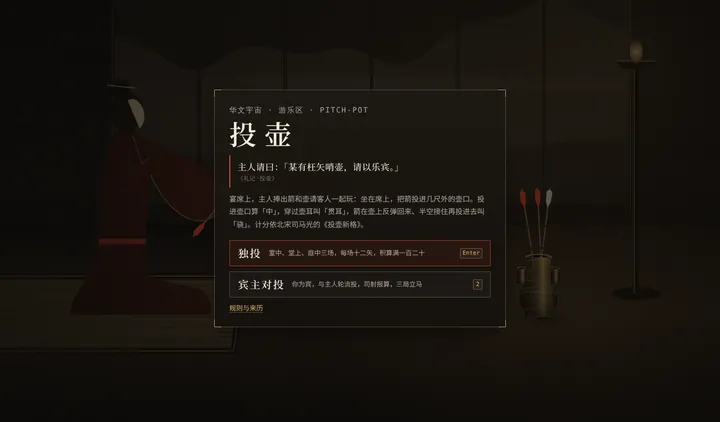 You·4Pitch-Pot12 arrows, one pot, by the rules of the Book of Rites and the New Rules for Pitch-Pot