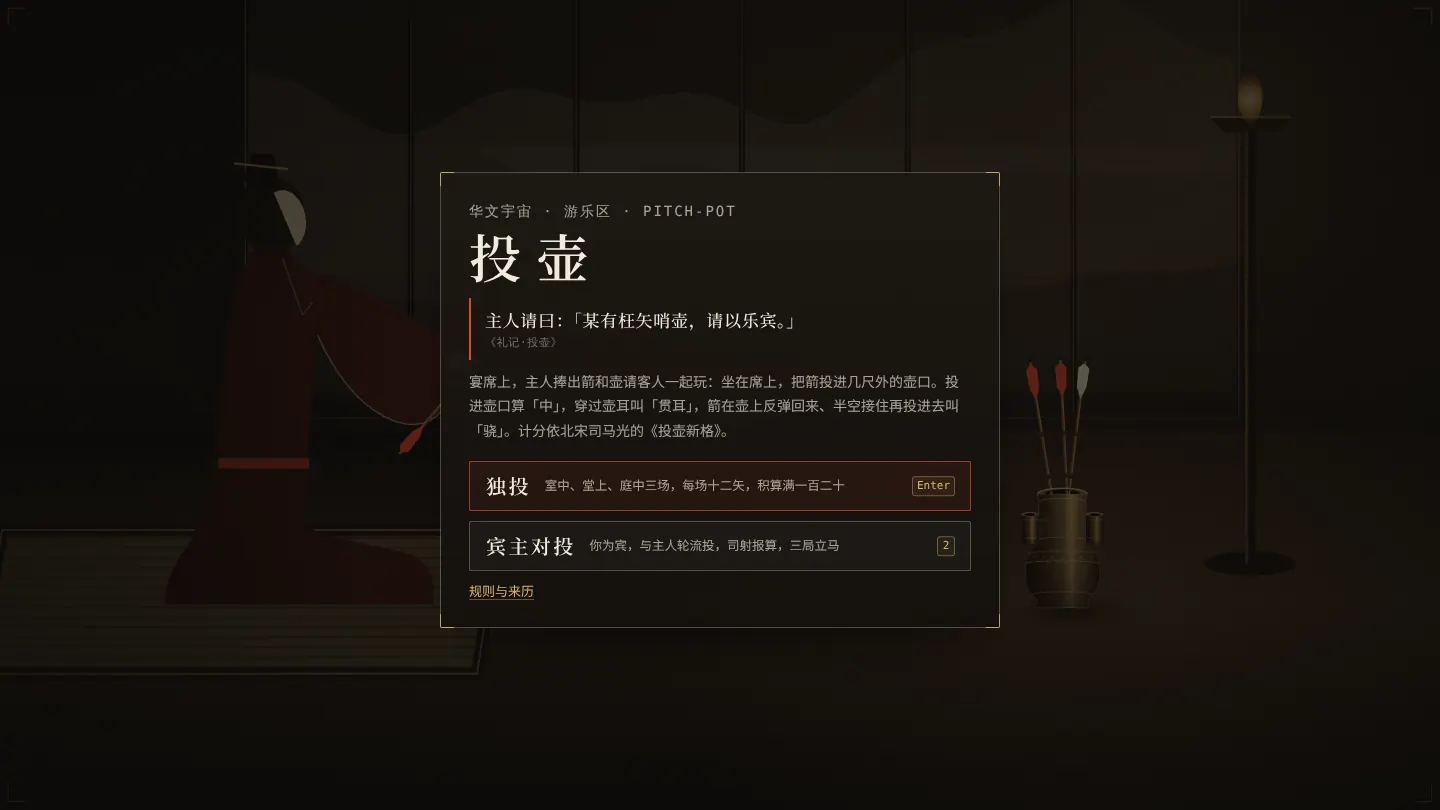
You·4Playground
Pitch-Pot
Twelve arrows into one pot, following the Book of Rites and Sima Guang’s New Rules for Pitch-Pot
- Accession no.
- You·4
- Location
- Playground
- Category
- Games
- Period
- Spring and Autumn to Song
- Directed by
- Hu Yilin
- Made by
- Claude Opus 5.5
- Similar commission
- from S$18.75
About the exhibit
Pitch-pot was a game played at banquets in ancient times: host and guests, seated on their mats, took turns throwing arrows into a pot a few feet away. The Zuo Commentary records, under the 12th year of Duke Zhao, that when the Marquis of Jin feasted the Marquis of Qi they played pitch-pot at the table, and Zhonghang Muzi of Jin spoke for his lord: “We have wine like the Huai, and meat like its islands. If our lord hits with this, he shall lead the feudal lords.” The Marquis of Jin hit. The Marquis of Qi raised an arrow and replied: “We have wine like the Sheng, and meat like the hills. If I hit with this, I shall take my turn to rise after you.” He hit too. In the Warring States period, Chunyu Kun, describing to King Wei of Qi the pleasures of a village feast, also mentions “liubo and pitch-pot” (Records of the Grand Historian, “Biographies of the Jesters”).
The “Pitch-Pot” chapter of the Book of Rites sets it out as a rite between host and guest. The host brings out his “crooked arrows and wry-mouthed pot” and invites the guest to share the fun; the guest declines twice before accepting. Host and guest throw in turn while the master of archery keeps score beside them, laying down a counting rod for every arrow that goes in. When the throwing is over the rods are counted, “two counters make a pair”, and he announces “So-and-so is better than so-and-so by so many pairs”; then “the winner gives the loser to drink”: the winning side makes the losing side drink a cup. The pot is filled with small beans, “to stop the arrows leaping out”. Under Emperor Wu of Han, Guo Sheren made his arrows of bamboo and set out instead to “make the arrow spring back”: one arrow could go back and forth more than 100 times, and this was called the “rebound” (Miscellaneous Records of the Western Capital). In the Northern Song, Sima Guang wrote New Rules for Pitch-Pot. Dissatisfied that the old scoring charts “ranked the rare and spectacular highest”, he drew up new rules, “ranking precision highest and lucky hits lowest”, and said that pitch-pot “can discipline the mind, cultivate the self, help govern the state, and reveal a person’s character”.
The game has three settings. The Book of Rites gives the arrows as “5 fu long in the chamber, 7 fu in the hall, 9 fu in the courtyard”, and Zheng Xuan’s commentary says “four fingers laid side by side make a fu”; one finger is 1 cun, so a fu is 4 cun. It also says “the pot stands two and a half arrows from the mat”. So in the chamber the arrow is 2 chi long and the pot 5 chi away; in the hall the arrow is 2 chi 8 cun and the pot 7 chi away; in the courtyard the arrow is 3 chi 6 cun and the pot 9 chi away. Each round has 12 arrows (the New Rules: “arrows, twelve in number”), and the scoring follows the New Rules. A hit with the first arrow is “a good start”, worth 10; each hit after that in an unbroken run is worth 5; once the run has been broken, each hit earns only 1, and these are called “stray arrows”; a hit with the 12th arrow is “a good finish”, worth 15. “Through the ear”, an arrow that passes through one of the pot’s ears, and the “rebound arrow”, which bounces off the pot into the air, is caught and then thrown in, each earn an extra 10. A “leaning shaft”, propped slantwise in the mouth of the pot, scores nothing but does not break the run; an “upside-down hit”, where the arrow goes in tail first, cancels everything scored so far; and 12 hits out of 12 make a “full pot”, which wins outright whatever the score. You can throw alone through the three rounds, aiming for a total of 120, or play as the guest, taking turns with the host while the master of archery counts the score, passes the cup and sets up the tally “horses”; after three games comes the call to “congratulate the many horses”.
How this work was made
The arrow is a two-dimensional rigid body: gravity pulls it down, the fletching swings the head round into the direction of travel, and a slight error at release makes the shaft wobble gently in flight. The mouth, neck and belly of the pot and its two tubular ears are all collision bodies, and each collision works out bounce, friction and spin from the impulse: an arrow can graze the rim and slide in, knock against the rim and bounce back, come to rest lying across the mouth, or stick into the beans at the bottom and lean against the rim. Once the arrow is still, where it lies decides whether it is a hit, “through the ear”, a “leaning shaft”, “sword at the belt” or “across the pot”. The scene is seen from the side, so the two ears can only be drawn one in front of the other; an ear is only 1 cun across, much harder to hit than the mouth, and the game simulates this with an invisible sideways error. The host, played by the computer, first uses the same physics to work out how hard to throw, then adds a human error: in the chamber it hits a little over half the time, and the farther the pot, the harder it gets.
Everything on screen is drawn by code on a canvas, without a single image: the six-panel screen and the lamp stand in the chamber; the lattice windows, two vermilion-lacquered pillars and a swinging lantern in the hall; the moon, the courtyard wall and a pine in the courtyard. The hanging lantern in the hall and the night wind in the courtyard are the game’s own additions, not found in the old books. Sound is synthesised live in the browser: the swish of the throw, the “ding” of an arrow striking the bronze pot, the rustle as it drops into the beans. The drumbeat at the start of each round follows the first half of the “Lu drum” score at the end of the “Pitch-Pot” chapter of the Book of Rites, with a different drum sound for each of its two symbols, 〇 and □. The New Rules is a terse text, and in a few places the scoring is the game’s own reading; each of these is set out under “Rules and Origins” in the game. Your best score is kept only in your own browser; the game collects and uploads no data.
Sources and references
- Book of Rites: “Pitch-Pot”, with Zheng Xuan’s commentary
- Sima Guang, New Rules for Pitch-Pot (Touhu Xinge), in the Shuofu collection, chapter 101, part 1
- Zuo Commentary: Duke Zhao, Year 12
- Records of the Grand Historian: “Biographies of the Jesters”
- Miscellaneous Records of the Western Capital (Xijing Zaji), chapter 5
Spotted an error in the history, data or sources? Please write to [email protected].
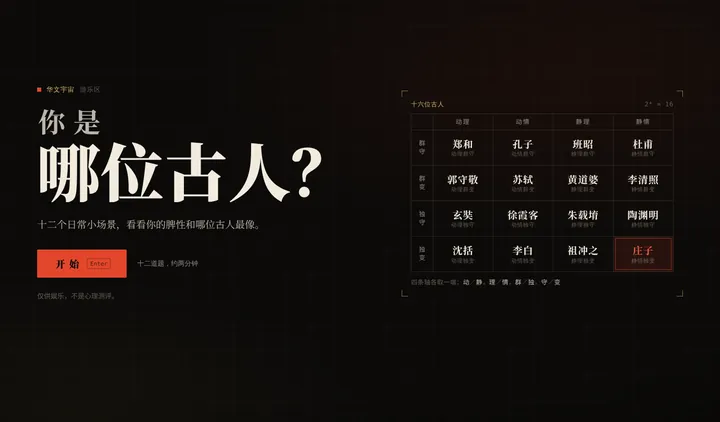 You·1Which Ancient Are You?12 small everyday scenes, 16 ancients
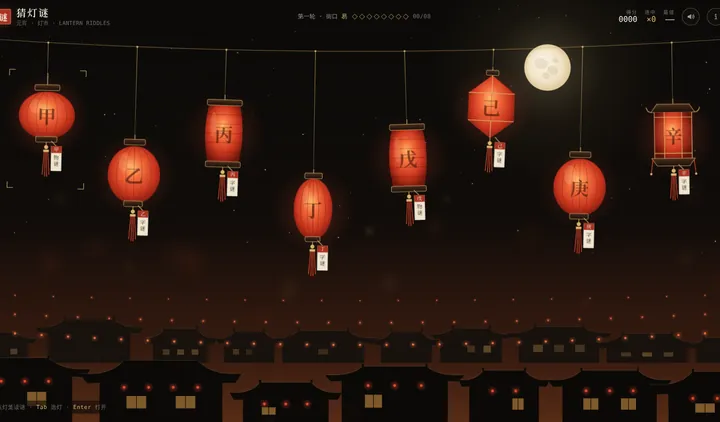 You·2Lantern RiddlesA Lantern Festival fair: three rounds, 24 lanterns
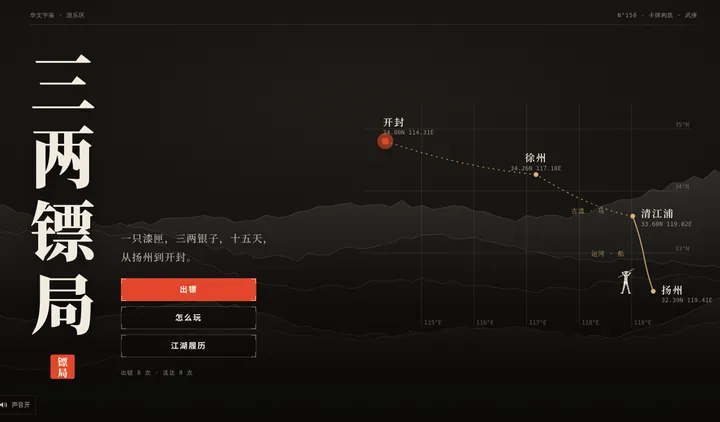 You·3The Three-Tael Escort AgencyA lacquer box to deliver from Yangzhou to Kaifeng