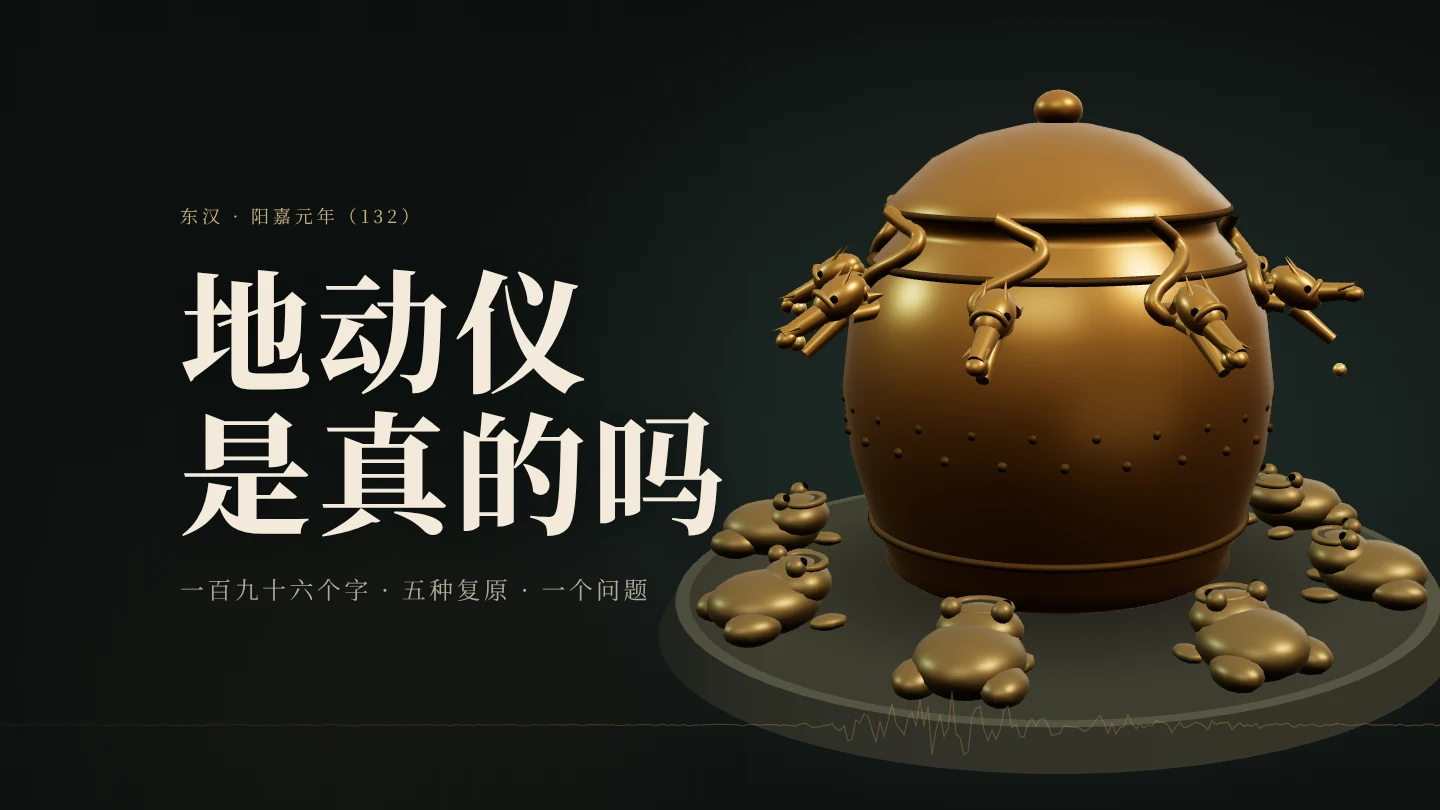
Shu·7The Study
Is the Seismoscope Real?
An exhibition on Zhang Heng’s seismoscope: the texts, the early accounts, five reconstructions and five debates
- Accession no.
- Shu·7
- Location
- The Study
- Category
- Online exhibitions
- Period
- Eastern Han–present
- Directed by
- Hu Yilin
- Made by
- Claude Opus 5.5
- Similar commission
- from S$50
About the exhibit
In 132, Zhang Heng, then Grand Astrologer of the Eastern Han, made a bronze instrument that the Book of the Later Han calls the houfeng didong yi: eight chi across, shaped like a wine vessel, with eight dragons holding balls above eight toads, and inside a “central column”, “eight tracks” and a “catch” and “trigger”. When the earth moved, one dragon dropped its ball, and “from its direction one knew where the quake was”. The instrument is lost and no drawing survives. The one most often seen in textbooks and museums is Wang Zhenduo’s reconstruction of 1951.
The exhibition has eight parts. It first splits “was it real?” into three questions: did the Han have such an instrument; could it detect distant earthquakes and point to them; what was inside it. It then reads the 196-character passage in Zhang Heng’s biography line by line, with notes showing what each key word becomes in the different reconstructions, and compares it with the earlier accounts of Sima Biao (surviving only in quotations) and Yuan Hong: the instrument is described in much the same way, but the story of the Longxi earthquake appears only in Fan Ye. A timeline runs from Zhang Heng’s birth to 2020, including later records such as Xindu Fang’s illustrated Qi zhun and Lin Xiaogong’s lost book, and the reconstructions and debates of the last century and a half.
The gallery holds five illustrative 3D models — Milne (1883), Imamura (1939), Wang Zhenduo (1951), Sleeswyk and Sivin (1983) and Feng Rui’s team (2005). Each can be turned, cut open and labelled to show what the central column, tracks, catch, trigger and ball are in that design, and each can be given an earthquake from any of eight directions: in the same distant quake some designs drop the ball towards the source and some do not stir, and whether the ground is first pushed or pulled can reverse the answer. Five debates — the reliability of the sources, one instrument or two, standing or hanging column, distant quakes and direction, and the textbook model and the claim that it is all a fake — are each set out with both sides. The conclusion has three columns: what the sources support, what reconstructors suppose, and what no one knows.
How this work was made
Every classical passage was checked character by character against the editions on Chinese Wikisource: the biography, annals and treatise in the Book of the Later Han, Yuan Hong’s Annals, Sima Biao’s Continued Book of Han as quoted in the Chuxue ji and Taiping Yulan, the relevant biographies and bibliographies in the Books of Wei, Northern Qi and Sui, the Yuhai, and Cui Yuan’s funerary inscription for Zhang Heng. Modern studies were read in the original journal or thesis wherever possible; those we could not see are marked “at second hand”, and details we could not confirm are left out. The models are built live in the browser with three.js from each team’s published principle and diagrams; the outside follows the text, while size and detail are illustrative — not artefacts, nor anyone’s original drawings. When you make a quake, the ground motion and each design’s response come from a simplified mechanical model whose sensitivities are set for illustration, not taken from measurements. The whole exhibition is in Simplified Chinese, Traditional Chinese and English.
Sources and references
- 范晔《后汉书》卷五十九《张衡列传》(含论与李贤注),维基文库本:https://zh.wikisource.org/wiki/後漢書/卷59
- 范晔《后汉书》卷六《顺帝纪》(阳嘉元年、阳嘉三年、永和三年),维基文库本:https://zh.wikisource.org/wiki/後漢書/卷6
- 司马彪《续汉书·五行志四》(今为《后汉书》志第十六),维基文库本:https://zh.wikisource.org/wiki/後漢書/卷106
- 袁宏《后汉纪》卷十八、卷十九,维基文库本:https://zh.wikisource.org/wiki/後漢紀/卷18 ;https://zh.wikisource.org/wiki/後漢紀/卷19
- 徐坚等《初学记》卷五(四库全书本)引司马彪《续汉书》:https://zh.wikisource.org/wiki/初學記_(四庫全書本)/卷05
- 李昉等《太平御览》卷七五二《工艺部·巧》、卷二三五《职官部·太史令》引司马彪《续汉书》:https://zh.wikisource.org/wiki/太平御覽/0752 ;https://zh.wikisource.org/wiki/太平御覽/0235
- 崔瑗《河间相张平子碑》(《古文苑》;严可均《全后汉文》卷四十五):https://zh.wikisource.org/wiki/全後漢文/卷四十五
- 严可均辑《全后汉文》卷五十二至五十五(张衡文):https://zh.wikisource.org/wiki/全後漢文/卷五十二
- 魏收《魏书》卷九十一《术艺传》(信都芳):https://zh.wikisource.org/wiki/魏書/卷91
- 李百药《北齐书》卷四十九《方伎传》(信都芳):https://zh.wikisource.org/wiki/北齊書/卷49
- 魏徵等《隋书》卷七十八《艺术传》(临孝恭)、卷三十四《经籍志三》:https://zh.wikisource.org/wiki/隋書/卷78 ;https://zh.wikisource.org/wiki/隋書/卷34
- 王应麟《玉海》卷四(四库全书本)「汉阳嘉候风地动仪」:https://zh.wikisource.org/wiki/玉海_(四庫全書本)/卷004
- John Milne, Earthquakes and Other Earth Movements(1883 年序;New York: Appleton, 1886),第一章:https://www.gutenberg.org/ebooks/60007
- 王振铎:《汉张衡候风地动仪造法之推测》,《燕京学报》第 20 期,1936,577—586 页 (at second hand)
- 王振铎:《科技考古论丛》,文物出版社,1989(收《张衡候风地动仪的复原研究》,转引)
- Imamura Akitsune(今村明恒),Japanese Journal of Astronomy and Geophysics 16,1939 (at second hand)
- Joseph Needham, Science and Civilisation in China, vol. 3, Cambridge University Press, 1959 (at second hand)
- 关野雄:《張衡の候風地動儀における都柱の復原》,《東方學會創立二十五周年記念東方學論集》,1972,433—449 页 (at second hand)
- 李善邦:《中国地震》,地震出版社,1981 (at second hand)
- A. W. Sleeswyk and N. Sivin, “Dragons and toads: the Chinese seismoscope of A.D. 132”, Chinese Science 6 (1983): 1–19 (at second hand)
- Qian Wenyuan, The Great Inertia: Scientific Stagnation in Traditional China, Croom Helm, 1985 (at second hand)
- 雷立柏:《张衡,科学与宗教》,社会科学文献出版社,2000 (at second hand)
- Duncan C. Agnew, “History of Seismology”, International Handbook of Earthquake and Engineering Seismology, 2002,作者注释:https://igppweb.ucsd.edu/~agnew/Pubs/agnew.a66notes.pdf
- 冯锐、武玉霞:《张衡候风地动仪的原理复原研究》,《中国地震》19(4),2003,358—376 页 (at second hand)
- 袁道阳等:《138 年金城—陇西 6¾ 级地震的史料考证与构造背景探讨》,《地震地质》26(1),2004,52—60 页 (at second hand)
- 冯锐等:《张衡地动仪的科学性及其历史贡献》《对地动仪传统模型的置疑》《地动仪的史料和模型研究》《张衡地动仪的科学复原》,《自然科学史研究》25 增刊,2006 (at second hand)
- 冯锐、俞言祥:《张衡地动仪与公元 134 年陇西地震》,《地震学报》28(6),2006,654—668 页:https://dzxb.org/en/article/pdf/preview/3c8b24dc-6de6-4b7f-b2e3-bc6d1ef88baa.pdf
- 萧国鸿:《张衡地动仪感震机构之系统化复原设计》,成功大学博士论文,2007:https://www.seismoscope.allshookup.org/design-reconstruct-seismoscope.pdf
- Hong-Sen Yan and Kuo-Hung Hsiao, “Reconstruction design of the lost seismoscope of ancient China”, Mechanism and Machine Theory 42(12), 2007: 1601–1617 (at second hand)
- Kuo-Hung Hsiao and Hong-Sen Yan, “The review of reconstruction designs of Zhang Heng’s seismoscope”, Journal of Japan Association for Earthquake Engineering 9(4), 2009: 1–10:https://www.jaee.gr.jp/stack/submit-j/v09n04/hon/090401_paper.pdf
- 余建刚、肖城辉:《漫谈张衡地动仪》,《中学物理教学参考》2009 年第 6 期:https://enjoyphysics.cn/Article559
- 冯锐:《科学,激活了张衡地动仪》,《物理》38(7),2009,476—488 页:https://wuli.iphy.ac.cn/article/id/31494
- 冯锐:《中国地震科学史研究》,《地震学报》31(5),2009,564—582 页:https://dzxb.org/cn/article/pdf/preview/b60de0d4-6325-4f21-bacd-78ebe60d8ced.pdf
- 蔡虹、张星海:《地动仪的历史泡沫》,《科技导报》28(24),2010:https://castjournals.cast.org.cn/joweb/kjdb/CN/PDF/1242121079976690538
- 胡宁生:《张衡地动仪的奥秘》,南京大学出版社,2014 (at second hand)
- 江晓原:《三件奇物的复制问题》,收入《科学外史 I》,上海人民出版社,2019:https://www.aisixiang.com/data/139379.html
- 胡宁生:《张衡地动仪立柱验震的复原与研究》,《中国科技史杂志》41(3),2020,425—434 页 (at second hand)
- 孙小淳:《张衡——中国古代科学家的典范》,光明网,2021-09-03:https://m.gmw.cn/baijia/2021-09/03/35136022.html
- 胡宁生:《为张衡地动仪恢复名誉》,光明网,2021-09-06:https://m.gmw.cn/baijia/2021-09/06/35142150.html
- 《科学家破解张衡地动仪之谜》,南京晨报,2005-04-24:https://news.sina.com.cn/c/2005-04-24/09545735297s.shtml
- 《方舟子质疑张衡地动仪「不管用」 专家否认》,京华时报,2010-12-02:http://www.taiwan.cn/xwzx/dl/shh/201012/t20101202_1629938.htm
- 《地动仪测地震:并非只是传说》,中国新闻网,2010-12-09:https://www.chinanews.com.cn/cul/2010/12-09/2711554.shtml
- 扬子晚报报道胡宁生复原模型,中国新闻网 2013-11-19 转载:https://www.chinanews.com.cn/cul/2013/11-19/5517376.shtml
- 《张衡地动仪走出统编教材?人教社回应:并没有》,新华社,2018-10-10:https://www.piyao.org.cn/2018-10/10/c_129968769.htm ;界面新闻:https://www.jiemian.com/article/2526599.html
- 英国科学博物馆集团藏品:1953 年中国发行的一套四枚邮票:https://collection.sciencemuseumgroup.org.uk/objects/co54056/set-of-four-postage-stamps-issued-by-china-in-1953
- 3D engine: three.js (MIT License)
Want something like this? See how to commission an online exhibition →
Spotted an error in the history, data or sources? Please write to [email protected] and let us know.
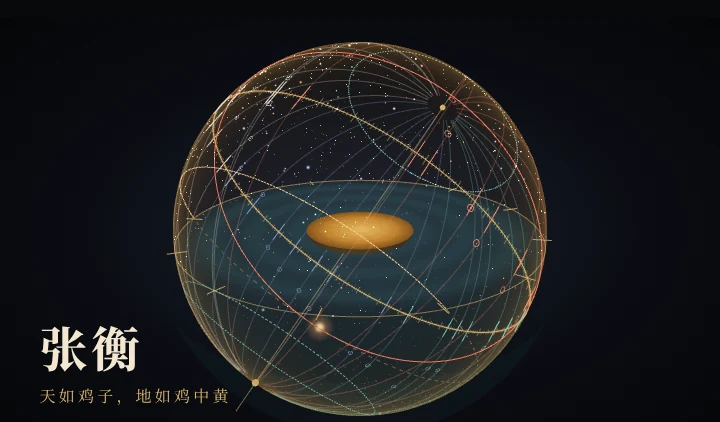 Shu·8Zhang Heng’s Scholar CardThe sky like an egg: turn an enveloping heaven built from the Hun yi zhu
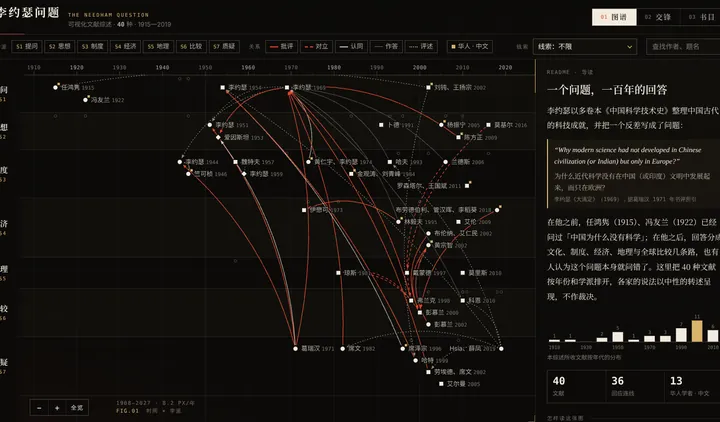 Shu·2The Needham QuestionA visual literature review: why modern science did not arise in China, and whether the question should be asked this way
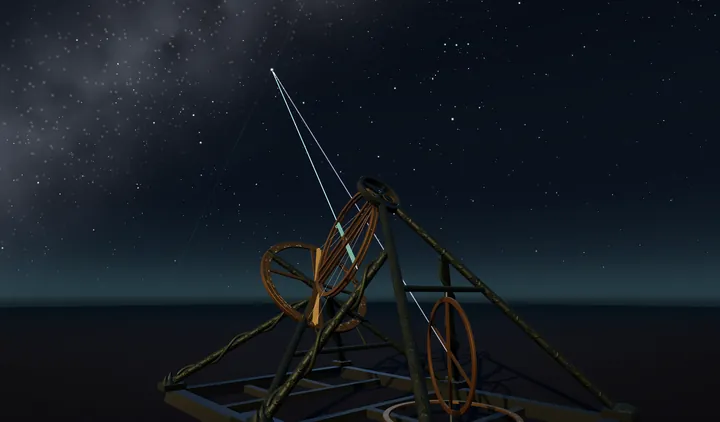 Tian·5Guo Shoujing and the Simplified ArmillaThe armillary sphere split into two instruments that no longer block each other; turn the double declination ring to sight a star
 Ya·6The Water-Powered Astronomical Clock TowerA cutaway look at an astronomical clock tower driven by water