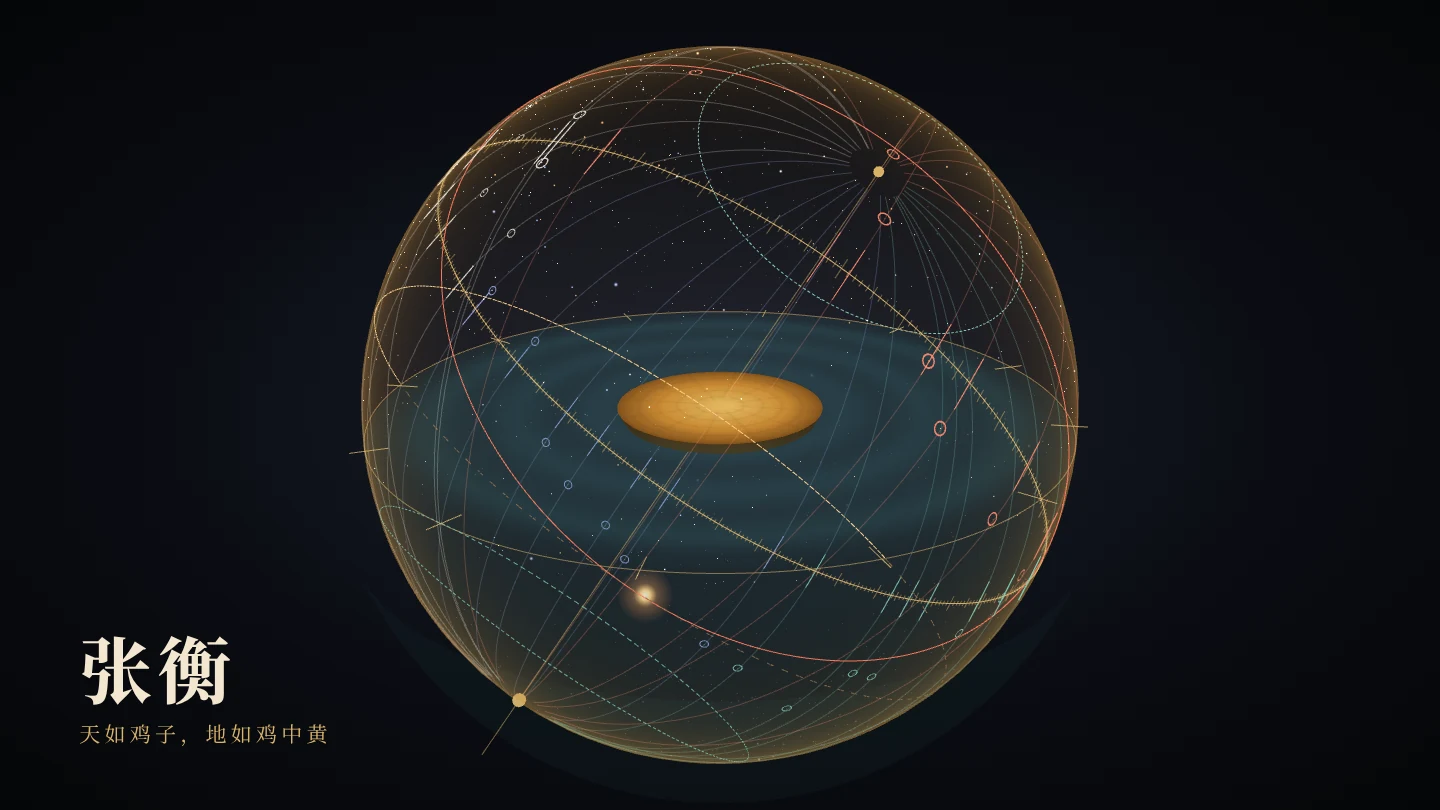
Shu·8The Study
Zhang Heng’s Scholar Card
The sky like an egg: turn an enveloping heaven built from the Hun yi zhu
- Accession no.
- Shu·8
- Location
- The Study
- Period
- Eastern Han
- Directed by
- Hu Yilin
- Made by
- Claude Opus 5.5
- Similar commission
- from S$18.75
About the exhibit
Zhang Heng (78–139), courtesy name Pingzi, of Xi’e in Nanyang, was an astronomer and writer of the Eastern Han. Registrar to Bao De, governor of Nanyang, he was twice Grand Astrologer and later Palace Attendant, Chancellor of Hejian and Master of Writing. He built a celestial globe turned by dripping water and the seismoscope, wrote the Lingxian, the Rhapsody on the Two Capitals and Returning to the Fields, and asked the throne to ban the prophecy books. His friend Cui Yuan wrote on his stele that “his reckonings exhausted heaven and earth; his makings rivalled creation”.
At the heart of the card is the enveloping heaven. The 3D sphere is built to the numbers of the Hun yi zhu: a circle of 365¼ du, the north pole 36 du above the earth, upper and lower circles 72 du across, the ecliptic 24 du outside and inside the equator; the twenty-eight lodges carry the Eastern Han Sifen calendar’s widths and the stars are set back to 130 CE. Turn to the solstices or the equinox and the text appears beside the readings — “rises at chen, sets at shen, 146-plus du above the earth by day” — matching what the model computes. Nine questions follow: what shape is the sky, how a bronze globe kept pace with it, where heaven and earth came from, where moonlight comes from, how many stars there are, the seismoscope, π, what a Grand Astrologer did, and what he wrote when not watching the sky. Whether he wrote the Hun yi zhu, whether his earth was flat or round, and whether the “dark void” is the earth’s shadow are each set out with both sides and their sources.
The museum’s “Is the Seismoscope Real?” is devoted to the seismoscope; “Guo Shoujing’s Simplified Armilla” and “The Water-Driven Clock Tower” show how later astronomical instruments carried on. The companion essay, Reckoning Heaven and Earth, is an intellectual biography in eight sections with sources for every note.
How this piece was made
Classical texts were checked word by word against the editions on Chinese Wikisource: his biography and the annals, with Liu Zhao’s treatise commentary and the Zhonghua collation notes; the astronomical and bibliographic treatises of the Books of Jin and Sui; the Kaiyuan zhanjing, Chuxue ji, Taiping yulan and Wenxuan (Siku editions); the Nine Chapters (Sibu congkan); and Yan Kejun’s Quan Hou Han wen. Modern studies were read in the original where possible; those seen only through others are marked as cited at second hand, and anything uncertain was left out. The 3D heaven is drawn live with three.js: its degrees, pole height and obliquity follow the text; star positions come from the Yale Bright Star Catalogue, moved back to 130 CE with IAU 1976 precession, and are illustrative; determinative stars follow the identification usual from the Han to the Yuan. The mechanism of the water-turned globe is not recorded, so its gears are illustrative. Everything is available in simplified Chinese, traditional Chinese and English.
Sources and references
- 范晔《后汉书》卷五十九《张衡列传》(含论、赞与李贤注),维基文库本:https://zh.wikisource.org/wiki/後漢書/卷59
- 范晔《后汉书》卷六《顺帝纪》,维基文库本:https://zh.wikisource.org/wiki/後漢書/卷6
- 司马彪《续汉书·律历志中、下》(今为《后汉书》志第二、第三,含刘昭注引张衡浑仪与四分历宿度),维基文库本:https://zh.wikisource.org/wiki/後漢書/卷92 ;https://zh.wikisource.org/wiki/後漢書/卷93
- 司马彪《续汉书·天文志上》(今为《后汉书》志第十,含刘昭注引《灵宪》、蔡邕《表志》与校勘记),维基文库本:https://zh.wikisource.org/wiki/後漢書/卷100
- 司马彪《续汉书·百官志二》(今为《后汉书》志第二十五),维基文库本:https://zh.wikisource.org/wiki/後漢書/卷115
- 崔瑗《河间相张平子碑》,严可均辑《全后汉文》卷四十五:https://zh.wikisource.org/wiki/全後漢文/卷四十五
- 严可均辑《全后汉文》卷五十五(张衡《灵宪》《浑天仪》《绶笥铭》《四愁诗序》等):https://zh.wikisource.org/wiki/全後漢文/卷五十五
- 瞿昙悉达《开元占经》卷一(四库全书本):https://zh.wikisource.org/wiki/唐開元占經_(四庫全書本)/卷001
- 房玄龄等《晋书》卷十一《天文志上》:https://zh.wikisource.org/wiki/晉書/卷011
- 魏徵等《隋书》卷十九、卷二十《天文志》,卷三十四、卷三十五《经籍志》:https://zh.wikisource.org/wiki/隋書/卷19 ;https://zh.wikisource.org/wiki/隋書/卷20 ;https://zh.wikisource.org/wiki/隋書/卷34 ;https://zh.wikisource.org/wiki/隋書/卷35
- 徐坚等《初学记》卷二十五(四库全书本):https://zh.wikisource.org/wiki/初學記_(四庫全書本)/卷25
- 今本《竹书纪年》五帝纪:https://zh.wikisource.org/wiki/今本竹書紀年/五帝紀
- 刘徽注《九章算术》卷四(四部丛刊本):https://zh.wikisource.org/wiki/九章算術_(四部叢刊本)/卷第四
- 《易传·系辞上》:https://zh.wikisource.org/wiki/易傳/繫辭上
- 李善注《文选》卷十五、卷二十九(四库全书本):https://zh.wikisource.org/wiki/文選注_(四庫全書本)/卷15 ;https://zh.wikisource.org/wiki/文選注_(四庫全書本)/卷29
- 沈约《宋书》卷十八《礼志五》:https://zh.wikisource.org/wiki/宋書/卷18
- 李昉等《太平御览》卷七五二(四库全书本):https://zh.wikisource.org/wiki/太平御覽_(四庫全書本)/卷0752
- 李昉等《太平广记》卷二一〇:https://zh.wikisource.org/wiki/太平廣記/卷第210
- 张彦远《历代名画记》卷四:https://zh.wikisource.org/wiki/歷代名畫記/卷第四
- 丁四新:《浑天说的宇宙生成论和结构论溯源》,《人文杂志》2017 年第 10 期:https://www.phil.tsinghua.edu.cn/info/1037/1388.htm
- 陈久金:《浑天说的发展历史新探》,《科技史文集(一)》,1978(转引)
- 陈美东:《张衡〈浑天仪注〉新探》,《社会科学战线》1984 年第 3 期(转引)
- 唐如川:《张衡等浑天家的天圆地平说》,《科学史集刊》第 4 集,1962(转引)
- IAU/USGS Gazetteer of Planetary Nomenclature, Chang Heng:https://planetarynames.wr.usgs.gov/Feature/1133
- JPL Small-Body Database, 1802 Zhang Heng:https://ssd.jpl.nasa.gov/tools/sbdb_lookup.html#/?sstr=1802
- 「张衡一号」发射报道(国防科工局、国家航天局消息),2018-02-02:https://finance.sina.cn/2018-02-02/detail-ifyremfz3898837.d.html
- 耶鲁亮星表第五版(Hoffleit & Warren 1991,NASA HEASARC,公有领域);国际天文学联合会 1976 年系统的岁差与黄赤交角公式
- 冯时:《中国古代物质文化史·天文历法》,开明出版社,2013(二十八宿距星认定,据维基百科「二十八宿」条转引)
Want something like this? See how to commission a talk website or a literature review →
Spotted an error in the history, data or sources? Please write to [email protected] and let us know.
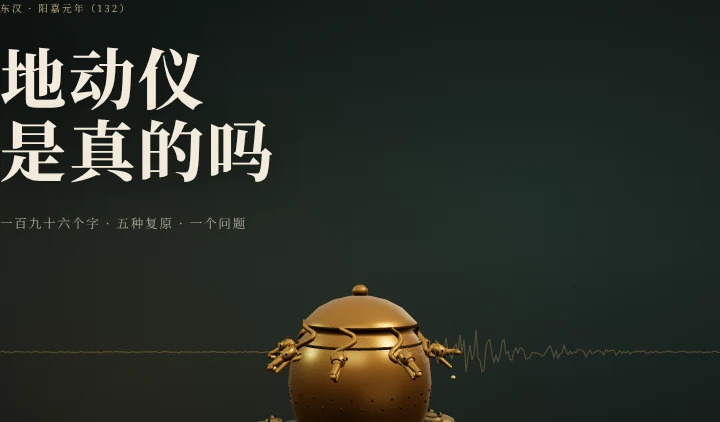 Shu·7Is the Seismoscope Real?An exhibition on Zhang Heng’s seismoscope: the texts, the early accounts, five reconstructions and five debates
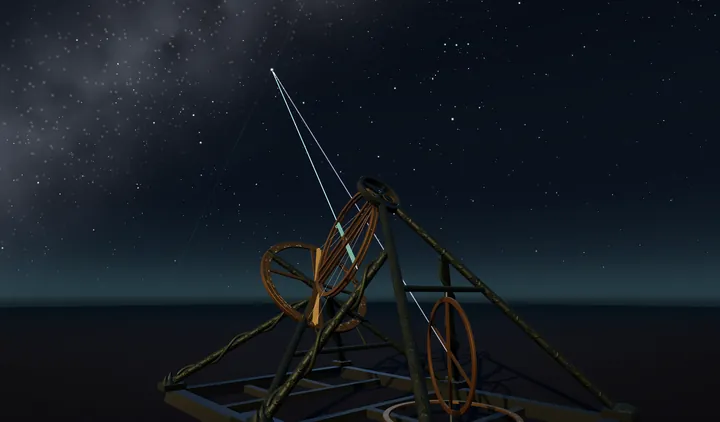 Tian·5Guo Shoujing and the Simplified ArmillaThe armillary sphere split into two instruments that no longer block each other; turn the double declination ring to sight a star
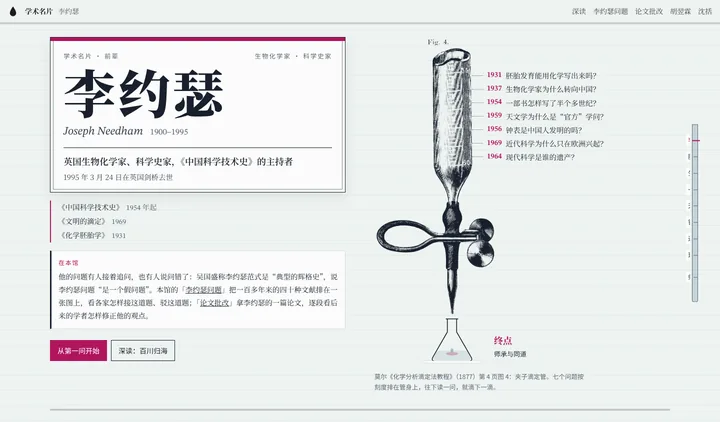 Shu·5Joseph Needham’s Scholar CardA burette, with seven questions dripping down its scale
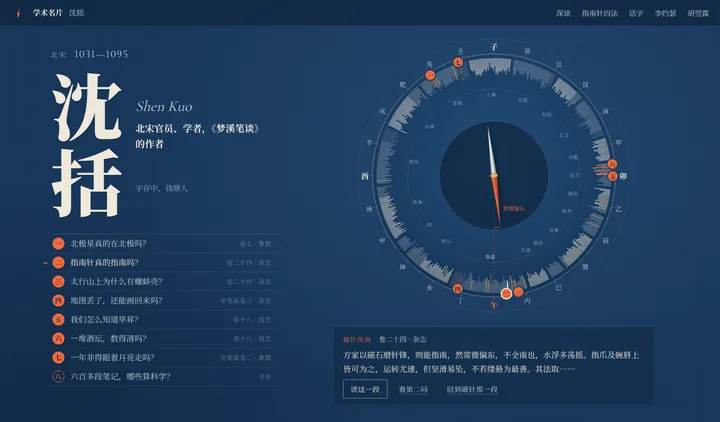 Ya·3Shen Kuo’s Scholar CardAlways Slightly East: turn a compass laid out from the Dream Pool Essays