Lü·4Bronze Sounds, Jade Echoes: Music and TemperamentFeatured
Jasmine Flower in Eight Versions
One folk tune from Jiangnan, played eight ways: from silk-and-bamboo to Nagasaki, Milan, Hong Kong and the Nanyang
- Accession no.
- Lü·4
- Category
- Video production
- Period
- Qing to present
- Running time
- 6:18
- Directed by
- Hu Yilin
- Made by
- Claude Opus 5.5
- Similar commission
- from S$18.75
About the exhibit
Jasmine Flower began as a folk tune of Jiangnan, the region south of the lower Yangtze. Over two centuries and more it travelled to northern China and to Nagasaki, found its way into an opera house in Milan, and came back to sound at the Hong Kong handover and the Beijing Olympics. This video plays the same melody eight times, in the order of the places and years it passed through: Jiangnan, the North, Japan, opera, cello, saxophone, New Year and electronic. Each version opens with a title card naming its source; each has its own instruments, and its own way of drawing the flower – a white flower in ink wash, a red rosette like a paper-cut, small white blossoms on golden waves, a flower radiating like stage lights, a sphere woven of fine lines, a flower in violet smoke, fireworks, and finally lines of light. In the coda the petals come together as the character 花, “flower”.
From Xianhua diao to Mo Li Hua
The tune was first known as Xianhua diao, “Fresh Flower Tune”. It is usually dated to the Qianlong reign of the Qing dynasty, though some scholars trace the words back to the Wanli years of the Ming; the old lyrics sang of three flowers. In the winter of 1942, He Fang, then fourteen and touring with a New Fourth Army drama troupe, performed below Jinniu Mountain in Liuhe near Nanjing. A local performer taught him the song and he wrote it down line by line. More than ten years later, by then an army musician, he reworked it and made all three flowers jasmine – the Jiangsu Jasmine Flower most people know today. Northern China has its own versions too; the video’s northern version follows the one sung in Nanpi, Hebei.
A folk tune that went round the world
In 1793, John Barrow, a member of Lord Macartney’s embassy to China, wrote the tune down in Western notation, and in 1804 he published it in his Travels in China, making it one of the first Chinese folk songs to be notated and printed in Europe. More than a century later Puccini, writing Turandot, heard it from a music box belonging to an Italian diplomat who had served in China, and used it for the children’s chorus “Là, sui monti dell’Est”. The opera opened at La Scala in Milan in 1926, more than a year after Puccini’s death. 2:15
Jasmine Flower was played at the Hong Kong handover ceremony in 1997; Tan Dun’s Symphony 1997: Heaven Earth Mankind, written for the handover with Yo-Yo Ma as cello soloist, has a Jasmine Flower setting modelled on Puccini’s. 3:00 It was heard again at the Macau handover in 1999, in the Beijing segment of the closing ceremony of the 2004 Athens Olympics, and at the medal ceremonies of the 2008 Beijing Olympics, where the music was an arrangement by Tan Dun and Wang Hesheng. Pop music loves it too: the Asian edition of Kenny G’s 1992 album Breathless includes “Jasmine Flower”. 3:47
Nagasaki’s “Suisenka”
In the Edo period, Chinese popular songs reached Nagasaki on trading ships. In Japan they were called Shingaku, “Qing music”, later grouped with the older Mingaku as Minshingaku, and for a while in the late Edo period they were all the rage. The City of Nagasaki notes that the well-known Minshingaku song “Suisenka” (Narcissus) grew out of Jasmine Flower sung in tōon, the Chinese pronunciation of the day: its source was a Fujian version that took on a Nagasaki accent. The video’s Japanese version follows this line, played on shakuhachi, koto and shamisen. 1:38
How this work was made
All eight versions share one melody; the instruments, rhythm and pictures differ, and the title card at the start of each version names where it comes from. Vertical 1080×1920, six minutes eighteen seconds in all. The pictures, music and title cards were made by Claude Opus 5.5. The chapter times on this page mark the moment the picture changes to each version.
Sources and references
- “Mo Li Hua”, Wikipedia
- John Barrow, Travels in China, London, 1804
- “Breathless (Kenny G album)”, Wikipedia (Asian edition track list)
- Tan Dun, Symphony 1997: Heaven Earth Mankind (All Classical Portland work notes)
- China News Service, 25 March 2022, on He Fang and the Liuhe “Xianhua diao” (in Chinese): https://www.chinanews.com.cn/cul/2022/03-25/9711243.shtml
- City of Nagasaki, “Nagazine”, on the Minshingaku songs “Suisenka” and “Kyūrenkan” (in Japanese): https://www.city.nagasaki.lg.jp/nagazine/uta/040924/index.html
- Giacomo Puccini, Turandot (first performed at La Scala, Milan, April 1926)
Want a video like this? See how to commission video production →
Spotted an error in the history, data or sources? Please write to [email protected].
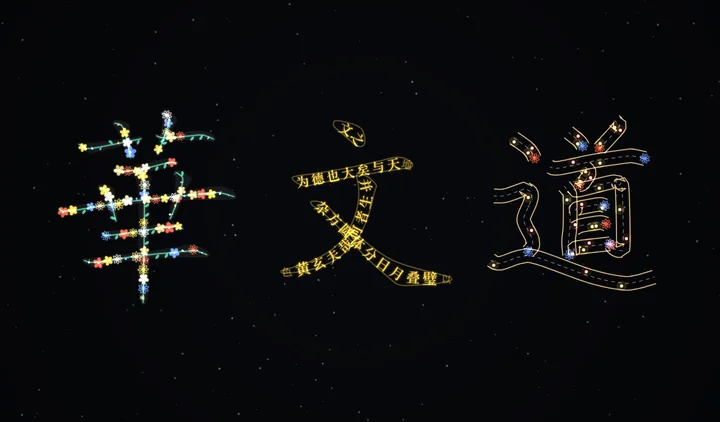 Men·3Hua · Wen · DaoA flower opens and its petals settle into 華; writing flows inside 文; the strokes of 道 grow into roads
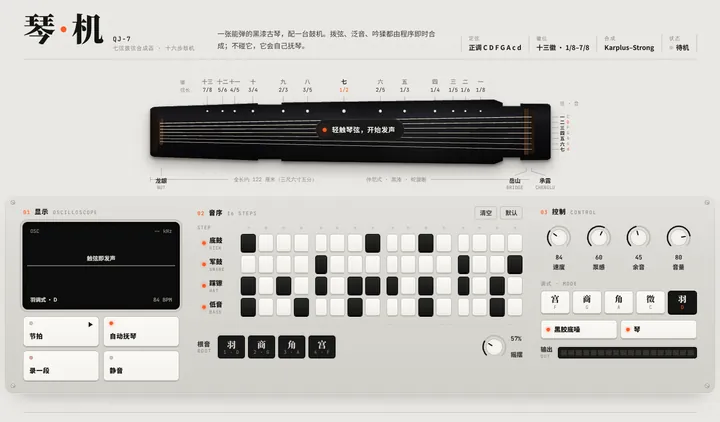 Lü·1Qin · MachineA playable qin with an electronic beat
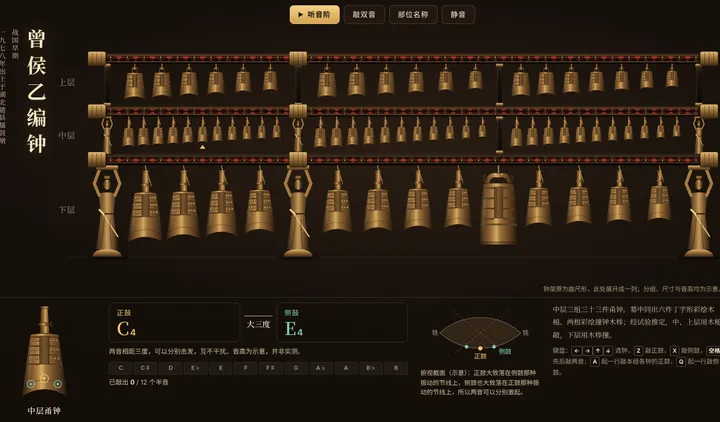 Lü·2The Bells of Marquis Yi of ZengOne bell, two notes
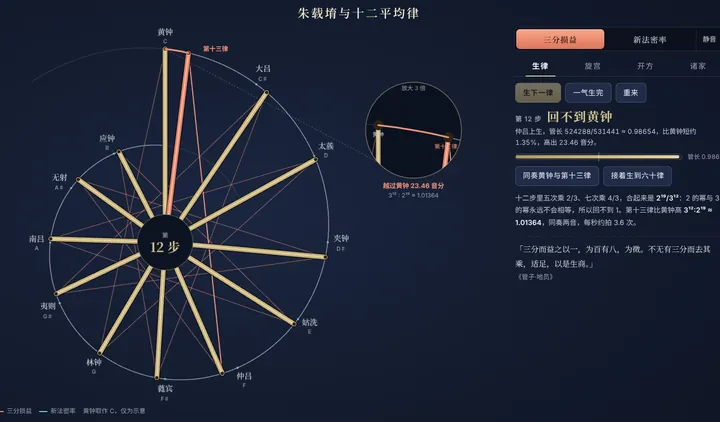 Lü·3Zhu Zaiyu and Equal TemperamentHow the 12 pitches come full circle