Men·4Entrance Hall
Baoxiang Flower: Watching the Breath
Breathe with a baoxiang flower, in as it opens and out as it closes: a mindfulness practice of about seven and a half minutes
- Accession no.
- Men·4
- Location
- Entrance Hall
- Category
- Motion and generative art
- Directed by
- Hu Yilin
- Made by
- Claude Opus 5.5
- Similar commission
- from S$18.75
About the exhibit
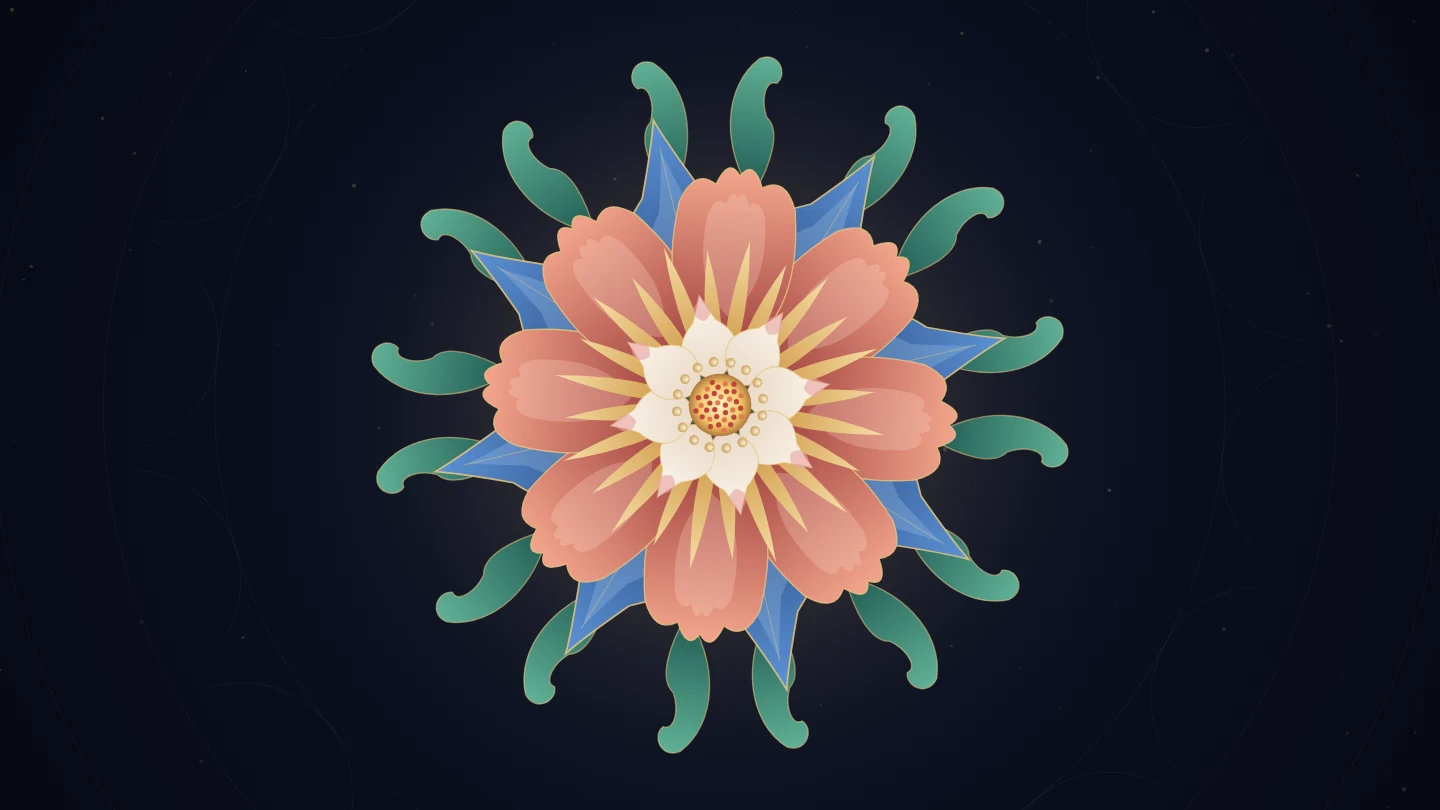
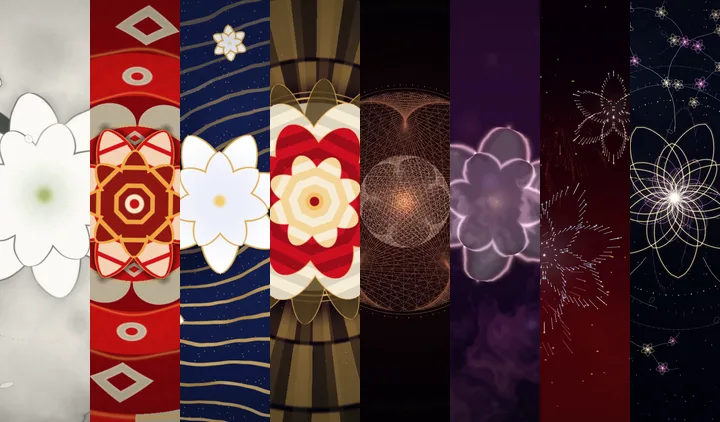
This is a mindful-breathing practice of about seven and a half minutes. On the screen is a baoxiang flower: it opens as you breathe in and closes as you breathe out, while a thin ring around it keeps time – one turn, one breath (in for five seconds, out for seven). A woman’s voice guides you gently in Mandarin, with English subtitles: first settling the body, then bringing attention to the breath. When she describes how the baoxiang flower is put together, its rings light up one by one; later a ring of petals drifts apart and gathers again, like thoughts that come and go. You can also choose music only, and when the practice ends you can keep breathing with the flower, without a clock.
The baoxiang flower was a rosette ornament popular in the Sui and Tang dynasties: rooted in the lotus and blended with peony, chrysanthemum and other blossoms and leaves, it is an imagined flower. Baoxiang, “precious countenance”, was originally a Buddhist term of respect for images of the Buddha.
How this work was made
The flower is drawn live in your browser, with no image files: from the centre outwards, a seed-heart and a ring of pearls, small lotus petals, chrysanthemum petals, cloud-curl petals, large lotus petals and honeysuckle scrolls, coloured in azurite blue, malachite green, vermilion and gold. The music is synthesised too – a low drone, slowly changing pentatonic tones, strikes like a singing bowl and a soft wind that rises and falls with the breath – with no ready-made recordings. The guiding voice is a synthesised female voice; every line was transcribed back by a separate model to check the pronunciation.
Sources and references
- Baoxiang flower: Chen Pin, “1400年前的月饼图案这么美” (These 1,400-year-old mooncake patterns are so beautiful), China Writers Network, 18 September 2024 (first published in Beijing Youth Daily)
- Voice: speech synthesis (Google Gemini 3.8 Flash TTS); the subtitles follow the voice
- Font: Noto Serif CJK SC, SIL Open Font License 1.1
Want something like this? See how to commission an online exhibition →
Spotted an error in the history, data or sources? Please write to [email protected] and let us know.
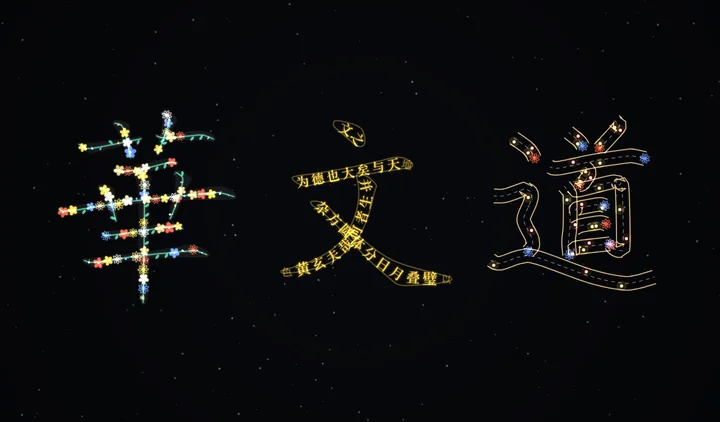 Men·3Hua · Wen · DaoA flower opens and its petals settle into 華; writing flows inside 文; the strokes of 道 grow into roads
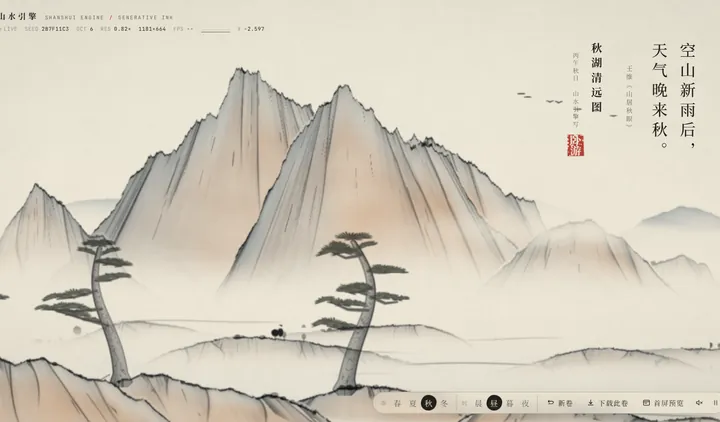 Ya·2The Three Distances of LandscapeAn ink landscape scroll, generated in real time
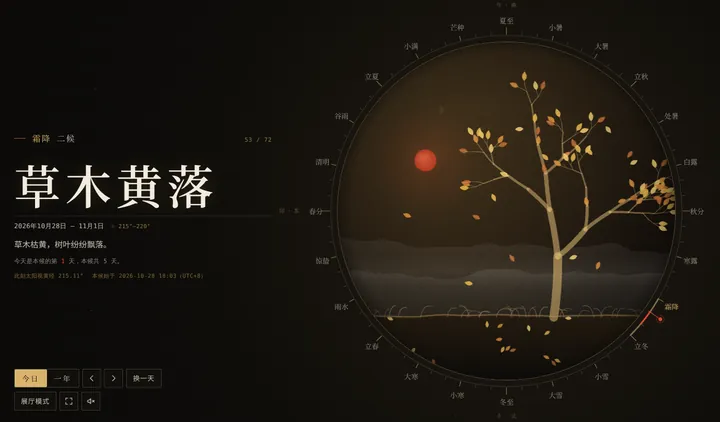 Tian·4The 72 PentadsFive days to a pentad: 72 generated vignettes cycling through a whole year
 Lü·4Jasmine Flower in Eight VersionsOne folk tune from Jiangnan, played eight ways: from silk-and-bamboo to Nagasaki, Milan, Hong Kong and the Nanyang