Nan·1SingaporeFeatured
Singapore’s Chinese Dialect Groups
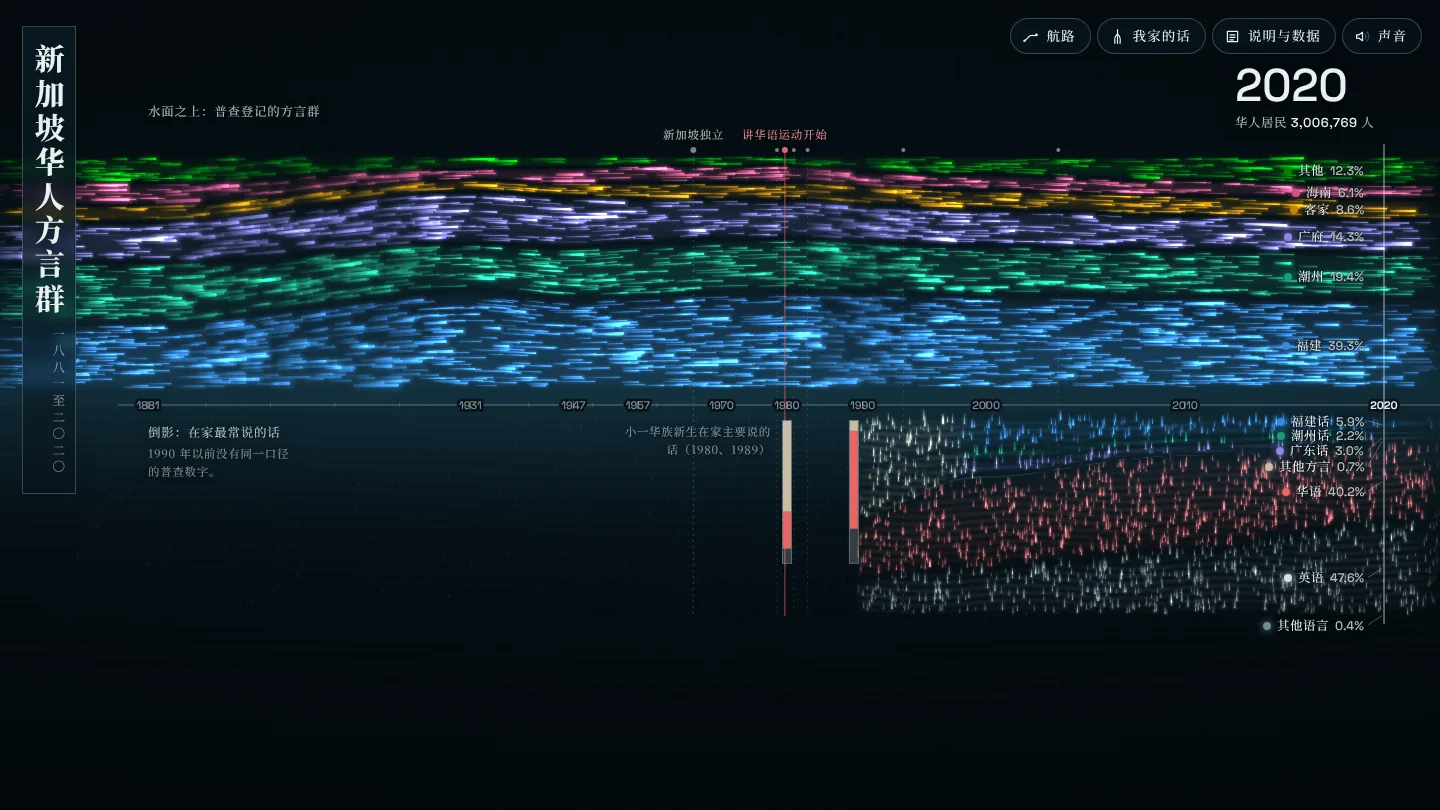
Census figures spanning 140 years, drawn as a river at night: the dialect groups on the surface, the language spoken at home in the reflection
- Accession no.
- Nan·1
- Location
- Singapore
- Category
- Data visualisation
- Period
- Modern to contemporary
- Directed by
- Hu Yilin
- Made by
- Claude Opus 5.5
- Similar commission
- from S$18.75
About the exhibit
Most Chinese immigrants to Singapore came from Fujian, Guangdong and Hainan, and formed “dialect groups” by ancestral home and dialect: Hokkien (Minnan), Teochew, Cantonese, Hakka, Hainanese and others, called “bang” in the 19th century. The censuses of the colonial period already counted each dialect group separately, and the population censuses after independence kept this item. This work draws, as a river at night, the census figures that can be checked. Above the surface are the dialect groups registered in the census: for 1881, 1931, 1947, 1957, 1970 and 1980, percentages compiled by scholars; for 2000, 2010 and 2020, numbers published by the Singapore Department of Statistics. The reflection is the language most often spoken at home by Chinese residents aged 5 and over, for which figures on the same basis exist from 1990.
From 1931 onwards, the Hokkien have consistently made up about 40% of Singapore’s Chinese, the largest dialect group; the Teochew about 20%; the Cantonese a little over 20% in 1931 and 1947, falling after that to 14.3% in 2020; and the Hakka and the Hainanese about 5% to 10% each. The make-up in 1881 was clearly different: the Hokkien were only 28.8% and the Teochew 26.1%.
The dialect group registered in the census is not the same as the language spoken at home. In 1990, among Chinese residents aged 5 and over, 50.3% most often spoke a Chinese dialect at home, 30.1% Mandarin and 19.3% English; by 2020 the three figures were 11.8%, 40.2% and 47.6%. By age, 77.5% of Chinese children aged 5–9 in 2020 most often spoke English at home and only 0.4% a dialect, while 70.5% of those aged 85 and over spoke a dialect. On 7 September 1979 the government launched the Speak Mandarin Campaign; television dropped all dialect programmes in 1981, and radio stopped broadcasting them altogether from 1 January 1983. According to Primary 1 registration records, the share of Chinese Primary 1 pupils who mainly spoke Mandarin at home rose from 26% in 1980 to 69% in 1989.
Open any dialect group to see its ancestral homeland, its 19th-century burial grounds, temples and clan associations, the traditional trades of each bang, and the dialect names still written on hawker-centre signs, such as He Mee (prawn noodles), Kway Chup (rice sheets in braised broth), Wanton Mee (wonton noodles) and Yong Tau Foo (stuffed tofu). “Sea routes” draws each dialect group’s ancestral homeland and its direction south to Singapore on a map of the South China Sea; the routes are illustrative. “My family’s language” lets visitors draw their family’s own strand flowing into the river, based on what each generation spoke at home, and compare it with the proportions for people of the same age in the 2020 census.
The censuses of 1891–1921 and of 1990 also counted dialect groups, but since complete figures that could be checked were not available, they are left out, and no estimates are made. Differences in how the population was counted from year to year (the scope of the colonial statistics, the counting of only citizens and permanent residents from 2000, and the changing content of the “Others” category) are each listed in the work’s “Notes and data”.
Sources and references
- Eddie Kuo and Luo Futeng, Diversity and Unity: Language and Society in Singapore (2022), p. 6, Table 1, “Proportions of the Chinese dialect groups in the population, 1881 to 2020”. Cited in Luo Futeng, “Chinese dialects in Singapore”, Culturepaedia, Singapore Chinese Cultural Centre. https://culturepaedia.singaporeccc.org.sg/zh/language-education/chinese-dialects-in-singapore/
- Singapore Department of Statistics, Census of Population 2000: Chinese Resident Population by Age Group, Dialect Group and Sex (SingStat Table Builder CT/10118). https://tablebuilder.singstat.gov.sg/table/CT/10118
- Singapore Department of Statistics, Census of Population 2010: Chinese Resident Population by Age Group, Dialect Group and Sex (CT/8531). https://tablebuilder.singstat.gov.sg/table/CT/8531
- Singapore Department of Statistics, Census of Population 2020: Chinese Resident Population by Age Group, Detailed Ethnic Group and Sex (CT/17397). https://tablebuilder.singstat.gov.sg/table/CT/17397
- Singapore Department of Statistics, Census of Population 2000: Advance Data Release, Chapter 4, “Literacy and Language”, Table 3 (language most frequently spoken at home by Chinese residents, 1990 and 2000) and Table 4 (by age group, 1990 and 2000). https://www.singstat.gov.sg/files/08753a10-22bc-44c0-8672-6c6ca325eaba.pdf
- Census of Population 2000: Resident Population Aged 5 Years and Over by Language Most Frequently Spoken at Home, Ethnic Group and Sex (CT/5959). https://tablebuilder.singstat.gov.sg/table/CT/5959
- Census of Population 2010: Resident Population Aged 5 Years and Over by Language Most Frequently Spoken at Home, Ethnic Group and Sex (CT/5980). https://tablebuilder.singstat.gov.sg/table/CT/5980
- Census of Population 2010: Resident Population Aged 5 Years and Over by Age Group, Ethnic Group and Language Most Frequently Spoken at Home (CT/5979). https://tablebuilder.singstat.gov.sg/table/CT/5979
- Census of Population 2020: Resident Population Aged 5 Years and Over by Language Most / Second Most Frequently Spoken at Home, Age Group and Ethnic Group (Chinese) (CT/17435). https://tablebuilder.singstat.gov.sg/table/CT/17435
- Culturepaedia Editorial Team, “The history and development of the Speak Mandarin Campaign” (partly adapted from the Promote Mandarin Council’s A Mandarin Anchor in a Changing World, 2014), Culturepaedia. https://culturepaedia.singaporeccc.org.sg/zh/language-education/the-speak-mandarin-campaign/
- Speak Mandarin Campaign (Promote Mandarin Council), “Milestones”. https://www.mandarin.languagecouncils.sg/en/about/milestones
- National Archives of Singapore, “Proclamation of Singapore drafted by E W Barker and signed by Lee Kuan Yew on 9 August 1965” (caption of an archival photograph). https://www.nas.gov.sg/archivesonline/photographs/record-details/72ffcf37-b8b1-11e3-927b-0050568939ad
- Hue Guan Thye, “Chinese dialect groups in 19th-century Singapore”, Culturepaedia. https://culturepaedia.singaporeccc.org.sg/zh/communities/chinese-communities-and-major-dialect-groups-in-19th-century-singapore/
- Luo Futeng, “Chinese dialects in Singapore”, Culturepaedia. https://culturepaedia.singaporeccc.org.sg/zh/language-education/chinese-dialects-in-singapore/
- Culturepaedia Editorial Team, “Traditional trades of the Hokkiens in Singapore” (compiled from Headways: The Professions of the Singapore Hokkiens, edited by Perng Peck Seng et al.), Culturepaedia. https://culturepaedia.singaporeccc.org.sg/zh/communities/traditional-trades-of-the-hokkiens-in-singapore/
- Lee Chee Hiang, “Traditional trades of the Teochews in Singapore”, Culturepaedia. https://culturepaedia.singaporeccc.org.sg/zh/communities/traditional-trades-of-the-teochews-in-singapore/
- Chan Hong Yin, “Traditional trades of the Cantonese community in Singapore”, Culturepaedia. https://culturepaedia.singaporeccc.org.sg/zh/communities/traditional-trades-of-the-cantonese-community-in-singapore/
- Lee Leong Sze, “Traditional trades of the Hakka community in Singapore”, Culturepaedia. https://culturepaedia.singaporeccc.org.sg/zh/communities/traditional-trades-of-the-hakka-community-in-singapore/
- Wong Chin Soon, “Traditional trades of the Hainanese community in Singapore”, Culturepaedia. https://culturepaedia.singaporeccc.org.sg/zh/communities/traditional-trades-of-the-hainanese-community-in-singapore/
- Luo Futeng, “The linguistic landscape of Singapore’s hawker centres”, Culturepaedia. https://culturepaedia.singaporeccc.org.sg/zh/language-education/the-linguistic-landscape-of-singapores-hawker-centres/
- Cheng Lim Keak, “Patterns of Social Alignment: A Case Study of Hakka Associations in Singapore”, Southeast Asian Studies 32(4), 1995, pp. 477–494, Table 2, “The Hakka Population in Singapore, 1881–1980”. https://kyoto-seas.org/pdf/32/4/320404.pdf
- Voon Phin-Keong, “The Hakkas of Malaysia to 1970: Population, Livelihood, and Culture”, Malaysian Journal of Chinese Studies 13(1), 2024, pp. 37–59. https://ejournal.newera.edu.my/mjcs/article/download/23/13/46
- “Chinese Dialect Groups and Their Occupations in 19th- and Early 20th-Century Singapore”, BiblioAsia 6(1), National Library Board, Singapore, April 2010. https://biblioasia.nlb.gov.sg/vol-6/issue-1/apr-2010/singapore-chinese-dialect-occupation/
- Annual Report on the Social and Economic Progress of the People of the Straits Settlements, 1931 (Colonial Reports—Annual No. 1599, London: HMSO, 1932), Chapter 3, “Population”, p. 6. https://seadelt.net/Asset/Source/Document_ID-407_No-01.pdf
- Natural Earth 1:50m Land (public domain), converted via world-atlas (Mike Bostock, ISC licence); used for the coastlines on the “Sea routes” map. https://www.naturalearthdata.com/
Want something like this? See how to commission an interactive teaching page →
Spotted an error in the history, data or sources? Please write to [email protected].
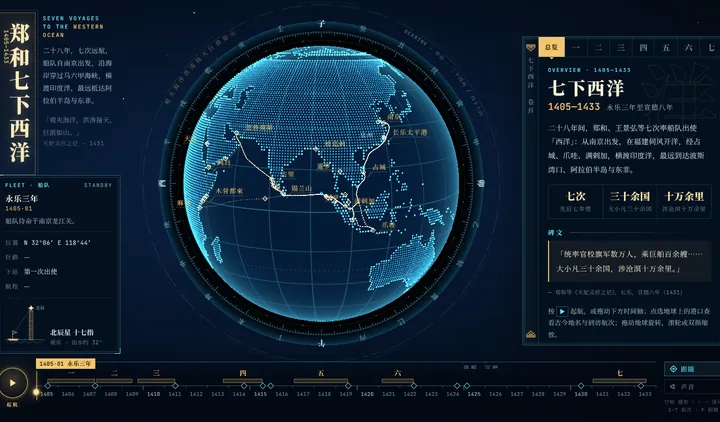 Hai·1Zheng He’s Seven VoyagesSeven voyages, drawn on a globe you can turn
 Hai·4Crossing the Ocean by the StarsMeasuring star heights with a star board to tell how far north or south the ship is
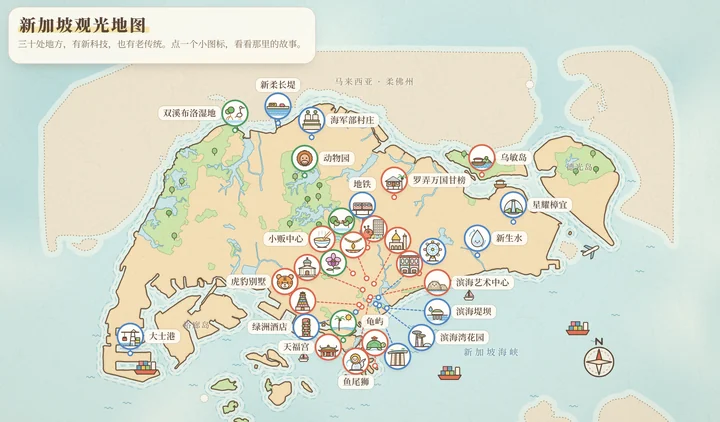 Nan·2Singapore Sightseeing MapA hand-drawn map, thirty places: new technology and old traditions on one island
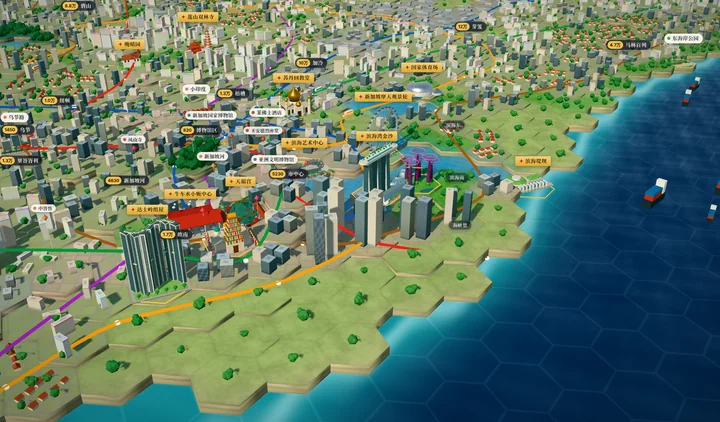 Nan·3Xingzhou AtlasOne island in nearly five thousand hexagons: click a cell for its town, switch lenses for the data, and find twenty-two wonders, one cell each