Men·2Entrance HallFeatured
Spring Couplets
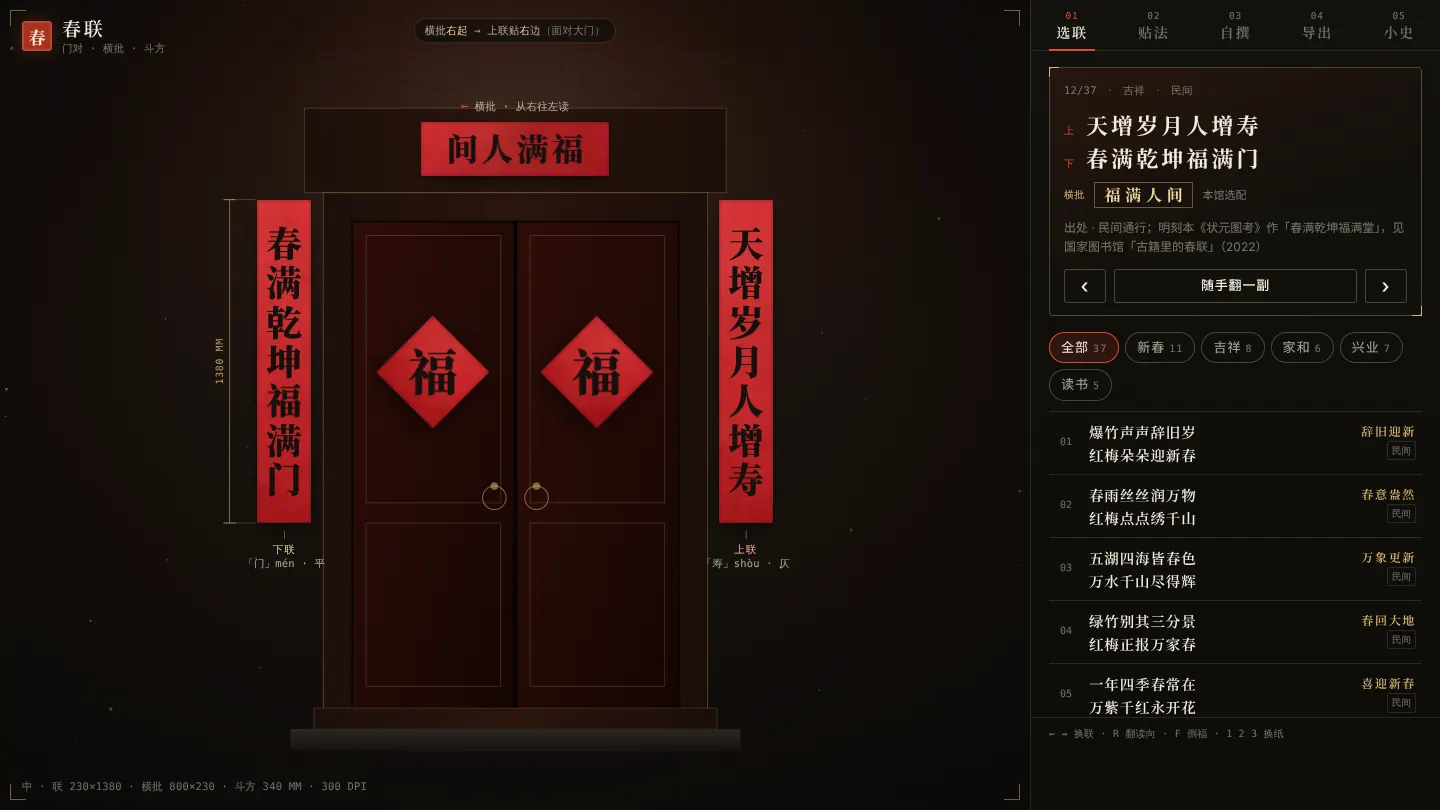
Thirty-seven traditional spring couplets with horizontal scrolls and fu characters, hung according to their reading direction and exported as print files
- Accession no.
- Men·2
- Location
- Entrance Hall
- Category
- Merchandise and print
- Period
- Tang–present
- Directed by
- Hu Yilin
- Made by
- Claude Opus 5.5
- Similar commission
- from S$12.50
About the exhibit
The spring couplet grew out of the peach-wood charm (taofu): people of old hung boards of peach wood on their doors, inscribed with the names of the two door gods Shenshu and Yulü, to ward off evil. According to the History of Song, Meng Chang, ruler of Later Shu in the Five Dynasties period, wrote on a peach-wood charm: “The new year receives abundant blessings; the fine festival is called Lasting Spring.” This couplet was long regarded as the earliest spring couplet; later, couplets written in the Tang dynasty, such as “The three yang begin to spread; the four seasons first unfold”, were found in the Dunhuang manuscript S.0610. From the Song onwards, red paper gradually took the place of the peach-wood boards, and by the Ming the name chunlian, “spring couplet”, had come into general use.
There are two basic rules for hanging spring couplets. The first tells the two lines apart: usually the first line ends on an oblique tone and the second on a level tone. The second settles left and right: the first line goes on whichever side the horizontal scroll starts reading from. Traditionally the horizontal scroll reads from right to left, so, facing the door, the first line is on the right and the second on the left; today the scroll is often written from left to right, and then the first line belongs on the left. In this exhibit, when you switch the reading direction of the horizontal scroll, the two lines on the door change sides with it.
The collection holds 37 couplets in five categories: New Year, good fortune, family harmony, thriving business, and study. Some are folk couplets still common today; others come from “Spring Couplets from Ancient Books”, a selection the National Library of China made from the old books in its collection, with the edition noted. The texts in the old books have no horizontal scrolls; the museum has paired each with a commonly used one and says so in the list. Every couplet has been checked so that the first line ends on an oblique tone and the second on a level tone, and the lines also avoid ending on characters such as 福 fu, 竹 zhu and 节 jie, which were entering-tone (and so oblique) in older Chinese but are read with a level tone today, so that they can be counted either way. The square fu sign on the door can be hung upright or upside down: many people hang it upside down, since “fu is upside down” sounds the same as “good fortune has arrived”; some folklorists, on the other hand, hold that the fu on a main door should be hung upright.
How this work was made
The door and paper are drawn live by code. The door is drawn in the true proportions of the chosen print size; the specks, fibres and gold leaf of the three paper styles — wannian hong (‘ten-thousand-year red’), gold-sprinkled, and cinnabar with gold tracing — are generated at random, so no two sheets are alike. The characters are set in a bold Song typeface, and the gold-traced characters also get a gold gradient and outline. When you change couplets, the three sheets unfold in the order horizontal scroll, first line, second line; when you flip the reading direction, the characters of the horizontal scroll swap places and the two lines change sides.
For print files, each sheet is rendered separately: it is drawn strip by strip at 300 dpi and compressed into a PNG as it goes, with the resolution written into the file, so even a couplet 1.8 metres long takes up only as much memory as a narrow strip of canvas. The whole set can be packed into a single ZIP with a sheet of hanging instructions. There are also 1080×1350 social media images, phone wallpapers and a print version split into A4 pages. Under “Write your own” you can compose your own couplet; it checks only that the two lines have the same number of characters and that the last characters follow the rule of an oblique tone ending the first line and a level tone ending the second. The tone lookup table is compiled from the Unicode Unihan database and covers the more than 6,700 characters of GB2312. Whether the parallelism is neat or the meaning good, it does not judge. Everything happens in the browser, and no data is uploaded.
Sources and references
- China Economic Net, “National Library of China Releases 21 ‘Spring Couplets from Ancient Books’”, 2022-01-19
- China Economic Net, “Spring Couplets from Ancient Books”, 2023-01-18
- Beijing Daily online, “2025 ‘Spring Couplets from Ancient Books’ Released as the National Library ‘Writes Couplets and Sends Blessings’”, 2025-01-22
- China News Service, “Experts on Hanging Spring Couplets: The Direction of the Horizontal Scroll Decides Which Side the First Line Goes On”, 2016-02-05
- Guangming Online, “How Exactly Should Spring Couplets Be Hung? How Do You Tell the First Line from the Second?” (from CCTV News), 2025-01-27
- The Beijing News, “‘The New Year Receives Abundant Blessings; the Fine Festival Is Called Lasting Spring’: The Origins and Uses of Couplets” (excerpted from Cheng Zhangcan, Lessons on Couplets, Nanjing University Press, 2025), 2026-02-13
- Sun Xuefeng, “Composing the Words and Writing the Calligraphy of Spring Couplets”, Guangming Daily, 2024-02-04
- Xiao Fang and Yuan Changshun, “Keeping New Year Customs Alive”, Knowledge of Literature and History (Wenshi Zhishi), 2015, no. 2 (reprinted by the China Intangible Cultural Heritage Network)
- Ding Meidong, “One Sheet of Calligraphy Paper Turns a Whole Town ‘Red’”, People’s Daily Overseas Edition, 2025-01-24
- Ningshan County People’s Government website, “Spring Festival Couplets”, 2009-01-13
- Yibin District Administrative Committee (The Paper, Pengpai Hao), “The Complete Spring Couplets for the 2024 Jiachen Year of the Dragon (with Horizontal Scrolls)”, 2024-01-12
- Yang Ting, “Nurturing Honest Rural Customs through the Fine Culture of Couplets”, Qiushi, 2026, no. 15
- Zdic (zdic.net): wufeng shiyu (timely wind and rain), sanyang kaitai (the three yang bring prosperity), wufu (the five blessings), jishan yuqing (blessings from accumulated goodness), sanjing (the three paths), zhilan (irises and orchids), tangdi (the bush cherry), jidi (passing the imperial examinations)
- Unicode Unihan Database (kHanyuPinlu, kMandarin, kXHC1983, kTang, kCantonese)
Spotted an error in the history, data or sources? Please write to [email protected].
 Men·1Three Motion PostersPosters for three fictional events, made three ways