書·三書房
論文批改:李約瑟《東西方的科學與社會》
六十年來的學者,在李約瑟最常被引用的一篇論文上留下的硃批
展品說明
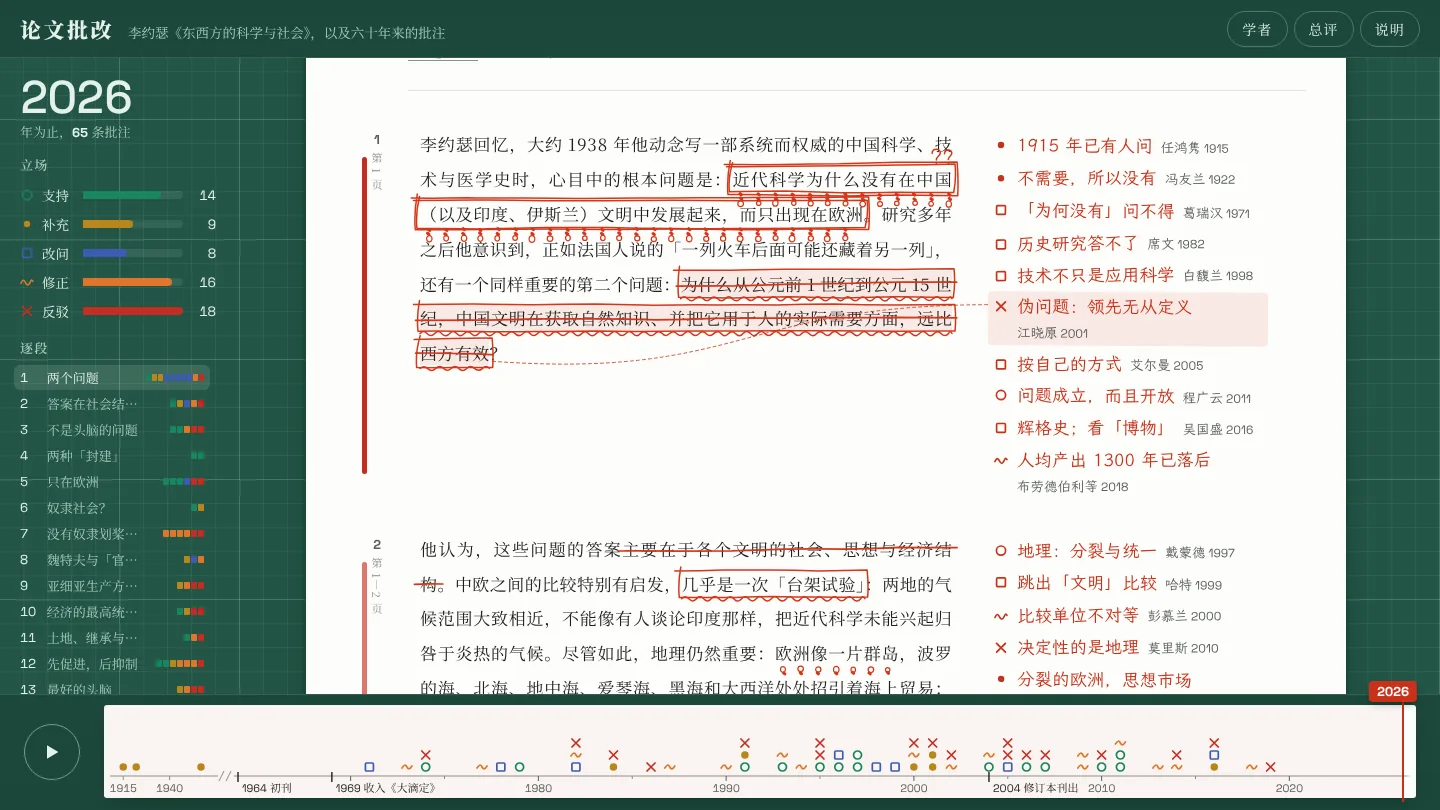
「近代科學為什麼沒有在中國產生」,這個問題在李約瑟 1964 年的《東西方的科學與社會》裡得到了最常被引用的表述。他把它寫成兩問:近代科學為什麼只在歐洲興起;而在此前一千多年裡,中國為什麼在獲取和運用自然知識方面比西方有效得多。他的回答主要是社會與經濟的:中國的「官僚封建制」起初有利於自然知識的增長和應用,後來卻抑制了資本主義與近代科學。這篇文章 1964 年先後刊于貝爾納紀念文集《科學的科學》、美國期刊《科學與社會》和科學史期刊《半人馬座》,1969 年收入文集《大滴定》;作者生前修訂的版本,2004 年收入《中國科學技術史》第七卷第二分冊。
這裡逐段轉述劍橋大學出版社公開的修訂本試讀部分(第 1—10 頁,共 15 段),在頁邊批上此後學者的回應。批註分五種:支援、補充、修正、反駁,以及認為這句話問錯了、該換個問法的「改問」。批註最集中的是第 1 段的提問方式:葛瑞漢、席文認為「為什麼沒有」不是歷史研究能夠回答的問題,江曉原稱之為偽問題,也有學者為它辯護;第 7 段關於奴隸制與節省勞力器械的推測、第 12 段「官僚封建制先促進、後抑制」的核心解釋,也都引來了大量修正與反駁——關於國家的角色,大分流研究給出的答案甚至方向相反。連作者自己也改過:修訂本的腳註裡,他承認「官僚封建制」不如叫「封建官僚制」。
摘述是轉述,不是原文的譯文;原文請看出版方公開的試讀本。每條批註都註明學者、年份和著作,書目資訊與論點都對照過出版方、期刊或書評的說明。也收在「李約瑟問題」圖譜裡的文獻,可以從批註直接跳過去。
出處與參考
- 論文:Joseph Needham(李約瑟), “Science and Society in East and West”(東西方的科學與社會),1964
- 初刊于貝爾納紀念文集:Maurice Goldsmith & Alan Mackay (eds.), The Science of Science (London: Souvenir Press, 1964)
- Science & Society 28 (4) (1964): 385–408(DOI 10.1177/003682376402800401)
- Centaurus 10 (3) (1964): 174–197(DOI 10.1111/j.1600-0498.1965.tb00399.x)
- 收入 The Grand Titration: Science and Society in East and West (London: George Allen & Unwin, 1969): 190–217
- 修訂本:Science and Civilisation in China, Vol. 7, Part II: General Conclusions and Reflections, ed. Kenneth Girdwood Robinson (Cambridge: Cambridge University Press, 2004),第 50 章 (a) 節
- 本作品轉述的公開試讀本(劍橋大學出版社):https://assets.cambridge.org/052108/7325/excerpt/0521087325_excerpt.pdf
- 任鴻雋《說中國無科學之原因》,《科學》第 1 卷第 1 期(1915)
- Fung Yu-lan(馮友蘭), “Why China Has No Science—An Interpretation of the History and Consequences of Chinese Philosophy”, International Journal of Ethics 32 (3) (1922): 237–263(DOI 10.1086/intejethi.32.3.2377487)
- Karl A. Wittfogel, Oriental Despotism: A Comparative Study of Total Power (New Haven: Yale University Press, 1957);李約瑟的書評見 Science and Society 23 (1) (1959): 58–65
- A. C. Graham, “China, Europe, and the Origins of Modern Science: Needham’s The Grand Titration”, Asia Major, new series 16 (1971): 178–196
- Mark Elvin, The Pattern of the Chinese Past: A Social and Economic Interpretation (Stanford: Stanford University Press, 1973)
- Perry Anderson, Lineages of the Absolutist State (London: New Left Books, 1974),書末附論 “The ‘Asiatic Mode of Production’”
- Ray Huang(黃仁宇)& Joseph Needham, “The Nature of Chinese Society: A Technical Interpretation”, East and West, new series 24 (1974): 381–401
- G. William Skinner (ed.), The City in Late Imperial China (Stanford: Stanford University Press, 1977)
- Edward W. Said, Orientalism (New York: Pantheon Books, 1978)
- 黃現璠《我國民族歷史沒有奴隸社會的探討》(1979),據焦培民《中國歷史分期新論》,刊於《廣西師範大學學報》1979 年第 2 期;張廣志《略論奴隸制的歷史地位》,《青海師範學院學報》1980 年第 1 期
- Nathan Sivin, “Why the Scientific Revolution Did Not Take Place in China—or Didn’t It?”, Chinese Science 5 (1982): 45–66(DOI 10.1163/26669323-00501006)
- Peter C. Perdue, “Water Control in the Dongting Lake Region during the Ming and Qing Periods”, The Journal of Asian Studies 41 (4) (1982): 747–765;另見其 Exhausting the Earth: State and Peasant in Hunan, 1500–1850 (Cambridge, MA: Council on East Asian Studies, Harvard University, 1987)(DOI 10.2307/2055448)
- William T. Rowe, Hankow: Commerce and Society in a Chinese City, 1796–1889 (Stanford: Stanford University Press, 1984)
- 金觀濤、劉青峰《興盛與危機》(長沙:湖南人民出版社,1984)
- Robert P. Hymes, Statesmen and Gentlemen: The Elite of Fu-chou, Chiang-hsi, in Northern and Southern Sung (Cambridge: Cambridge University Press, 1986)
- 余英時《中國近世宗教倫理與商人精神》(臺北:聯經出版事業公司,1987)
- Mark Edward Lewis, Sanctioned Violence in Early China (Albany: State University of New York Press, 1990)(https://www.sunypress.edu/p-752-sanctioned-violence-in-early-ch.aspx)
- Derk Bodde, Chinese Thought, Society, and Science: The Intellectual and Social Background of Science and Technology in Pre-modern China (Honolulu: University of Hawaii Press, 1991)
- Randall A. Dodgen, “Hydraulic Evolution and Dynastic Decline: The Yellow River Conservancy, 1796–1855”, Late Imperial China 12 (2) (1991): 36–63(DOI 10.1353/late.1991.0009)
- Pierre-Étienne Will & R. Bin Wong, Nourish the People: The State Civilian Granary System in China, 1650–1850 (Ann Arbor: University of Michigan Center for Chinese Studies, 1991)(DOI 10.3998/mpub.19044)
- Toby E. Huff, The Rise of Early Modern Science: Islam, China, and the West (Cambridge: Cambridge University Press, 1993)
- M. J. T. Lewis, “The Origins of the Wheelbarrow”, Technology and Culture 35 (3) (1994): 453–475(DOI 10.1353/tech.1994.0036)
- Justin Yifu Lin(林毅夫), “The Needham Puzzle: Why the Industrial Revolution Did Not Originate in China”, Economic Development and Cultural Change 43 (2) (1995): 269–292(DOI 10.1086/452150)
- Alastair Iain Johnston, Cultural Realism: Strategic Culture and Grand Strategy in Chinese History (Princeton: Princeton University Press, 1995)(DOI 10.1515/9780691213149)
- 席澤宗《關於“李約瑟難題”和近代科學源於希臘的對話》,《科學》第 48 卷第 4 期(1996):32–34
- Steven Shapin, The Scientific Revolution (Chicago: University of Chicago Press, 1996)
- Jared Diamond, Guns, Germs, and Steel: The Fates of Human Societies (New York: W. W. Norton, 1997)
- R. Bin Wong(王國斌), China Transformed: Historical Change and the Limits of European Experience (Ithaca: Cornell University Press, 1997)(DOI 10.7591/9781501736049)
- Francesca Bray, “Technics and Civilization in Late Imperial China: An Essay in the Cultural History of Technology”, Osiris 13 (1998): 11–33;2019 年重刊於開放獲取文集 The History of Science in a World of Readers (Berlin: Edition Open Access)(DOI 10.1086/649278)
- Roger Hart, “Beyond Science and Civilization: A Post-Needham Critique”, East Asian Science, Technology, and Medicine 16 (1999): 88–114(DOI 10.1163/26669323-01601006)
- Kenneth Pomeranz, The Great Divergence: China, Europe, and the Making of the Modern World Economy (Princeton: Princeton University Press, 2000)
- Kevin Greene, “Technological Innovation and Economic Progress in the Ancient World: M. I. Finley Re-Considered”, The Economic History Review 53 (1) (2000): 29–59(DOI 10.1111/1468-0289.00151)
- Benjamin A. Elman, A Cultural History of Civil Examinations in Late Imperial China (Berkeley: University of California Press, 2000)(DOI 10.1525/9780520921474)
- 江曉原《被中國人誤讀的李約瑟——紀念李約瑟誕辰一百週年》,《自然辯證法通訊》第 23 卷第 1 期(2001)(https://www.aisixiang.com/data/104650.html)
- Robin D. S. Yates, “Slavery in Early China: A Socio-Cultural Approach”, Journal of East Asian Archaeology 3 (1) (2001): 283–331(DOI 10.1163/156852301100402723)
- Donald B. Wagner, The State and the Iron Industry in Han China (Copenhagen: Nordic Institute of Asian Studies, 2001)(https://donwagner.dk/)
- Andrew Wilson, “Machines, Power and the Ancient Economy”, The Journal of Roman Studies 92 (2002): 1–32(DOI 10.2307/3184857)
- Philip C. C. Huang(黃宗智), “Development or Involution in Eighteenth-Century Britain and China? A Review of Kenneth Pomeranz’s The Great Divergence”, The Journal of Asian Studies 61 (2) (2002): 501–538(DOI 10.2307/2700299)
- Pamela H. Smith, The Body of the Artisan: Art and Experience in the Scientific Revolution (Chicago: University of Chicago Press, 2004)
- Joseph Needham, Science and Civilisation in China, Vol. 7, Part II: General Conclusions and Reflections, ed. Kenneth Girdwood Robinson (Cambridge: Cambridge University Press, 2004),第 5 頁注 15(https://assets.cambridge.org/052108/7325/excerpt/0521087325_excerpt.pdf)
- Benjamin A. Elman, On Their Own Terms: Science in China, 1550–1900 (Cambridge, MA: Harvard University Press, 2005)
- 楊振寧《〈易經〉對中華文化的影響》,《自然雜誌》第 27 卷第 1 期(2005):1–3
- Madeleine Zelin, The Merchants of Zigong: Industrial Entrepreneurship in Early Modern China (New York: Columbia University Press, 2005)
- David S. Landes, “Why Europe and the West? Why Not China?”, Journal of Economic Perspectives 20 (2) (2006): 3–22(DOI 10.1257/jep.20.2.3)
- Joanna Waley-Cohen, The Culture of War in China: Empire and the Military under the Qing Dynasty (London: I. B. Tauris, 2006)
- 馮天瑜《“封建”考論》(武漢:武漢大學出版社,2007)
- Kapil Raj, Relocating Modern Science: Circulation and the Construction of Knowledge in South Asia and Europe, 1650–1900 (Basingstoke: Palgrave Macmillan, 2007)
- Robert C. Allen, The British Industrial Revolution in Global Perspective (Cambridge: Cambridge University Press, 2009)
- Nicola Di Cosmo (ed.), Military Culture in Imperial China (Cambridge, MA: Harvard University Press, 2009)
- Ian Morris, Why the West Rules—For Now (New York: Farrar, Straus and Giroux, 2010)
- H. Floris Cohen, How Modern Science Came into the World: Four Civilizations, One 17th-Century Breakthrough (Amsterdam: Amsterdam University Press, 2010)
- 程廣雲《泛李約瑟問題:無窮窮舉——駁李約瑟問題終結論》,《社會科學輯刊》2011 年第 1 期(https://www.aisixiang.com/data/51545.html)
- Toby E. Huff, Intellectual Curiosity and the Scientific Revolution: A Global Perspective (Cambridge: Cambridge University Press, 2011)
- Jean-Laurent Rosenthal & R. Bin Wong, Before and Beyond Divergence: The Politics of Economic Change in China and Europe (Cambridge, MA: Harvard University Press, 2011)(DOI 10.4159/harvard.9780674061293)
- Benjamin A. Elman, Civil Examinations and Meritocracy in Late Imperial China (Cambridge, MA: Harvard University Press, 2013)(DOI 10.4159/harvard.9780674726048)
- Tuan-Hwee Sng, “Size and Dynastic Decline: The Principal-Agent Problem in Late Imperial China, 1700–1850”, Explorations in Economic History 54 (2014): 107–127(DOI 10.1016/j.eeh.2014.05.002)
- Loren Brandt, Debin Ma & Thomas G. Rawski, “From Divergence to Convergence: Reevaluating the History Behind China’s Economic Boom”, Journal of Economic Literature 52 (1) (2014): 45–123(DOI 10.1257/jel.52.1.45)
- 吳國盛《什麼是科學》(廣州:廣東人民出版社,2016);臧繼賢、朱凡《專訪北大教授吳國盛:中國古代沒有數理科學,這本是命運》,澎湃新聞,2016 年 9 月 3 日;溫新紅《中國古代有“科學”》,《中國科學報》2016 年 12 月 23 日(https://m.thepaper.cn/newsDetail_forward_1523638)
- Joel Mokyr, A Culture of Growth: The Origins of the Modern Economy (Princeton: Princeton University Press, 2016)
- Ling Zhang, The River, the Plain, and the State: An Environmental Drama in Northern Song China, 1048–1128 (Cambridge: Cambridge University Press, 2016)
- Stephen Broadberry, Hanhui Guan & David Daokui Li, “China, Europe, and the Great Divergence: A Study in Historical National Accounting, 980–1850”, The Journal of Economic History 78 (4) (2018): 955–1000(DOI 10.1017/S0022050718000529)
- Debin Ma & Jared Rubin, “The Paradox of Power: Principal-Agent Problems and Administrative Capacity in Imperial China (and Other Absolutist Regimes)”, Journal of Comparative Economics 47 (2) (2019): 277–294(DOI 10.1016/j.jce.2019.03.002)
- Florence Hsia & Dagmar Schäfer, “History of Science, Technology, and Medicine: A Second Look at Joseph Needham”, Isis 110 (1) (2019): 94–99(DOI 10.1086/702895)
- 《史記·酈生陸賈列傳》(陸賈「居馬上得之,寧可以馬上治之乎」)
想做一件類似的?看看演講網頁、文獻綜述怎樣委託 →
發現史實、資料或出處有誤?請寫信到 [email protected] 告訴我們。
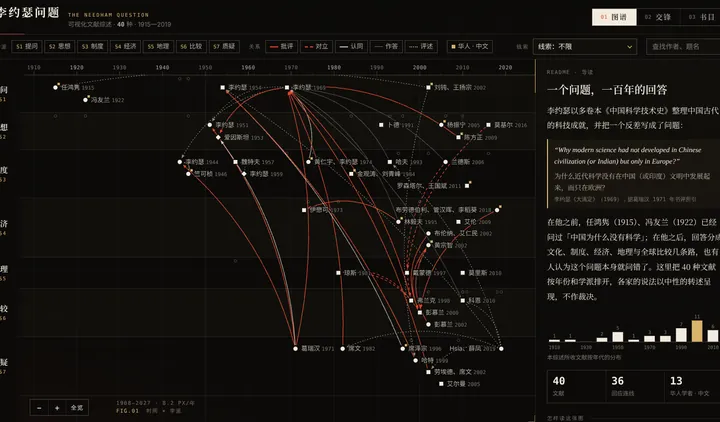 書·二李約瑟問題一份視覺化文獻綜述:近代科學為什麼沒有在中國產生,以及這個問題該不該這樣問
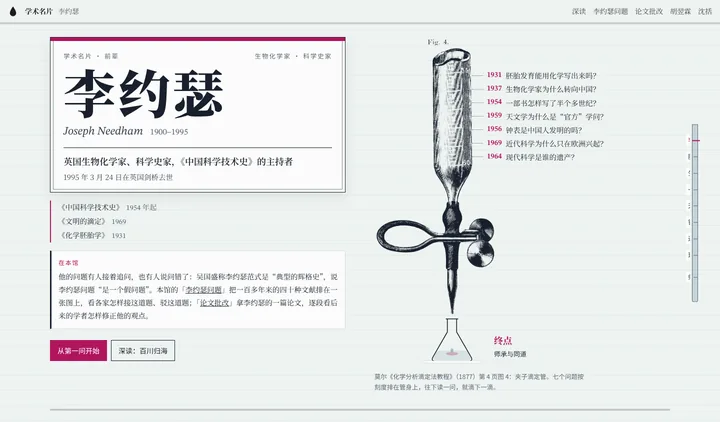 書·五李約瑟的學術名片一支滴定管,七個問題按刻度往下滴
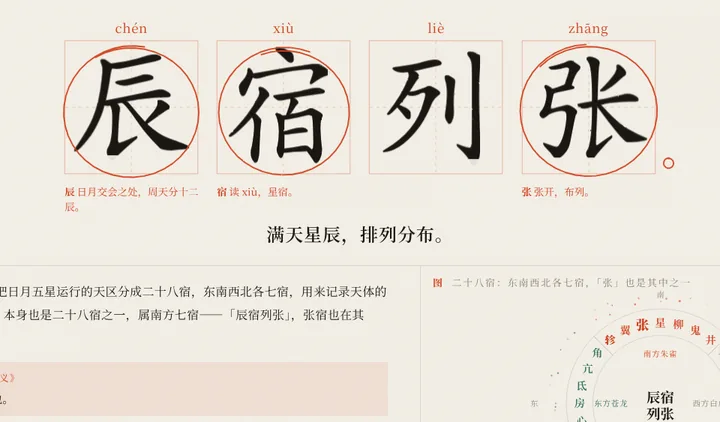 書·一千字文:一句一幕二百五十句逐句寫出、逐句批註;一千個字的全景,還能把名字集出來
 書·四胡翌霖的學術名片一臺老式視窗桌面,八個程式依次開啟
 書·六華夏文明在科技時代的復興隨軒文選:一本能翻頁、能批註的線裝書