講·二演講廳
把事物畫在一起
科學史中的視覺化
展品說明
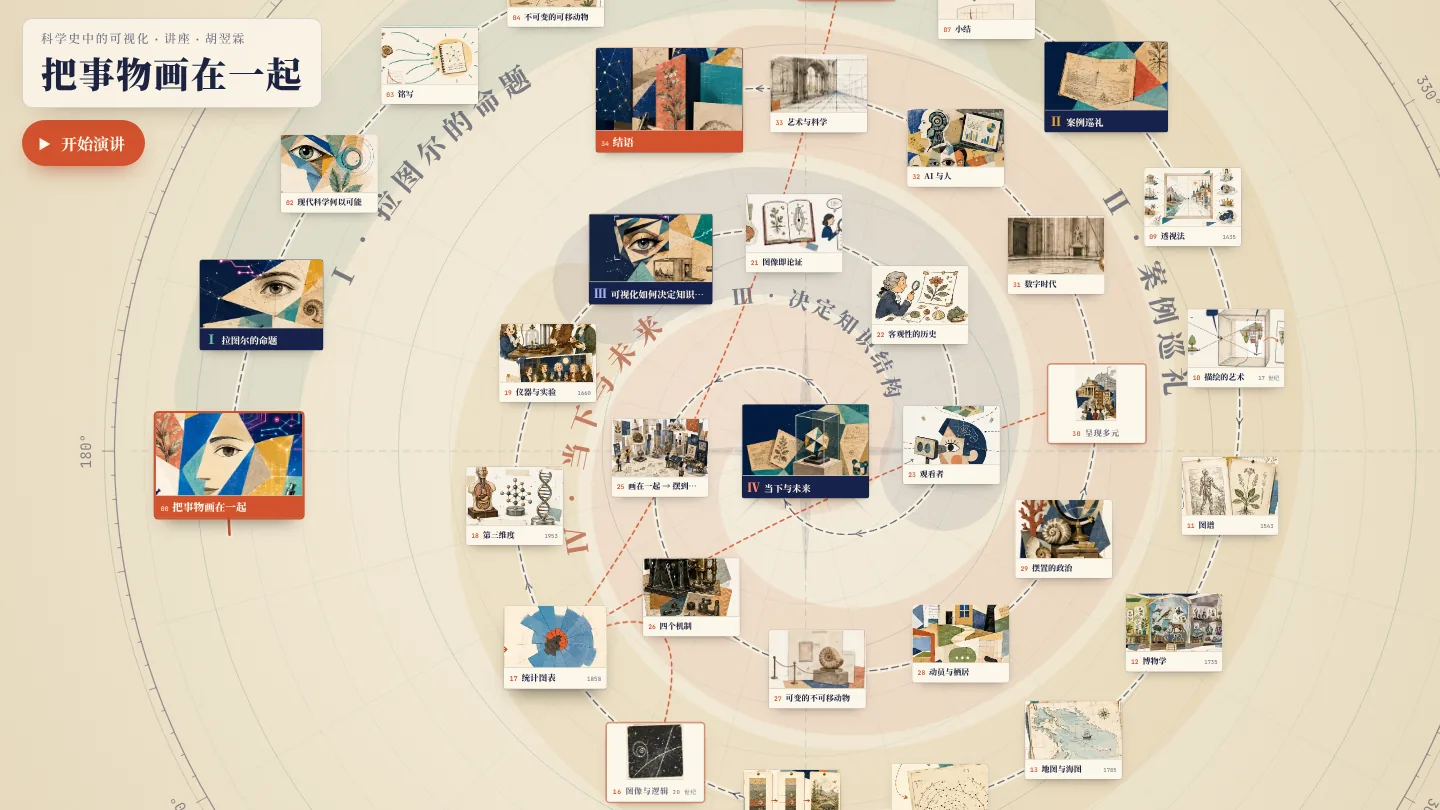
這是胡翌霖的一場講座。題目借自科學知識社會學家布魯諾·拉圖爾(Bruno Latour)的一篇名文:1986 年初刊時題為《視覺化與認知:用眼睛和手思考》,1990 年收入林奇與伍爾加主編的《科學實踐中的表徵》,改題「把事物畫在一起」。講座分四幕,加上封面與結語共三十五頁,排在一條雙螺旋上:前三幕講科學怎樣「把事物畫在一起」,第四幕講博物館怎樣「把事物擺到一起」。
第一幕 拉圖爾的命題。現代科學何以在十六、十七世紀的歐洲出現?常見的回答訴諸宏大的原因:新的心靈、新的方法、新的經濟。拉圖爾建議先看科學家手上在做什麼:他們不停地製造紙面上的痕跡,圖表、地圖、星表、曲線、照片、標本標籤、儀器讀數,統稱「銘寫」。好的銘寫是「不可變的可移動物」:運到哪裡都保持內部關係不變,可以縮放、複製、疊合,可以和文字、幾何合流。透視法提供了「光學一致性」,讓城市、風景、星辰、機器都能投到同一種平面上;銘寫一層層匯聚到「計算中心」,最後被壓成一個數。
第二幕 案例巡禮。阿爾伯蒂《論繪畫》(1435)的透視作圖;荷蘭「描繪的藝術」與暗箱;維薩里《人體構造》(1543)與福克斯的植物圖譜(1542),版畫讓影像第一次能原樣複製;林奈《自然系統》(1735)按雄蕊把植物分進二十四綱;拉佩魯茲遠航(1785—1788)時,庫頁島的當地人在沙灘上畫出島嶼與大陸,眼看潮水要把它抹掉,一位年輕人用鉛筆把它畫進了拉佩魯茲的筆記本;後來萊塞普斯帶著日誌與海圖橫穿西伯利亞回到巴黎;第谷的星表與開普勒在紙上得出的橢圓軌道;地層對比與「深時」復原圖;伽裡森所說的雲室照片與計數器兩種傳統;普萊費爾(1786、1821)與南丁格爾(1858)的統計圖;沃森與克里克 1953 年的 DNA 雙螺旋模型;波義耳的空氣泵(1660)與實驗報告造就的公共見證。
第三幕 視覺化如何決定知識結構。影像不是文字的插圖,而是論證本身:伽利略在《星際信使》(1610)裡,用明暗交界線外的亮點論證月亮上有山。達斯頓與伽裡森的《客觀性》區分了三種認知美德:忠於自然、機械客觀性、訓練有素的判斷,「客觀」本身也有歷史。克拉裡《觀察者的技術》指出,十九世紀的視覺玩具與立體鏡把觀看者自己變成了研究物件。
第四幕 當下與未來。如果科學是把世界畫進紙面,科學博物館就是把紙面重新擺出為世界。講座把這叫作「逆向銘寫」,提出器物化、操作化、過程化、公共化四個機制;與「不可變的可移動物」相對,提出「可變的不可移動物」;區分視覺化的「動員」與空間化的「棲居」,借胡塞爾《歐洲科學的危機》所說的「生活世界」,把空間化看作讓科學接回生活世界的方向;回顧博物館從繆斯宮、奇珍室到公共博物館的幾次起源,引吳國盛的看法:博物館在近代的出現與現代性的內在邏輯有關;再對照國際博物館協會 2007 年與 2022 年的兩個定義;再談數字時代的在場、AI 時代人在學術中的位置,最後回到藝術與科學的再會合。
網頁裡的圖。講座講到的歷史影像都用程式重新畫過,每一頁都能動手。數字有據可查的照原樣:波義耳 1662 年《為空氣彈性與重量學說辯護》中「空氣壓縮表」的二十五行數字;普萊費爾 1821 年的小麥價格與工錢、南丁格爾 1858 年的各月死亡年率,取自 M. Friendly 等整理的 HistData 資料集;DNA 雙螺旋按沃森與克里克論文給出的尺寸(每圈 34 埃、十個鹼基對);拉佩魯茲船隊的停靠點與日期據 1797 年出版的航海記與萊塞普斯 1790 年的遊記整理,海岸線用 Natural Earth 的公有領域資料;國際博物館協會三份定義的英文為原文,中文為意譯。開普勒的「觀測」由開普勒定律反推,月面、雲室徑跡、地層與葉片由程式生成,都是示意,不是原始影像。各頁的插畫是胡翌霖為這場講座用 ChatGPT 生成的,網頁裡去掉了畫中的文字。
出處與參考
- 胡翌霖《把事物畫在一起:科學史中的視覺化》講座幻燈片(36 頁),第三版。幻燈片中的整頁插畫由胡翌霖用 ChatGPT 生成,本作品裁切、去字後用作各頁插圖。
- Bruno Latour, “Visualisation and Cognition: Thinking with Eyes and Hands”, Knowledge and Society: Studies in the Sociology of Culture Past and Present 6 (1986): 1–40.
- Bruno Latour, “Drawing Things Together”, in Michael Lynch & Steve Woolgar (eds.), Representation in Scientific Practice, Cambridge, MA: MIT Press, 1990, pp. 19–68.
- Bruno Latour, Science in Action: How to Follow Scientists and Engineers through Society, Cambridge, MA: Harvard University Press, 1987(第六章 “Centres of Calculation”).
- Tessa Morris-Suzuki, “The Telescope and the Tinderbox: Rediscovering La Pérouse in the North Pacific”, East Asian History 39 (2014):https://eah.anu.edu.au/39/Morris-Suzuki/index.html
- William M. Ivins Jr., On the Rationalization of Sight, New York: Metropolitan Museum of Art, 1938.
- William M. Ivins Jr., Prints and Visual Communication, Cambridge, MA: Harvard University Press, 1953.
- Leon Battista Alberti, De pictura(《論繪畫》), 1435.
- Samuel Y. Edgerton, The Renaissance Rediscovery of Linear Perspective, New York: Basic Books, 1975.
- Samuel Y. Edgerton, The Heritage of Giotto’s Geometry: Art and Science on the Eve of the Scientific Revolution, Ithaca: Cornell University Press, 1991.
- Svetlana Alpers, The Art of Describing: Dutch Art in the Seventeenth Century, Chicago: University of Chicago Press, 1983.
- Andreas Vesalius, De humani corporis fabrica libri septem(《人體構造》), Basel: Oporinus, 1543.
- Leonhart Fuchs, De historia stirpium commentarii insignes, Basel: Isingrin, 1542.
- Sachiko Kusukawa, Picturing the Book of Nature: Image, Text, and Argument in Sixteenth-Century Human Anatomy and Medical Botany, Chicago: University of Chicago Press, 2012.
- Carl Linnaeus, Systema Naturae(《自然系統》), Leiden, 1735.
- Georg Dionysius Ehret, Methodus plantarum sexualis in Sistemate naturae descripta, Leiden, 1736.
- Gerardus Mercator, Nova et aucta orbis terrae descriptio ad usum navigantium emendate accommodata, Duisburg, 1569.
- L. A. Milet-Mureau (ed.), Voyage de La Pérouse autour du monde, Paris, 1797.
- Jean-Baptiste Barthélemy de Lesseps, Journal historique du voyage de M. de Lesseps, Paris, 1790;英譯本 Travels in Kamtschatka, during the Years 1787 and 1788, London, 1790.
- Linda Hall Library, “Scientist of the Day: Barthélemy de Lesseps”:https://www.lindahall.org/about/news/scientist-of-the-day/barthelmy-de-lesseps/
- Natural Earth, 1:110m Land(公有領域),經 world-atlas 的 TopoJSON 版本。
- Tycho Brahe, Astronomiae instauratae mechanica, Wandsbek, 1598.
- Johannes Kepler, Astronomia nova(《新天文學》), Prague, 1609.
- Martin J. S. Rudwick, Scenes from Deep Time: Early Pictorial Representations of the Prehistoric World, Chicago: University of Chicago Press, 1992.
- William Smith, A Delineation of the Strata of England and Wales, with Part of Scotland, London, 1815.
- Henry De la Beche, Duria Antiquior, 1830.
- Peter Galison, Image and Logic: A Material Culture of Microphysics, Chicago: University of Chicago Press, 1997.
- William Playfair, The Commercial and Political Atlas, London, 1786.
- William Playfair, A Letter on Our Agricultural Distresses, Their Causes and Remedies, London, 1821.
- Florence Nightingale, Notes on Matters Affecting the Health, Efficiency, and Hospital Administration of the British Army, London, 1858.
- Michael Friendly et al., HistData: Data Sets from the History of Statistics and Data Visualization(R 資料包,資料集 Wheat、Nightingale):https://cran.r-project.org/package=HistData
- Soraya de Chadarevian & Nick Hopwood (eds.), Models: The Third Dimension of Science, Stanford: Stanford University Press, 2004.
- J. D. Watson & F. H. C. Crick, “Molecular Structure of Nucleic Acids: A Structure for Deoxyribose Nucleic Acid”, Nature 171 (1953): 737–738.
- Robert Boyle, New Experiments Physico-Mechanicall, Touching the Spring of the Air, and Its Effects, Oxford, 1660.
- Robert Boyle, A Defence of the Doctrine Touching the Spring and Weight of the Air, London, 1662(「空氣壓縮表」).
- Steven Shapin & Simon Schaffer, Leviathan and the Air-Pump: Hobbes, Boyle, and the Experimental Life, Princeton: Princeton University Press, 1985.
- Jenny Uglow, The Lunar Men: The Friends Who Made the Future, London: Faber & Faber, 2002.
- Michael Lynch & Steve Woolgar (eds.), Representation in Scientific Practice, Cambridge, MA: MIT Press, 1990.
- Caroline A. Jones & Peter Galison (eds.), Picturing Science, Producing Art, New York: Routledge, 1998.
- Galileo Galilei, Sidereus nuncius(《星際信使》), Venice, 1610.
- Lorraine Daston & Peter Galison, Objectivity, New York: Zone Books, 2007.
- Jonathan Crary, Techniques of the Observer: On Vision and Modernity in the Nineteenth Century, Cambridge, MA: MIT Press, 1990.
- Charles Wheatstone, “Contributions to the Physiology of Vision. Part the First. On Some Remarkable, and Hitherto Unobserved, Phenomena of Binocular Vision”, Philosophical Transactions of the Royal Society of London 128 (1838): 371–394.
- Edmund Husserl, Die Krisis der europäischen Wissenschaften und die transzendentale Phänomenologie, 1936.
- 《對話|清華為何建設科學博物館,這個時代為何需要科學博物館》(吳國盛訪談),澎湃新聞,2020 年 12 月 18 日。
- ICOM(國際博物館協會),Museum Definition(2007 年維也納大會通過;2019 年京都大會提案,表決推遲;2022 年 8 月 24 日布拉格特別大會通過):https://icom.museum/en/resources/standards-guidelines/museum-definition/
- Léon Foucault, “Démonstration physique du mouvement de rotation de la Terre au moyen du pendule”, Comptes rendus hebdomadaires des séances de l’Académie des sciences 32 (1851): 135–138.
想做一件類似的?看看演講網頁、文獻綜述怎樣委託 →
發現史實、資料或出處有誤?請寫信到 [email protected] 告訴我們。
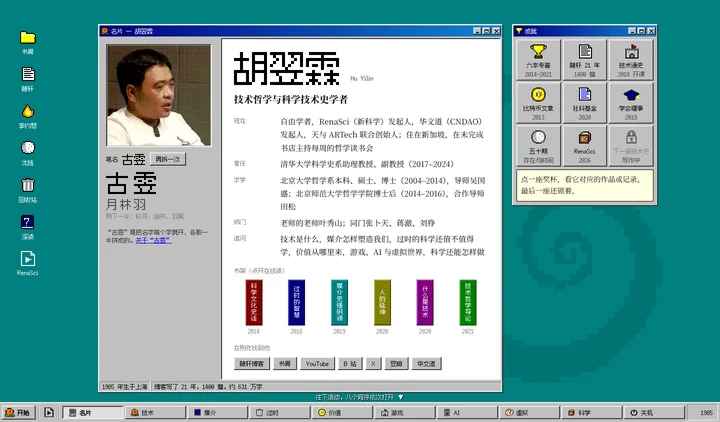 書·四胡翌霖的學術名片一臺老式視窗桌面,八個程式依次開啟
 玄·一鏈上起卦用比特幣區塊雜湊,按大衍筮法起卦
 字·一印信:從璽印到私鑰五件展品,把古今兩套「證明」擺在一起
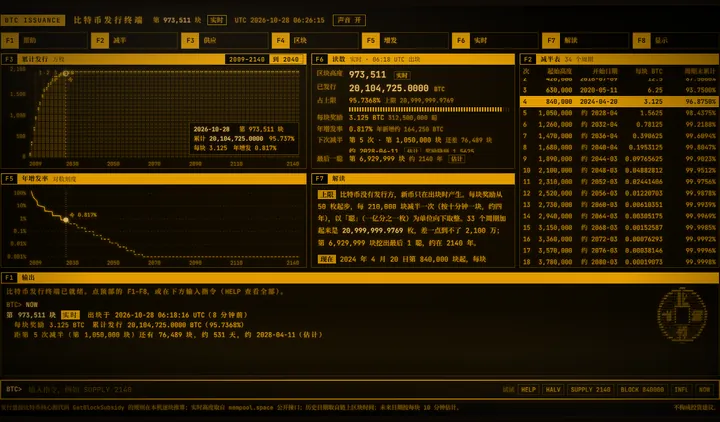 信·一比特幣發行終端從原始碼規則推算比特幣的發行
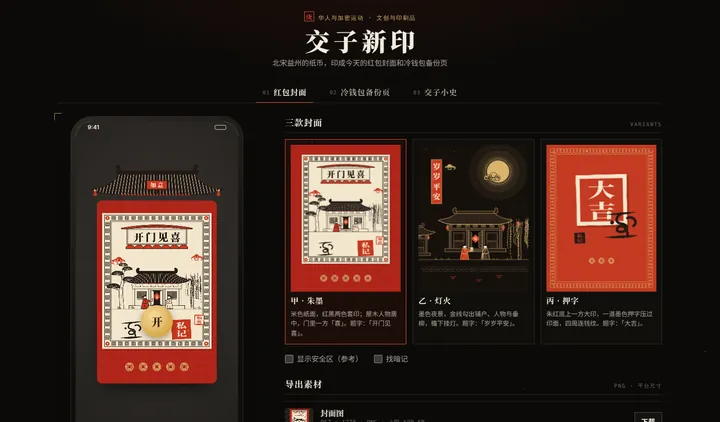 信·二交子新印北宋益州的紙幣,印成今天的紅包封面和冷錢包備份頁
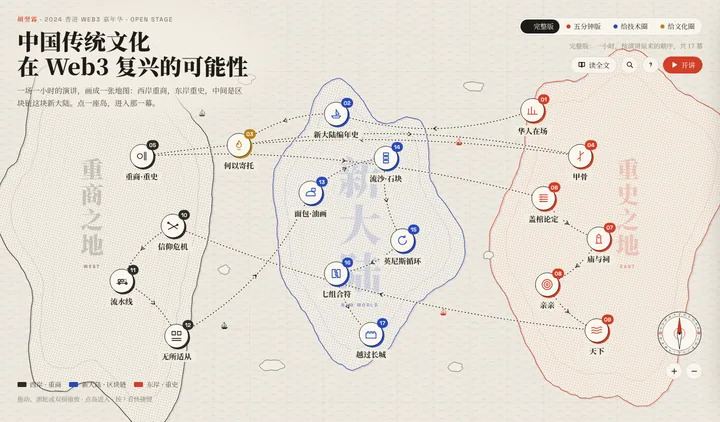 講·一中國傳統文化在 Web3 復興的可能性一場一小時的演講,畫成一張可以講、也可以玩的地圖
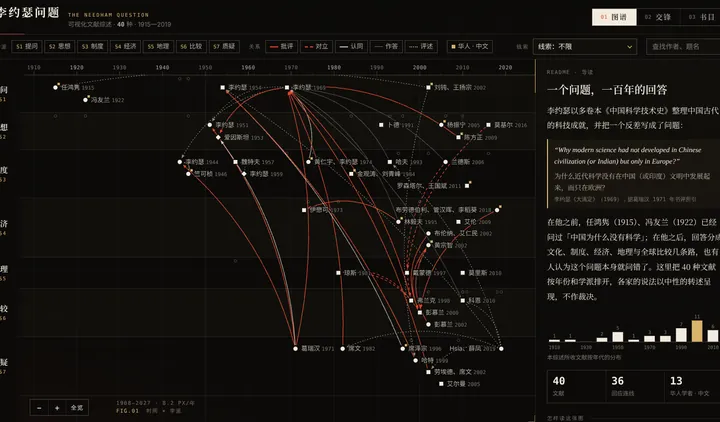 書·二李約瑟問題一份視覺化文獻綜述:近代科學為什麼沒有在中國產生,以及這個問題該不該這樣問
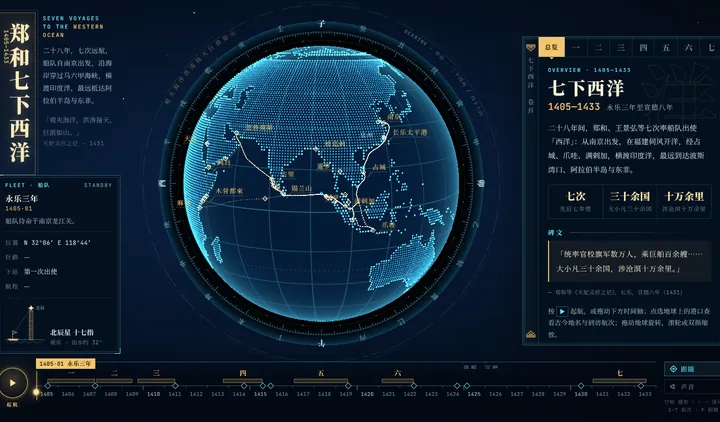 海·一鄭和七下西洋七次遠航,畫在一隻可以轉動的地球上
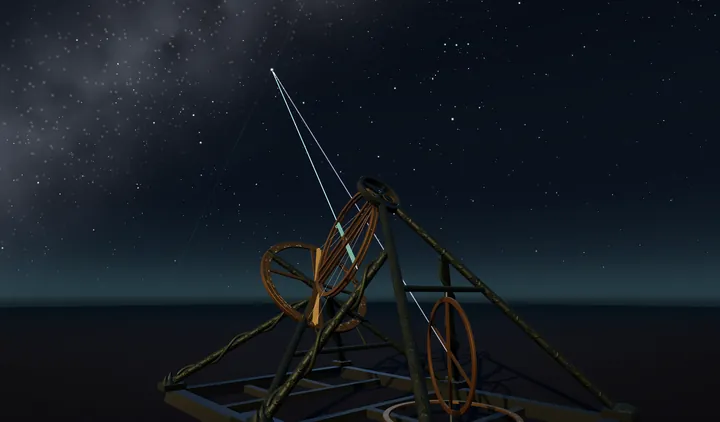 天·五郭守敬與簡儀把渾儀拆成互不遮擋的兩件,轉動四遊雙環對準一顆星
 海·四過洋牽星用牽星板量星高,定船的南北