南·一新加坡推薦
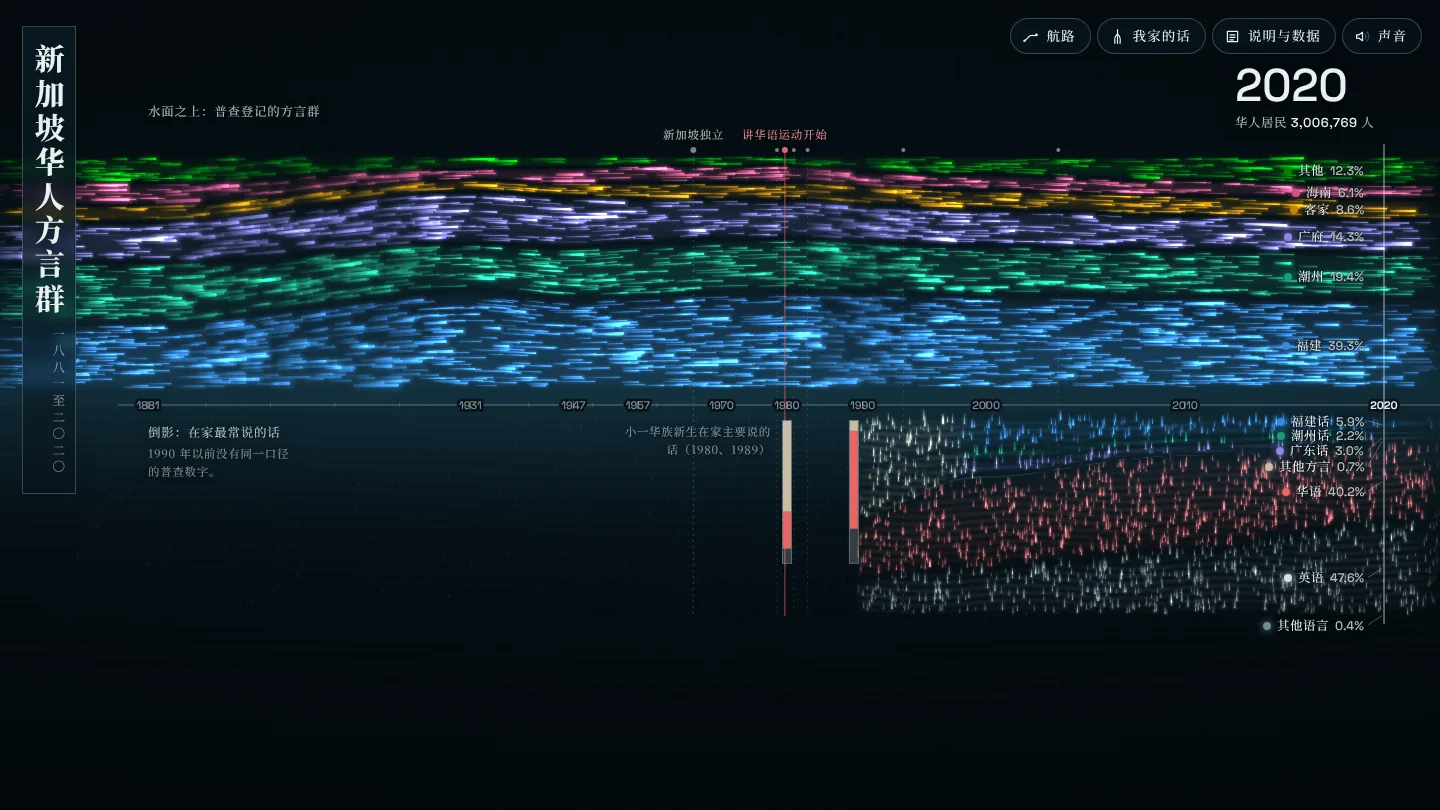
新加坡華人方言群
一百四十年的普查數字畫成一條夜裡的河:水面上是方言群,倒影裡是家裡說的話
展品說明
新加坡的華人移民大多來自福建、廣東和海南,按祖籍和方言形成福建(閩南)、潮州、廣府、客家、海南等「方言群」,19 世紀稱為「幫」。殖民地時期的普查就分別統計各方言群的人數,獨立後的人口普查也保留了這一項。這件作品把能夠核對的普查數字畫成一條夜裡的河:水面之上是普查登記的方言群,1881、1931、1947、1957、1970、1980 年取自學者彙編的百分比,2000、2010、2020 年取自新加坡統計局公佈的人數;倒影是華人居民(5 歲及以上)在家最常說的話,1990 年起有同一口徑的數字。
1931 年以後,福建人一直約佔新加坡華人的四成,是最大的方言群;潮州人約佔兩成;廣府人在 1931、1947 年約佔兩成多,此後降到 2020 年的 14.3%;客家人和海南人各佔約 5% 到 10%。1881 年的構成與後來明顯不同:福建人只佔 28.8%,潮州人佔 26.1%。
普查登記的方言群,並不等於家裡說的話。1990 年,5 歲及以上的華人居民有 50.3% 在家最常說漢語方言,30.1% 說華語,19.3% 說英語;到 2020 年,三者分別是 11.8%、40.2% 和 47.6%。按年齡看,2020 年 5—9 歲的華人孩子 77.5% 在家最常說英語,說方言的只有 0.4%;85 歲以上的長者 70.5% 說方言。1979 年 9 月 7 日,政府推出講華語運動;電視在 1981 年全面取消方言節目,電臺從 1983 年 1 月 1 日起全面停播方言節目。據小一生登記資料,在家主要講華語的華族小一生從 1980 年的 26% 增加到 1989 年的 69%。
點開每個方言群,可以看到它的祖籍地、19 世紀的墳山、廟宇和會館、各幫的傳統行業,以及至今還寫在小販中心招牌上的方言名稱,例如蝦面(He Mee)、粿汁(Kway Chup)、雲吞麵(Wanton Mee)、釀豆腐(Yong Tau Foo)。「航路」把各方言群的祖籍地和南下新加坡的方向畫在南中國海的地圖上,航線為示意。「我家的話」讓訪客按自己家幾代人在家說的話,畫出流進這條河的一縷,並和 2020 年普查裡同齡人的比例對照。
1891—1921 年與 1990 年的普查也有方言群統計,因未能取得可以核對的完整數字,沒有收入,也不做估算。各年人口口徑的差別——殖民地時期的統計範圍、2000 年起只計公民與永久居民、「其他」一項的內容變化——都在作品的「說明與資料」裡逐條列出。
出處與參考
- 郭振羽、羅福騰:《多元和統一:新加坡的語言與社會》(2022),頁 6,表一「1881年至2020年的華族方言群人口比例」。轉引自羅福騰〈新加坡華族方言〉,新加坡華族文化中心《新加坡華族文化百科》。https://culturepaedia.singaporeccc.org.sg/zh/language-education/chinese-dialects-in-singapore/
- Singapore Department of Statistics, Census of Population 2000:Chinese Resident Population by Age Group, Dialect Group and Sex(SingStat Table Builder CT/10118)。https://tablebuilder.singstat.gov.sg/table/CT/10118
- Singapore Department of Statistics, Census of Population 2010:Chinese Resident Population by Age Group, Dialect Group and Sex(CT/8531)。https://tablebuilder.singstat.gov.sg/table/CT/8531
- Singapore Department of Statistics, Census of Population 2020:Chinese Resident Population by Age Group, Detailed Ethnic Group and Sex(CT/17397)。https://tablebuilder.singstat.gov.sg/table/CT/17397
- Singapore Department of Statistics, Census of Population 2000: Advance Data Release,第四章「Literacy and Language」,表 3(華人居民在家最常說的語言,1990、2000 年)、表 4(按年齡組,1990、2000 年)。https://www.singstat.gov.sg/files/08753a10-22bc-44c0-8672-6c6ca325eaba.pdf
- Census of Population 2000:Resident Population Aged 5 Years and Over by Language Most Frequently Spoken at Home, Ethnic Group and Sex(CT/5959)。https://tablebuilder.singstat.gov.sg/table/CT/5959
- Census of Population 2010:Resident Population Aged 5 Years and Over by Language Most Frequently Spoken at Home, Ethnic Group and Sex(CT/5980)。https://tablebuilder.singstat.gov.sg/table/CT/5980
- Census of Population 2010:Resident Population Aged 5 Years and Over by Age Group, Ethnic Group and Language Most Frequently Spoken at Home(CT/5979)。https://tablebuilder.singstat.gov.sg/table/CT/5979
- Census of Population 2020:Resident Population Aged 5 Years and Over by Language Most / Second Most Frequently Spoken at Home, Age Group and Ethnic Group (Chinese)(CT/17435)。https://tablebuilder.singstat.gov.sg/table/CT/17435
- 新加坡華族文化百科編輯組:〈講華語運動的歷史與發展〉(部分整理自推廣華語理事會《華語·新時代》,2014),《新加坡華族文化百科》。https://culturepaedia.singaporeccc.org.sg/zh/language-education/the-speak-mandarin-campaign/
- Speak Mandarin Campaign(推廣華語理事會):Milestones。https://www.mandarin.languagecouncils.sg/en/about/milestones
- National Archives of Singapore:Proclamation of Singapore drafted by E W Barker and signed by Lee Kuan Yew on 9 August 1965(檔案照片說明)。https://www.nas.gov.sg/archivesonline/photographs/record-details/72ffcf37-b8b1-11e3-927b-0050568939ad
- 許源泰:〈19世紀的新加坡華人方言群〉,《新加坡華族文化百科》。https://culturepaedia.singaporeccc.org.sg/zh/communities/chinese-communities-and-major-dialect-groups-in-19th-century-singapore/
- 羅福騰:〈新加坡華族方言〉,《新加坡華族文化百科》。https://culturepaedia.singaporeccc.org.sg/zh/language-education/chinese-dialects-in-singapore/
- 新加坡華族文化百科編輯組:〈新加坡福建人的傳統行業〉(整理自方百成等編《頭路:新加坡福建人的行業》),《新加坡華族文化百科》。https://culturepaedia.singaporeccc.org.sg/zh/communities/traditional-trades-of-the-hokkiens-in-singapore/
- 李志賢:〈新加坡潮州人的傳統行業〉,《新加坡華族文化百科》。https://culturepaedia.singaporeccc.org.sg/zh/communities/traditional-trades-of-the-teochews-in-singapore/
- 陳康言:〈新加坡廣東人的傳統行業〉,《新加坡華族文化百科》。https://culturepaedia.singaporeccc.org.sg/zh/communities/traditional-trades-of-the-cantonese-community-in-singapore/
- 利亮時:〈新加坡客家人的傳統行業〉,《新加坡華族文化百科》。https://culturepaedia.singaporeccc.org.sg/zh/communities/traditional-trades-of-the-hakka-community-in-singapore/
- 王振春:〈新加坡海南人的傳統行業〉,《新加坡華族文化百科》。https://culturepaedia.singaporeccc.org.sg/zh/communities/traditional-trades-of-the-hainanese-community-in-singapore/
- 羅福騰:〈新加坡小販中心的語言文字景觀〉,《新加坡華族文化百科》。https://culturepaedia.singaporeccc.org.sg/zh/language-education/the-linguistic-landscape-of-singapores-hawker-centres/
- Cheng Lim Keak, “Patterns of Social Alignment: A Case Study of Hakka Associations in Singapore”, Southeast Asian Studies 32(4), 1995, pp. 477–494,表 2「The Hakka Population in Singapore, 1881–1980」。https://kyoto-seas.org/pdf/32/4/320404.pdf
- Voon Phin-Keong, “The Hakkas of Malaysia to 1970: Population, Livelihood, and Culture”, Malaysian Journal of Chinese Studies 13(1), 2024, pp. 37–59。https://ejournal.newera.edu.my/mjcs/article/download/23/13/46
- “Chinese Dialect Groups and Their Occupations in 19th- and Early 20th-Century Singapore”, BiblioAsia 6(1),新加坡國家圖書館管理局,2010 年 4 月。https://biblioasia.nlb.gov.sg/vol-6/issue-1/apr-2010/singapore-chinese-dialect-occupation/
- Annual Report on the Social and Economic Progress of the People of the Straits Settlements, 1931(Colonial Reports—Annual No. 1599,倫敦 HMSO,1932),第三章「Population」,第 6 頁。https://seadelt.net/Asset/Source/Document_ID-407_No-01.pdf
- Natural Earth 1:50m Land(公有領域),經 world-atlas(Mike Bostock,ISC 許可)轉換;用於「航路」地圖的海岸線。https://www.naturalearthdata.com/
想做一件類似的?看看教學互動網頁怎樣委託 →
發現史實、資料或出處有誤?請寫信到 [email protected] 告訴我們。
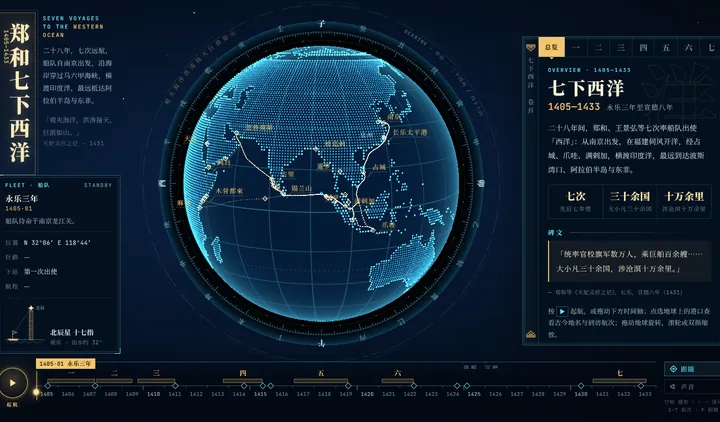 海·一鄭和七下西洋七次遠航,畫在一隻可以轉動的地球上
 海·四過洋牽星用牽星板量星高,定船的南北
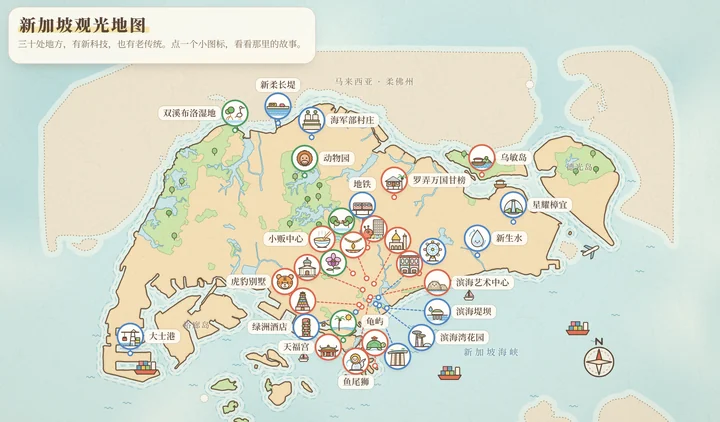 南·二新加坡觀光地圖一幅手繪地圖,三十處地方:新科技和老傳統,同在一座島上
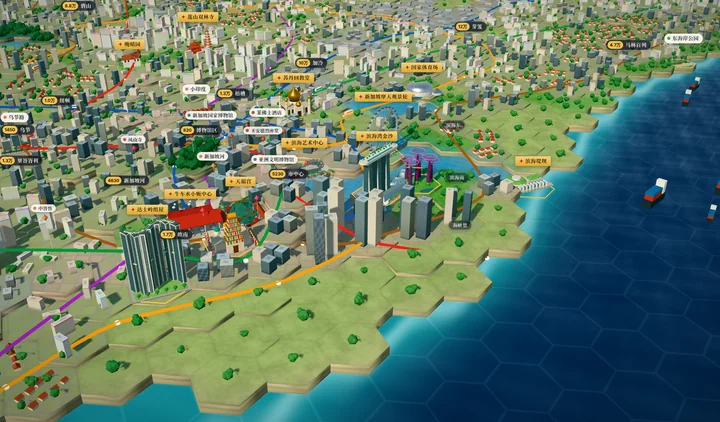 南·三星洲輿圖一座島鋪成近五千個六邊形格子:點一格看一個市鎮,換一個透鏡看一種資料,二十二處奇觀各佔一格