书·三书房
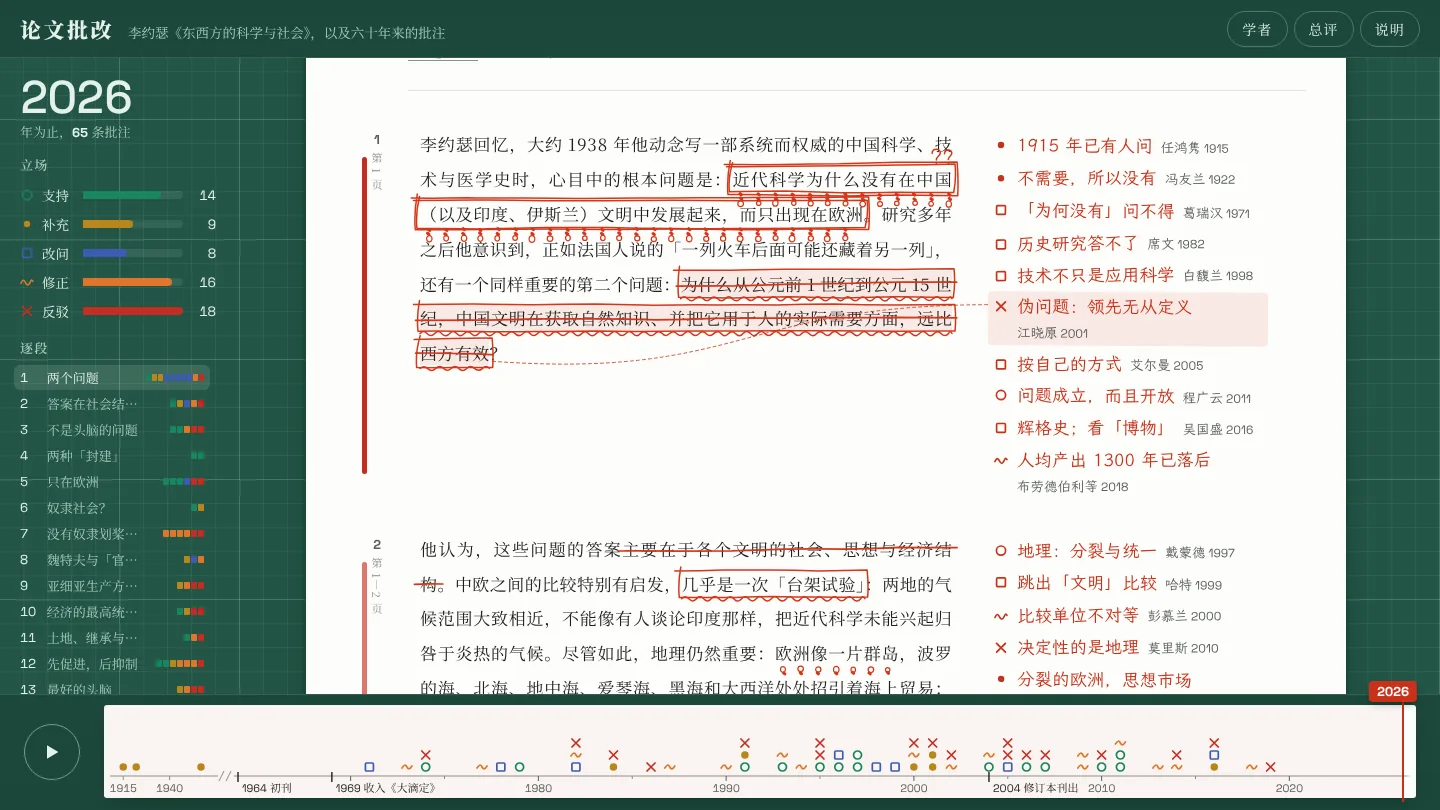
论文批改:李约瑟《东西方的科学与社会》
六十年来的学者,在李约瑟最常被引用的一篇论文上留下的朱批
展品说明
「近代科学为什么没有在中国产生」,这个问题在李约瑟 1964 年的《东西方的科学与社会》里得到了最常被引用的表述。他把它写成两问:近代科学为什么只在欧洲兴起;而在此前一千多年里,中国为什么在获取和运用自然知识方面比西方有效得多。他的回答主要是社会与经济的:中国的「官僚封建制」起初有利于自然知识的增长和应用,后来却抑制了资本主义与近代科学。这篇文章 1964 年先后刊于贝尔纳纪念文集《科学的科学》、美国期刊《科学与社会》和科学史期刊《半人马座》,1969 年收入文集《大滴定》;作者生前修订的版本,2004 年收入《中国科学技术史》第七卷第二分册。
这里逐段转述剑桥大学出版社公开的修订本试读部分(第 1—10 页,共 15 段),在页边批上此后学者的回应。批注分五种:支持、补充、修正、反驳,以及认为这句话问错了、该换个问法的「改问」。批注最集中的是第 1 段的提问方式:葛瑞汉、席文认为「为什么没有」不是历史研究能够回答的问题,江晓原称之为伪问题,也有学者为它辩护;第 7 段关于奴隶制与节省劳力器械的推测、第 12 段「官僚封建制先促进、后抑制」的核心解释,也都引来了大量修正与反驳——关于国家的角色,大分流研究给出的答案甚至方向相反。连作者自己也改过:修订本的脚注里,他承认「官僚封建制」不如叫「封建官僚制」。
摘述是转述,不是原文的译文;原文请看出版方公开的试读本。每条批注都注明学者、年份和著作,书目信息与论点都对照过出版方、期刊或书评的说明。也收在「李约瑟问题」图谱里的文献,可以从批注直接跳过去。
出处与参考
- 论文:Joseph Needham(李约瑟), “Science and Society in East and West”(东西方的科学与社会),1964
- 初刊于贝尔纳纪念文集:Maurice Goldsmith & Alan Mackay (eds.), The Science of Science (London: Souvenir Press, 1964)
- Science & Society 28 (4) (1964): 385–408(DOI 10.1177/003682376402800401)
- Centaurus 10 (3) (1964): 174–197(DOI 10.1111/j.1600-0498.1965.tb00399.x)
- 收入 The Grand Titration: Science and Society in East and West (London: George Allen & Unwin, 1969): 190–217
- 修订本:Science and Civilisation in China, Vol. 7, Part II: General Conclusions and Reflections, ed. Kenneth Girdwood Robinson (Cambridge: Cambridge University Press, 2004),第 50 章 (a) 节
- 本作品转述的公开试读本(剑桥大学出版社):https://assets.cambridge.org/052108/7325/excerpt/0521087325_excerpt.pdf
- 任鸿隽《说中国无科学之原因》,《科学》第 1 卷第 1 期(1915)
- Fung Yu-lan(冯友兰), “Why China Has No Science—An Interpretation of the History and Consequences of Chinese Philosophy”, International Journal of Ethics 32 (3) (1922): 237–263(DOI 10.1086/intejethi.32.3.2377487)
- Karl A. Wittfogel, Oriental Despotism: A Comparative Study of Total Power (New Haven: Yale University Press, 1957);李约瑟的书评见 Science and Society 23 (1) (1959): 58–65
- A. C. Graham, “China, Europe, and the Origins of Modern Science: Needham’s The Grand Titration”, Asia Major, new series 16 (1971): 178–196
- Mark Elvin, The Pattern of the Chinese Past: A Social and Economic Interpretation (Stanford: Stanford University Press, 1973)
- Perry Anderson, Lineages of the Absolutist State (London: New Left Books, 1974),书末附论 “The ‘Asiatic Mode of Production’”
- Ray Huang(黄仁宇)& Joseph Needham, “The Nature of Chinese Society: A Technical Interpretation”, East and West, new series 24 (1974): 381–401
- G. William Skinner (ed.), The City in Late Imperial China (Stanford: Stanford University Press, 1977)
- Edward W. Said, Orientalism (New York: Pantheon Books, 1978)
- 黄现璠《我国民族历史没有奴隶社会的探讨》(1979),据焦培民《中国历史分期新论》,刊于《广西师范大学学报》1979 年第 2 期;张广志《略论奴隶制的历史地位》,《青海师范学院学报》1980 年第 1 期
- Nathan Sivin, “Why the Scientific Revolution Did Not Take Place in China—or Didn’t It?”, Chinese Science 5 (1982): 45–66(DOI 10.1163/26669323-00501006)
- Peter C. Perdue, “Water Control in the Dongting Lake Region during the Ming and Qing Periods”, The Journal of Asian Studies 41 (4) (1982): 747–765;另见其 Exhausting the Earth: State and Peasant in Hunan, 1500–1850 (Cambridge, MA: Council on East Asian Studies, Harvard University, 1987)(DOI 10.2307/2055448)
- William T. Rowe, Hankow: Commerce and Society in a Chinese City, 1796–1889 (Stanford: Stanford University Press, 1984)
- 金观涛、刘青峰《兴盛与危机》(长沙:湖南人民出版社,1984)
- Robert P. Hymes, Statesmen and Gentlemen: The Elite of Fu-chou, Chiang-hsi, in Northern and Southern Sung (Cambridge: Cambridge University Press, 1986)
- 余英时《中国近世宗教伦理与商人精神》(台北:联经出版事业公司,1987)
- Mark Edward Lewis, Sanctioned Violence in Early China (Albany: State University of New York Press, 1990)(https://www.sunypress.edu/p-752-sanctioned-violence-in-early-ch.aspx)
- Derk Bodde, Chinese Thought, Society, and Science: The Intellectual and Social Background of Science and Technology in Pre-modern China (Honolulu: University of Hawaii Press, 1991)
- Randall A. Dodgen, “Hydraulic Evolution and Dynastic Decline: The Yellow River Conservancy, 1796–1855”, Late Imperial China 12 (2) (1991): 36–63(DOI 10.1353/late.1991.0009)
- Pierre-Étienne Will & R. Bin Wong, Nourish the People: The State Civilian Granary System in China, 1650–1850 (Ann Arbor: University of Michigan Center for Chinese Studies, 1991)(DOI 10.3998/mpub.19044)
- Toby E. Huff, The Rise of Early Modern Science: Islam, China, and the West (Cambridge: Cambridge University Press, 1993)
- M. J. T. Lewis, “The Origins of the Wheelbarrow”, Technology and Culture 35 (3) (1994): 453–475(DOI 10.1353/tech.1994.0036)
- Justin Yifu Lin(林毅夫), “The Needham Puzzle: Why the Industrial Revolution Did Not Originate in China”, Economic Development and Cultural Change 43 (2) (1995): 269–292(DOI 10.1086/452150)
- Alastair Iain Johnston, Cultural Realism: Strategic Culture and Grand Strategy in Chinese History (Princeton: Princeton University Press, 1995)(DOI 10.1515/9780691213149)
- 席泽宗《关于“李约瑟难题”和近代科学源于希腊的对话》,《科学》第 48 卷第 4 期(1996):32–34
- Steven Shapin, The Scientific Revolution (Chicago: University of Chicago Press, 1996)
- Jared Diamond, Guns, Germs, and Steel: The Fates of Human Societies (New York: W. W. Norton, 1997)
- R. Bin Wong(王国斌), China Transformed: Historical Change and the Limits of European Experience (Ithaca: Cornell University Press, 1997)(DOI 10.7591/9781501736049)
- Francesca Bray, “Technics and Civilization in Late Imperial China: An Essay in the Cultural History of Technology”, Osiris 13 (1998): 11–33;2019 年重刊于开放获取文集 The History of Science in a World of Readers (Berlin: Edition Open Access)(DOI 10.1086/649278)
- Roger Hart, “Beyond Science and Civilization: A Post-Needham Critique”, East Asian Science, Technology, and Medicine 16 (1999): 88–114(DOI 10.1163/26669323-01601006)
- Kenneth Pomeranz, The Great Divergence: China, Europe, and the Making of the Modern World Economy (Princeton: Princeton University Press, 2000)
- Kevin Greene, “Technological Innovation and Economic Progress in the Ancient World: M. I. Finley Re-Considered”, The Economic History Review 53 (1) (2000): 29–59(DOI 10.1111/1468-0289.00151)
- Benjamin A. Elman, A Cultural History of Civil Examinations in Late Imperial China (Berkeley: University of California Press, 2000)(DOI 10.1525/9780520921474)
- 江晓原《被中国人误读的李约瑟——纪念李约瑟诞辰一百周年》,《自然辩证法通讯》第 23 卷第 1 期(2001)(https://www.aisixiang.com/data/104650.html)
- Robin D. S. Yates, “Slavery in Early China: A Socio-Cultural Approach”, Journal of East Asian Archaeology 3 (1) (2001): 283–331(DOI 10.1163/156852301100402723)
- Donald B. Wagner, The State and the Iron Industry in Han China (Copenhagen: Nordic Institute of Asian Studies, 2001)(https://donwagner.dk/)
- Andrew Wilson, “Machines, Power and the Ancient Economy”, The Journal of Roman Studies 92 (2002): 1–32(DOI 10.2307/3184857)
- Philip C. C. Huang(黄宗智), “Development or Involution in Eighteenth-Century Britain and China? A Review of Kenneth Pomeranz’s The Great Divergence”, The Journal of Asian Studies 61 (2) (2002): 501–538(DOI 10.2307/2700299)
- Pamela H. Smith, The Body of the Artisan: Art and Experience in the Scientific Revolution (Chicago: University of Chicago Press, 2004)
- Joseph Needham, Science and Civilisation in China, Vol. 7, Part II: General Conclusions and Reflections, ed. Kenneth Girdwood Robinson (Cambridge: Cambridge University Press, 2004),第 5 页注 15(https://assets.cambridge.org/052108/7325/excerpt/0521087325_excerpt.pdf)
- Benjamin A. Elman, On Their Own Terms: Science in China, 1550–1900 (Cambridge, MA: Harvard University Press, 2005)
- 杨振宁《〈易经〉对中华文化的影响》,《自然杂志》第 27 卷第 1 期(2005):1–3
- Madeleine Zelin, The Merchants of Zigong: Industrial Entrepreneurship in Early Modern China (New York: Columbia University Press, 2005)
- David S. Landes, “Why Europe and the West? Why Not China?”, Journal of Economic Perspectives 20 (2) (2006): 3–22(DOI 10.1257/jep.20.2.3)
- Joanna Waley-Cohen, The Culture of War in China: Empire and the Military under the Qing Dynasty (London: I. B. Tauris, 2006)
- 冯天瑜《“封建”考论》(武汉:武汉大学出版社,2007)
- Kapil Raj, Relocating Modern Science: Circulation and the Construction of Knowledge in South Asia and Europe, 1650–1900 (Basingstoke: Palgrave Macmillan, 2007)
- Robert C. Allen, The British Industrial Revolution in Global Perspective (Cambridge: Cambridge University Press, 2009)
- Nicola Di Cosmo (ed.), Military Culture in Imperial China (Cambridge, MA: Harvard University Press, 2009)
- Ian Morris, Why the West Rules—For Now (New York: Farrar, Straus and Giroux, 2010)
- H. Floris Cohen, How Modern Science Came into the World: Four Civilizations, One 17th-Century Breakthrough (Amsterdam: Amsterdam University Press, 2010)
- 程广云《泛李约瑟问题:无穷穷举——驳李约瑟问题终结论》,《社会科学辑刊》2011 年第 1 期(https://www.aisixiang.com/data/51545.html)
- Toby E. Huff, Intellectual Curiosity and the Scientific Revolution: A Global Perspective (Cambridge: Cambridge University Press, 2011)
- Jean-Laurent Rosenthal & R. Bin Wong, Before and Beyond Divergence: The Politics of Economic Change in China and Europe (Cambridge, MA: Harvard University Press, 2011)(DOI 10.4159/harvard.9780674061293)
- Benjamin A. Elman, Civil Examinations and Meritocracy in Late Imperial China (Cambridge, MA: Harvard University Press, 2013)(DOI 10.4159/harvard.9780674726048)
- Tuan-Hwee Sng, “Size and Dynastic Decline: The Principal-Agent Problem in Late Imperial China, 1700–1850”, Explorations in Economic History 54 (2014): 107–127(DOI 10.1016/j.eeh.2014.05.002)
- Loren Brandt, Debin Ma & Thomas G. Rawski, “From Divergence to Convergence: Reevaluating the History Behind China’s Economic Boom”, Journal of Economic Literature 52 (1) (2014): 45–123(DOI 10.1257/jel.52.1.45)
- 吴国盛《什么是科学》(广州:广东人民出版社,2016);臧继贤、朱凡《专访北大教授吴国盛:中国古代没有数理科学,这本是命运》,澎湃新闻,2016 年 9 月 3 日;温新红《中国古代有“科学”》,《中国科学报》2016 年 12 月 23 日(https://m.thepaper.cn/newsDetail_forward_1523638)
- Joel Mokyr, A Culture of Growth: The Origins of the Modern Economy (Princeton: Princeton University Press, 2016)
- Ling Zhang, The River, the Plain, and the State: An Environmental Drama in Northern Song China, 1048–1128 (Cambridge: Cambridge University Press, 2016)
- Stephen Broadberry, Hanhui Guan & David Daokui Li, “China, Europe, and the Great Divergence: A Study in Historical National Accounting, 980–1850”, The Journal of Economic History 78 (4) (2018): 955–1000(DOI 10.1017/S0022050718000529)
- Debin Ma & Jared Rubin, “The Paradox of Power: Principal-Agent Problems and Administrative Capacity in Imperial China (and Other Absolutist Regimes)”, Journal of Comparative Economics 47 (2) (2019): 277–294(DOI 10.1016/j.jce.2019.03.002)
- Florence Hsia & Dagmar Schäfer, “History of Science, Technology, and Medicine: A Second Look at Joseph Needham”, Isis 110 (1) (2019): 94–99(DOI 10.1086/702895)
- 《史记·郦生陆贾列传》(陆贾「居马上得之,宁可以马上治之乎」)
想做一件类似的?看看演讲网页、文献综述怎样委托 →
发现史实、数据或出处有误?请写信到 [email protected] 告诉我们。
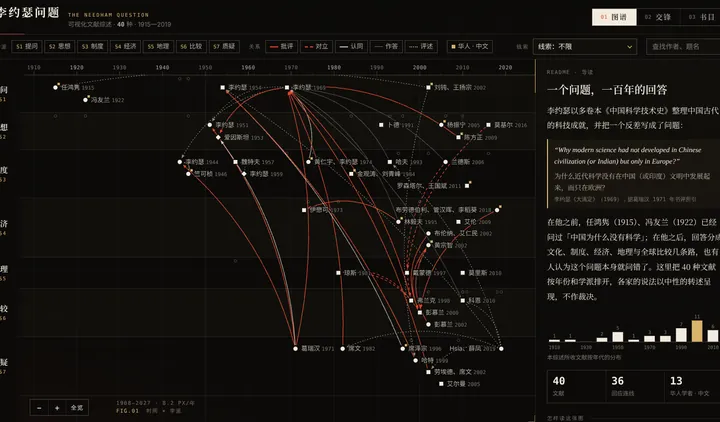 书·二李约瑟问题一份可视化文献综述:近代科学为什么没有在中国产生,以及这个问题该不该这样问
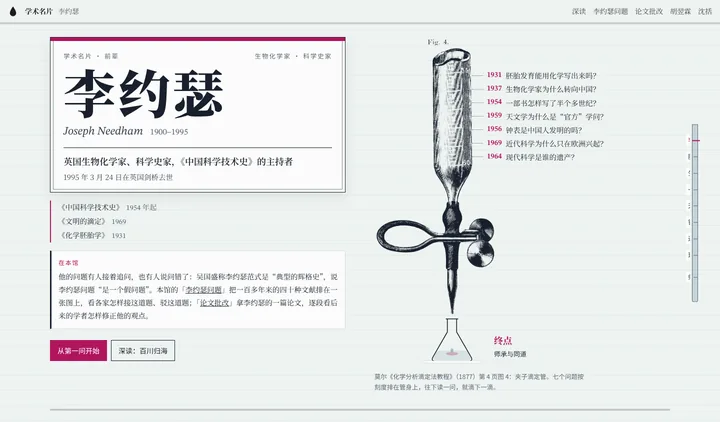 书·五李约瑟的学术名片一支滴定管,七个问题按刻度往下滴
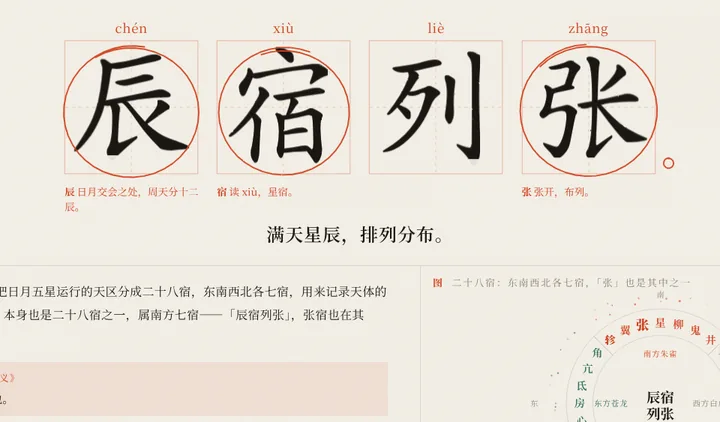 书·一千字文:一句一幕二百五十句逐句写出、逐句批注;一千个字的全景,还能把名字集出来
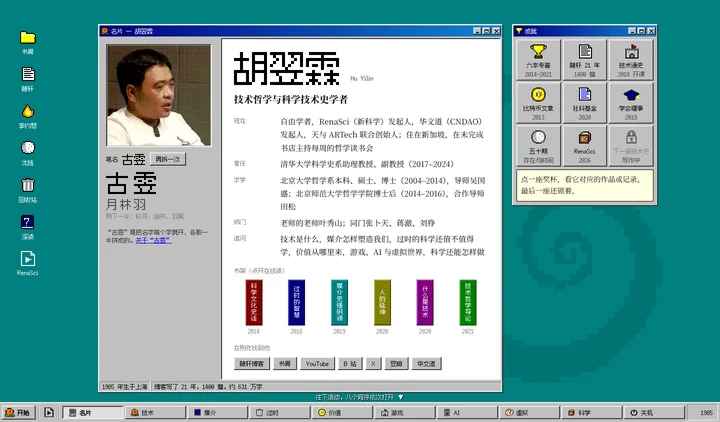 书·四胡翌霖的学术名片一台老式视窗桌面,八个程序依次打开
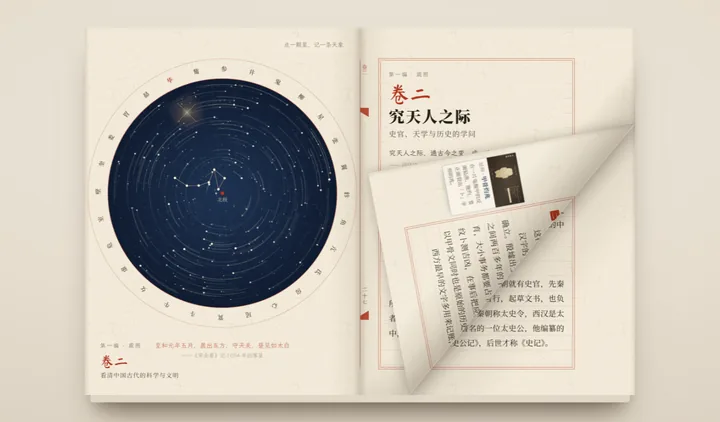 书·六华夏文明在科技时代的复兴随轩文选:一本能翻页、能批注的线装书