南·一新加坡推荐
新加坡华人方言群
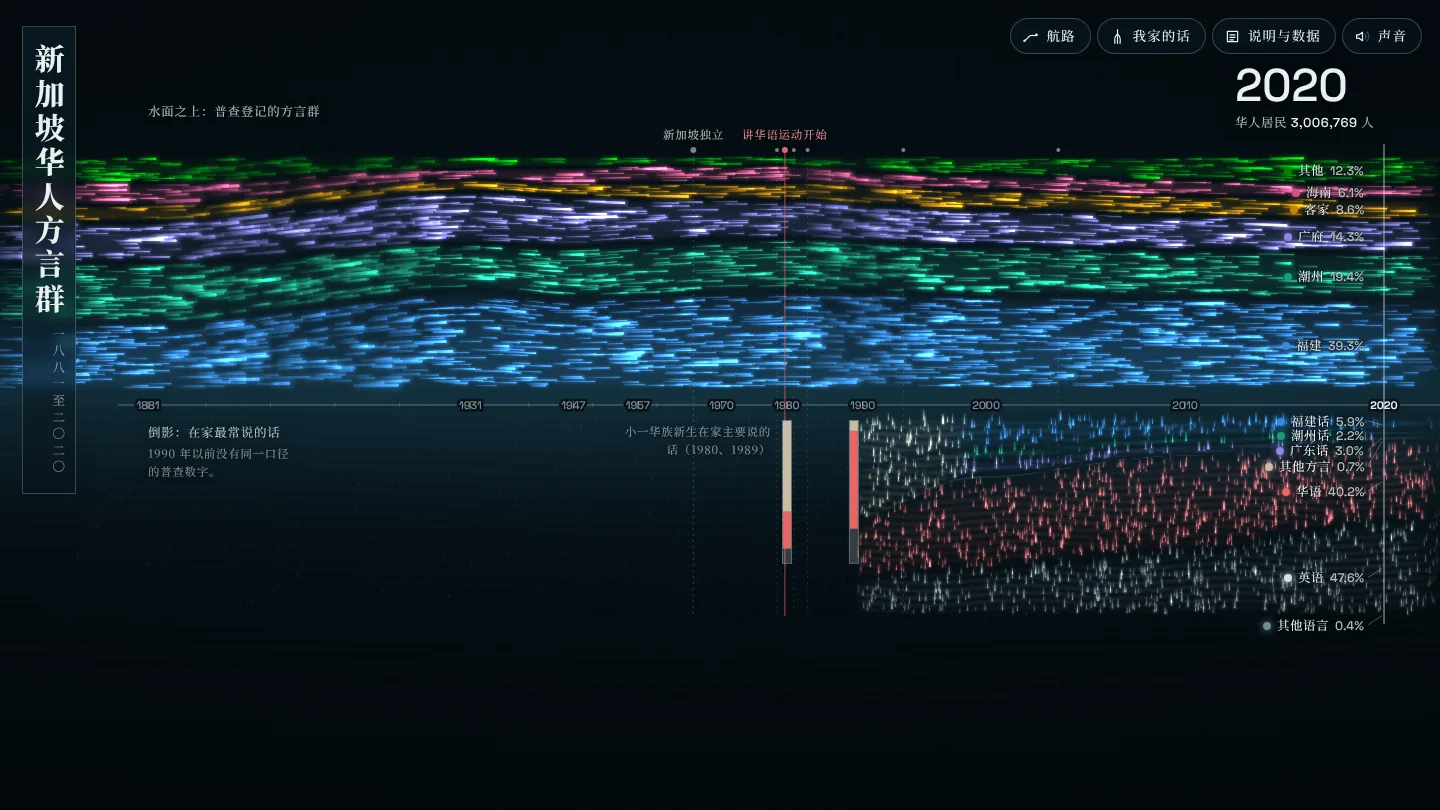
一百四十年的普查数字画成一条夜里的河:水面上是方言群,倒影里是家里说的话
展品说明
新加坡的华人移民大多来自福建、广东和海南,按祖籍和方言形成福建(闽南)、潮州、广府、客家、海南等「方言群」,19 世纪称为「帮」。殖民地时期的普查就分别统计各方言群的人数,独立后的人口普查也保留了这一项。这件作品把能够核对的普查数字画成一条夜里的河:水面之上是普查登记的方言群,1881、1931、1947、1957、1970、1980 年取自学者汇编的百分比,2000、2010、2020 年取自新加坡统计局公布的人数;倒影是华人居民(5 岁及以上)在家最常说的话,1990 年起有同一口径的数字。
1931 年以后,福建人一直约占新加坡华人的四成,是最大的方言群;潮州人约占两成;广府人在 1931、1947 年约占两成多,此后降到 2020 年的 14.3%;客家人和海南人各占约 5% 到 10%。1881 年的构成与后来明显不同:福建人只占 28.8%,潮州人占 26.1%。
普查登记的方言群,并不等于家里说的话。1990 年,5 岁及以上的华人居民有 50.3% 在家最常说汉语方言,30.1% 说华语,19.3% 说英语;到 2020 年,三者分别是 11.8%、40.2% 和 47.6%。按年龄看,2020 年 5—9 岁的华人孩子 77.5% 在家最常说英语,说方言的只有 0.4%;85 岁以上的长者 70.5% 说方言。1979 年 9 月 7 日,政府推出讲华语运动;电视在 1981 年全面取消方言节目,电台从 1983 年 1 月 1 日起全面停播方言节目。据小一生登记资料,在家主要讲华语的华族小一生从 1980 年的 26% 增加到 1989 年的 69%。
点开每个方言群,可以看到它的祖籍地、19 世纪的坟山、庙宇和会馆、各帮的传统行业,以及至今还写在小贩中心招牌上的方言名称,例如虾面(He Mee)、粿汁(Kway Chup)、云吞面(Wanton Mee)、酿豆腐(Yong Tau Foo)。「航路」把各方言群的祖籍地和南下新加坡的方向画在南中国海的地图上,航线为示意。「我家的话」让访客按自己家几代人在家说的话,画出流进这条河的一缕,并和 2020 年普查里同龄人的比例对照。
1891—1921 年与 1990 年的普查也有方言群统计,因未能取得可以核对的完整数字,没有收入,也不做估算。各年人口口径的差别——殖民地时期的统计范围、2000 年起只计公民与永久居民、「其他」一项的内容变化——都在作品的「说明与数据」里逐条列出。
出处与参考
- 郭振羽、罗福腾:《多元和统一:新加坡的语言与社会》(2022),页 6,表一「1881年至2020年的华族方言群人口比例」。转引自罗福腾〈新加坡华族方言〉,新加坡华族文化中心《新加坡华族文化百科》。https://culturepaedia.singaporeccc.org.sg/zh/language-education/chinese-dialects-in-singapore/
- Singapore Department of Statistics, Census of Population 2000:Chinese Resident Population by Age Group, Dialect Group and Sex(SingStat Table Builder CT/10118)。https://tablebuilder.singstat.gov.sg/table/CT/10118
- Singapore Department of Statistics, Census of Population 2010:Chinese Resident Population by Age Group, Dialect Group and Sex(CT/8531)。https://tablebuilder.singstat.gov.sg/table/CT/8531
- Singapore Department of Statistics, Census of Population 2020:Chinese Resident Population by Age Group, Detailed Ethnic Group and Sex(CT/17397)。https://tablebuilder.singstat.gov.sg/table/CT/17397
- Singapore Department of Statistics, Census of Population 2000: Advance Data Release,第四章「Literacy and Language」,表 3(华人居民在家最常说的语言,1990、2000 年)、表 4(按年龄组,1990、2000 年)。https://www.singstat.gov.sg/files/08753a10-22bc-44c0-8672-6c6ca325eaba.pdf
- Census of Population 2000:Resident Population Aged 5 Years and Over by Language Most Frequently Spoken at Home, Ethnic Group and Sex(CT/5959)。https://tablebuilder.singstat.gov.sg/table/CT/5959
- Census of Population 2010:Resident Population Aged 5 Years and Over by Language Most Frequently Spoken at Home, Ethnic Group and Sex(CT/5980)。https://tablebuilder.singstat.gov.sg/table/CT/5980
- Census of Population 2010:Resident Population Aged 5 Years and Over by Age Group, Ethnic Group and Language Most Frequently Spoken at Home(CT/5979)。https://tablebuilder.singstat.gov.sg/table/CT/5979
- Census of Population 2020:Resident Population Aged 5 Years and Over by Language Most / Second Most Frequently Spoken at Home, Age Group and Ethnic Group (Chinese)(CT/17435)。https://tablebuilder.singstat.gov.sg/table/CT/17435
- 新加坡华族文化百科编辑组:〈讲华语运动的历史与发展〉(部分整理自推广华语理事会《华语·新时代》,2014),《新加坡华族文化百科》。https://culturepaedia.singaporeccc.org.sg/zh/language-education/the-speak-mandarin-campaign/
- Speak Mandarin Campaign(推广华语理事会):Milestones。https://www.mandarin.languagecouncils.sg/en/about/milestones
- National Archives of Singapore:Proclamation of Singapore drafted by E W Barker and signed by Lee Kuan Yew on 9 August 1965(档案照片说明)。https://www.nas.gov.sg/archivesonline/photographs/record-details/72ffcf37-b8b1-11e3-927b-0050568939ad
- 许源泰:〈19世纪的新加坡华人方言群〉,《新加坡华族文化百科》。https://culturepaedia.singaporeccc.org.sg/zh/communities/chinese-communities-and-major-dialect-groups-in-19th-century-singapore/
- 罗福腾:〈新加坡华族方言〉,《新加坡华族文化百科》。https://culturepaedia.singaporeccc.org.sg/zh/language-education/chinese-dialects-in-singapore/
- 新加坡华族文化百科编辑组:〈新加坡福建人的传统行业〉(整理自方百成等编《头路:新加坡福建人的行业》),《新加坡华族文化百科》。https://culturepaedia.singaporeccc.org.sg/zh/communities/traditional-trades-of-the-hokkiens-in-singapore/
- 李志贤:〈新加坡潮州人的传统行业〉,《新加坡华族文化百科》。https://culturepaedia.singaporeccc.org.sg/zh/communities/traditional-trades-of-the-teochews-in-singapore/
- 陈康言:〈新加坡广东人的传统行业〉,《新加坡华族文化百科》。https://culturepaedia.singaporeccc.org.sg/zh/communities/traditional-trades-of-the-cantonese-community-in-singapore/
- 利亮时:〈新加坡客家人的传统行业〉,《新加坡华族文化百科》。https://culturepaedia.singaporeccc.org.sg/zh/communities/traditional-trades-of-the-hakka-community-in-singapore/
- 王振春:〈新加坡海南人的传统行业〉,《新加坡华族文化百科》。https://culturepaedia.singaporeccc.org.sg/zh/communities/traditional-trades-of-the-hainanese-community-in-singapore/
- 罗福腾:〈新加坡小贩中心的语言文字景观〉,《新加坡华族文化百科》。https://culturepaedia.singaporeccc.org.sg/zh/language-education/the-linguistic-landscape-of-singapores-hawker-centres/
- Cheng Lim Keak, “Patterns of Social Alignment: A Case Study of Hakka Associations in Singapore”, Southeast Asian Studies 32(4), 1995, pp. 477–494,表 2「The Hakka Population in Singapore, 1881–1980」。https://kyoto-seas.org/pdf/32/4/320404.pdf
- Voon Phin-Keong, “The Hakkas of Malaysia to 1970: Population, Livelihood, and Culture”, Malaysian Journal of Chinese Studies 13(1), 2024, pp. 37–59。https://ejournal.newera.edu.my/mjcs/article/download/23/13/46
- “Chinese Dialect Groups and Their Occupations in 19th- and Early 20th-Century Singapore”, BiblioAsia 6(1),新加坡国家图书馆管理局,2010 年 4 月。https://biblioasia.nlb.gov.sg/vol-6/issue-1/apr-2010/singapore-chinese-dialect-occupation/
- Annual Report on the Social and Economic Progress of the People of the Straits Settlements, 1931(Colonial Reports—Annual No. 1599,伦敦 HMSO,1932),第三章「Population」,第 6 页。https://seadelt.net/Asset/Source/Document_ID-407_No-01.pdf
- Natural Earth 1:50m Land(公有领域),经 world-atlas(Mike Bostock,ISC 许可)转换;用于「航路」地图的海岸线。https://www.naturalearthdata.com/
想做一件类似的?看看教学互动网页怎样委托 →
发现史实、数据或出处有误?请写信到 [email protected] 告诉我们。
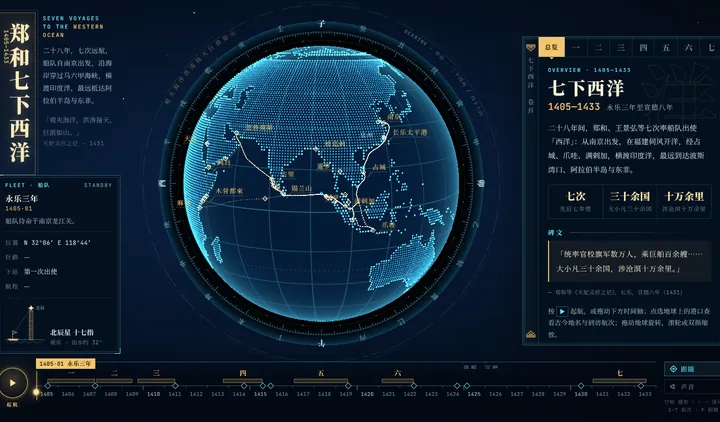 海·一郑和七下西洋七次远航,画在一只可以转动的地球上
 海·四过洋牵星用牵星板量星高,定船的南北
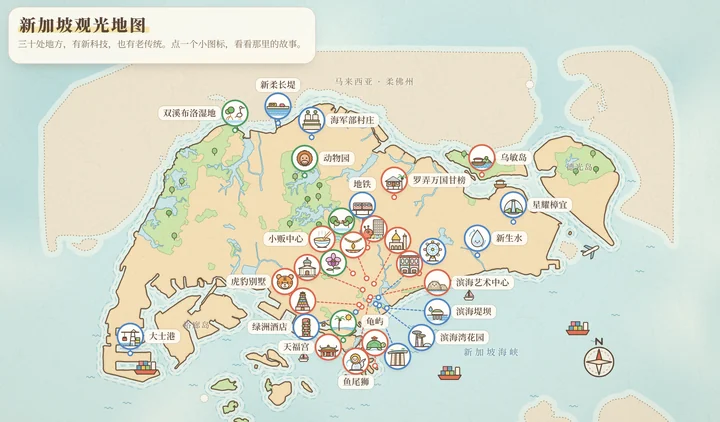 南·二新加坡观光地图一幅手绘地图,三十处地方:新科技和老传统,同在一座岛上
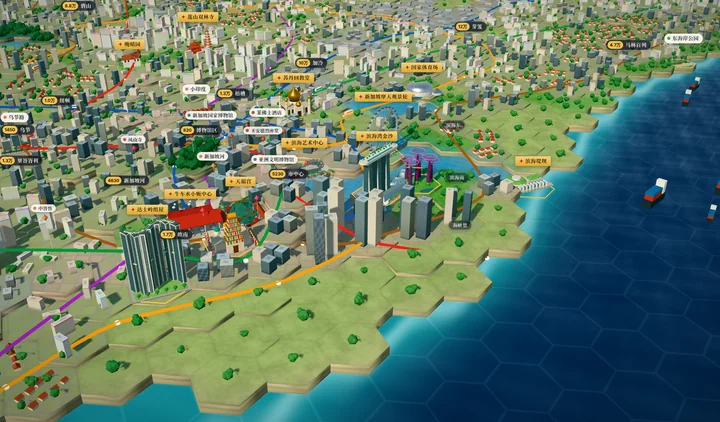 南·三星洲舆图一座岛铺成近五千个六边形格子:点一格看一个市镇,换一个透镜看一种数据,二十二处奇观各占一格